Logging Session Recaps Without Breaking Table Immersion
The 20-Minute Argument Before Every Session
You've been there. The party sits down, dice in hand, and someone says "wait, did we already give the key to the blacksmith or did we just say we would?" Twenty minutes later, the table has settled on a version of events that approximately two people actually remember correctly, the half-elf bard's player is annoyed because their scene got retconned out of existence, and you've burned a third of your prep time before a single roll.
That opening argument is not a player problem. It is a documentation failure with a predictable cost. In a 3-hour session, losing 20 minutes to recap reconstruction is a 10% efficiency penalty — applied before anyone rolls a die. Multiply that across a campaign with 80 sessions and you have effectively lost eight full sessions to calendar debates that a structured recap system would have compressed into two minutes of reading. The DM who builds a logging system isn't doing extra work; they're recovering time that would otherwise disappear into the argument every week.
Roleplaying Tips' guide to session notes identifies the core problem: DMs who skip structured session logging force themselves to reconstruct events from memory, which degrades with every week between sessions. The guide recommends recording game date, real-world date, key names, and important actions at each session end — but the technique of how you share that record is where most DMs go wrong.
The neuroscience is clear on why this matters. Research published in Scientific American on storytelling and memory storage found that narrative framing activates hippocampal encoding, making story recaps more memorable than raw fact lists. Your recap format isn't just housekeeping — it's determining how well your players retain what happened, and that retention directly affects how much they care about what comes next.
A PMC study on note-taking and cognitive load found that handwritten notes improve retention compared to typed notes due to deeper encoding — a useful reminder that the DM's own record-keeping method affects how accurately they reconstruct events, not just how legible their notes are.
The D&D logging challenge has two distinct problems: how you capture session content after it ends, and how you share that content before the next one. Both need different solutions.
Transit Logs and the Station Arrival Protocol
In a city transit system, every train has a log. Departure time, stations visited, delays encountered, passengers boarded. That log isn't broadcast over the intercom — it lives in the operations database. What passengers see is a simplified arrival board showing where the train came from and where it's going next.
Your session recap system needs both layers. The operations log is your DM notes — comprehensive, messy, capturing every subplot development, every NPC interaction, every player decision that might matter in 47 sessions. The arrival board is the player-facing recap — clean, narrative-framed, covering only what every player at the table needs to remember to engage with tonight's session.
These are different documents serving different purposes. Conflating them is the source of most immersion-breaking recaps. DMs who read their full operation log aloud at the start of a session are providing the wrong document to the wrong audience.
The Angry GM's analysis of the in-session recap recommends structured recaps that realign group memory without breaking narrative immersion. The technique involves framing the recap as a brief "previously on" moment in an in-world voice — a town crier, a journal entry, a bard's song — rather than a clinical summary. That framing shift activates narrative encoding rather than list encoding, which means players actually remember it.
For DMs building on top of visual systems, handwritten notes and visual story maps address the underlying architecture of how DM records can stay both comprehensive and navigable. The transit log metaphor works especially well when your campaign map is visually organized around the same stations your recap references.
The intermediate DM toolkit covers the broader question of what tools support campaign continuity across dozens of sessions — but the session recap discipline is the foundation those tools rest on.
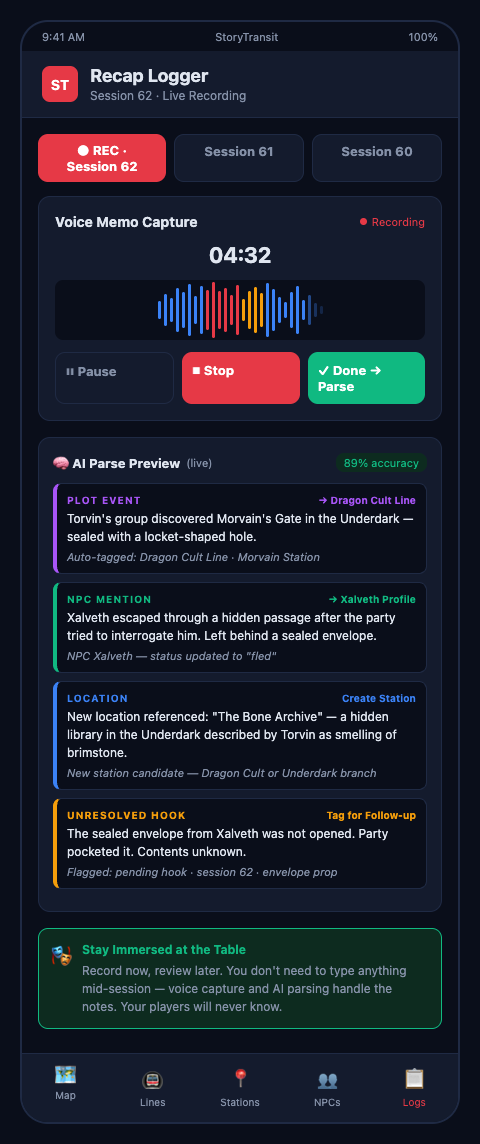
StoryTransit's session logging feature separates the operations layer from the arrival board layer, letting you maintain a comprehensive plot station log while generating clean player-facing recaps automatically.
Building a Recap System That Doesn't Break Flow
The best session recap process runs in two distinct phases: post-session capture (within 24 hours of play) and pre-session broadcast (48-72 hours before next session).
Post-session capture is for your operations log. Write it fast, write it rough, but capture three things: every subplot that advanced, every NPC who made a decision or was changed by the players, and every open question the party left unresolved. These become the stations on your campaign transit map that are now flagged as "visited."
Pre-session broadcast is your player-facing recap. Take your operations log, identify the five to seven facts every player needs to walk in knowing, and write them as a narrative paragraph. Past tense, active voice, specific proper nouns. Not "the party fought bandits near a village" but "the party drove off Skarren's mercenaries from the north road outside Brenhorn Village and found a brand on the dead captain's shoulder they hadn't seen before."
Collaborative note-taking reduces individual cognitive load — which suggests one powerful variation on this system: assign a rotating "session scribe" role to a player who writes the post-session broadcast in exchange for a small in-game reward. You capture the operations log, they craft the arrival board. The scribe's version often catches details you missed while running NPCs.
Sly Flourish's note organization system advocates minimal, focused note structure that keeps campaign records useful without over-engineering them. For DMs who over-document, that's a useful counter-pressure — a recap that nobody reads because it's 2,000 words defeats the purpose entirely.
The temporal gap between sessions is where campaign recap record-keeping earns its value most visibly. Real-world schedules mean many groups play every two to three weeks rather than weekly. After a three-week gap, even the most engaged player at Session 40 will have only partial recall of Session 39 without a structured recap. The operations log exists for you — to ensure your continuity remains intact. The arrival board exists for your players — to ensure their engagement remains intact. Neither document substitutes for the other, and neither should attempt to.
One practical addition to the two-layer system: tag every recap entry with a subplot code. "Skarren's mercenaries — cult subplot" or "merchant brand — guild conspiracy subplot" makes your session archive searchable by thread rather than only by date. When you need to trace the history of a specific subplot 47 sessions later, tagged entries reduce the search time from hours to minutes. That searchability is what makes the archive genuinely useful rather than just a documentation habit that never pays off.
The operations log and arrival board system also protects against a common DM failure: the retroactive retcon caused by misremembered session content. When a player challenges you on what was established in Session 23, "let me check my operations log" is a much stronger response than guessing. The written record protects narrative trust in both directions — it prevents you from contradicting yourself and it validates player memories when they're correct. A DM who can confirm what their players remember is a DM whose players trust the world.
Build the recap habit before you need it, not after you've lost the thread. Start the operations log from Session 1 and the arrival board from Session 2. At Session 50 you'll have a 50-entry archive that you can search in seconds and a recap discipline your players have come to rely on. Campaigns that develop documentation habits mid-run are always playing catch-up — trying to reconstruct context that was never captured. Session recaps are the foundation of dungeon master notes discipline, and foundations are cheapest to build at the beginning.
Advanced Tactics for Immersion-Safe Logging
The three-sentence rule. Your player-facing recap should cover what happened, what the party decided, and what's at stake going into tonight. Three sentences, maybe four. If you can't fit the relevant context into four sentences of narrative prose, you're including operational details that belong in your DM log, not the arrival board.
In-world delivery. Deliver the recap in a voice that belongs to your world. A tavern broadsheet read by the innkeeper. A journal entry from a party NPC who was watching. A prophecy fragment that recontextualizes the previous session with new meaning. These framings activate narrative encoding and build table immersion before the first die is rolled, not after.
Plot station tagging. Every subplot mentioned in your operations log gets a tag: active, dormant, or resolved. The recap only mentions active subplots. Dormant subplots are tracked but not broadcast — they're waiting to reactivate. This prevents the recap from becoming an overwhelming list of everything that has ever happened in 87 sessions of play.
Temporal anchoring. Always include in-world date or season in your operations log. "The party left Brenhorn Village on the 14th day of the Harvest Moon" is recoverable context. "After the village arc" is not. When you need to reconstruct a timeline after a long hiatus, temporal anchors are what make it possible.
Actual play podcast producers have refined these techniques further in their own context — the recap episodes guide covers how producers structure catch-up content for audiences who missed episodes, and the core discipline maps directly to DM session logging.
The campaign recap record-keeping system you build now will determine whether your campaign at Session 100 feels like a coherent world or a pile of disconnected sessions. Build it clean, build it early, and never break immersion delivering it.
Your Table Deserves Better Than "Who Had the Key?"
The 20-minute argument about what happened last session is not an unavoidable cost of long campaigns. It's a documentation failure, and it's fixable. Build a two-layer recap system, write your operations log within 24 hours, send a four-sentence narrative recap to your players 48 hours before the next session, and watch how quickly your table stops arguing and starts playing.
The practical startup cost is lower than most DMs expect. The operations log template takes about 15 minutes to build once — three fields, consistent headers, one entry per session. The first arrival board takes about ten minutes to write, because you're identifying which five facts your players need rather than summarizing everything. After two or three sessions the pattern becomes quick: operations log immediately post-session while the events are fresh, arrival board 48 hours later when you've had time to prioritize. Campaigns that start this habit at Session 5 arrive at Session 50 with a 45-entry searchable archive and players who trust the world's internal consistency. Campaigns that start it at Session 50 are playing catch-up, but even a late start captures forward continuity and prevents new inconsistencies from accumulating.
StoryTransit's logging tools are designed for homebrew D&D dungeon masters who want campaign continuity without sacrificing table immersion. Join the waitlist and bring structure to the chaos of long-campaign record-keeping — your players will notice the difference from the first sentence of next session's recap.