Converting Handwritten Campaign Notes Into Visual Story Maps
The Notebook Problem
A DM who had been running the same homebrew world for four years had seven notebooks of campaign notes. The notebooks contained everything: NPC sketches, faction diagrams, rough maps, session summaries, player quotes, and half-finished plot thread ideas that never made it into active play. By any measure, it was a rich archive.
It was also completely unsearchable. Finding a specific NPC mentioned in Year Two required paging through two notebooks, guessing at the session range, and hoping the handwriting was legible. Under session prep pressure, that search never happened. Instead, the DM reconstructed from memory — and the accuracy of that reconstruction declined steadily as the campaign aged.
A meta-analysis of 24 studies confirms handwritten notes outperform typed for conceptual retention — meaning the handwritten notebooks represent genuinely superior memory encoding compared to what a typed document would have produced. The problem isn't that the notes were written by hand. The problem is that they were never structured for retrieval.
Neuroscience research on handwriting confirms that the broader neural activation during handwriting creates stronger initial memory traces, but digital conversion unlocks the searchability and linking that handwritten documents cannot provide. The conversion process doesn't diminish the value of the original notes — it extends it.
76% of professionals report losing critical context from handwritten notes due to poor searchability. For a DM with four years of campaign history across seven notebooks, this isn't a minor inconvenience — it's a structural barrier to using the most valuable documentation they have.
The Conversion Framework
Converting handwritten campaign notes into a visual story map is not a transcription project — it's a restructuring project. You're not trying to digitize everything; you're extracting the structural elements that belong on a transit map and leaving the narrative texture where it is (or archiving it separately). The goal is homebrew documentation that functions as a retrieval system, not an archive — dungeon master organization built around what you'll actually need during prep, not a complete record of everything that ever happened. D&D note conversion at its most useful is selective: plot structure in, narrative flavor in a separate archive.
Phase 1: Triage, Don't Transcribe.
Start with a rapid pass through your notes — not reading carefully, but scanning for structural markers. You're looking for: NPC names with faction labels, location names connected to plot events, session numbers associated with story beats, and any language that signals a planted seed ("one day," "eventually," "the players don't know yet"). Mark these with a flag (a sticky tab, a different color pen, a digital highlight if you've scanned them) without stopping to process them.
This pass takes 15-20 minutes per notebook and produces a set of flagged entries that represent your raw conversion material.
Phase 2: Extract Plot Lines.
From your flagged entries, identify the distinct plot threads. Each thread that appears in multiple flagged entries across multiple sessions is a line on your campaign's transit map. Name the line (e.g., "Harbor Faction Conspiracy," "Rogue's Missing Sister Arc," "The Buried Temple") and list the session numbers where flagged entries reference it.
You now have a set of named lines with associated session numbers — the skeleton of a transit map. The lines may overlap, intersect, or branch at certain sessions. Those intersections are your transfer stations.
Phase 3: Place Stations.
For each session number associated with a line, write a one-sentence description of what the flagged entry records: what happened, what was revealed, what was promised. This sentence is the station label. You don't need to capture full narrative detail — you need the structural fact: "Party learned harbor master is Iron Veil agent (S44)."
Transit map schematization principles apply directly here: strip the geographic (narrative) detail and preserve the topological (structural) information. The result is a map you can navigate at a glance, not a document you have to read.
Phase 4: Identify Dormant Stops.
With stations placed, scan for any line that has no station more recent than 15 sessions ago. These are your dormant stops from the handwritten archive — plot threads introduced in the notebooks that have since been inactive. Flag them with their last known status and the session they went dormant.
This is typically the most valuable step for DMs with years of accumulated notes: you will find threads you completely forgot you had introduced. The notebooks become a discovery tool, surfacing dormant subplots that are now candidates for reactivation.
For session recap logs, converting existing handwritten recaps follows the same logic — extract structural facts, discard narrative texture, place stations on the appropriate lines.
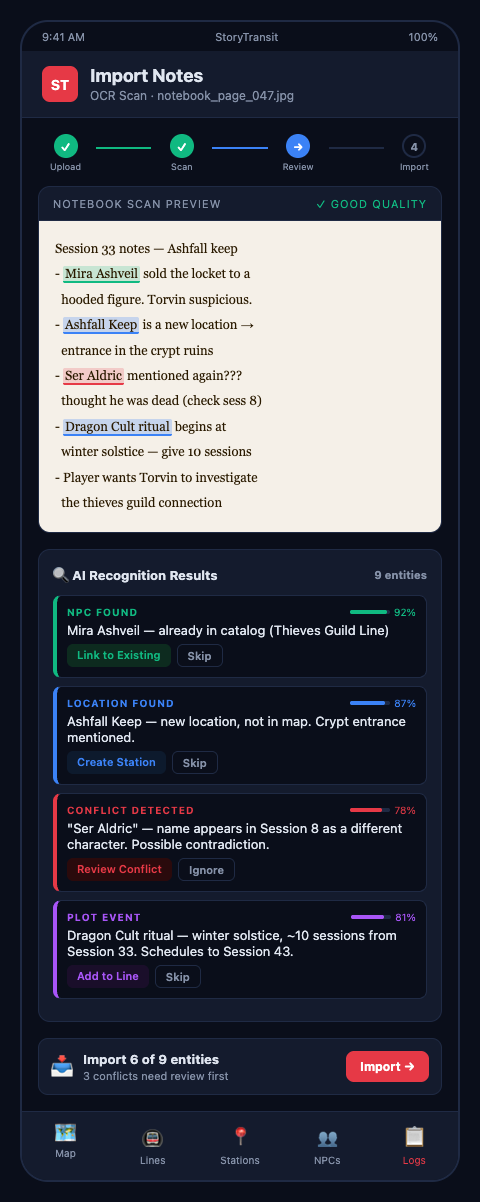
Practical Conversion Tools and Workflows
Scanning vs. manual entry. For DMs with large notebook archives, a document scanner (or a scanning app on a phone) creates a searchable PDF archive. Document digitization enables keyword search across thousands of pages — which transforms the seven-notebook problem from an archaeological challenge into a search query. Combined with the transit map built from the structural extraction, this gives you the best of both: deep archive search plus high-level topological view.
Phased conversion. Don't try to convert all your notes at once. Convert the most recent 20 sessions first — that's your current active state and the most immediately useful. Then work backward one batch of 20 sessions at a time as prep time allows. A campaign with 100 sessions of handwritten notes can be fully converted in five batches across five weeks, spending 30-45 minutes per batch.
The extraction-first rule. When converting, resist the impulse to improve or rewrite what you find in the notes. Your goal is to extract structure, not to retroactively improve the worldbuilding. If you find a plot thread that seems underdeveloped, log it as-is and decide later whether to develop it further. The conversion project is documentation, not revision.
Anchor new notes to the map. Once you've built the transit map from your handwritten archive, use it as the anchor for all new notes. Every new session's notes reference the existing station structure — a new event is a new station on an existing line or the start of a new line. This prevents the notebook pile from growing in isolation from the map.
StoryTransit's conversion tools are designed for exactly this use case: DMs who have years of handwritten campaign history and need to bring it into a structured transit map without losing the nuance of what was recorded. The first plot line map walkthrough in this series covers the map-building process for campaigns starting from scratch — this post covers the conversion path for campaigns starting from archives.
For LARP event organizers managing plot station maps across a weekend event, the same conversion logic applies when moving from a planning document to a live structural map that organizers can navigate during the event.
The note-taking software market is projected to reach $8B by 2030, driven by exactly this demand: people with years of accumulated handwritten knowledge who need to bring it into structures that support retrieval. Dungeon masters are among the most intensive note-takers of any hobby category, and the most underserved by existing tools.
Scientific American's research on how handwriting affects memory storage confirms that the DM's notebooks are not just notes — they're a memory extension that encodes campaign history at a depth typed documents don't reach. The conversion process honors that depth by preserving it in a form that can be retrieved and used.
Your Notebooks Contain Your Campaign's Best Moments
Homebrew D&D dungeon masters who have been running multi-year campaigns with handwritten notes are sitting on some of the richest worldbuilding documentation in the hobby — and most of it is inaccessible the moment prep pressure is high. StoryTransit's conversion tools are built for DMs who want to bring that history into a structured transit map without losing the texture that makes it valuable.
The most common sticking point in the conversion process is the scope problem: the archive feels too large to start. The phased approach solves this directly. Convert the most recent 20 sessions first — not because older sessions matter less, but because recent sessions are the ones shaping your current prep. The dormant stops most likely to surface in your next ten sessions are the ones planted in the last 30, not the ones from Year One. Once the recent batch is mapped, the older notebooks become a background archaeology project rather than a prerequisite, and you're already running better-prepared sessions while the deeper archive conversion happens gradually.
The waitlist for homebrew D&D DMs is open. If your campaign's best-documented subplots are buried in a notebook from three years ago, join the waitlist and get early access to the conversion tools that turn your archive into a working story map — one that surfaces the dormant stops you forgot you had, and the foreshadowing payoffs you've been meaning to deliver for 200 hours of play.