Building a Plot Station Map for Your LARP Weekend
Why Your Venue and Your Story Need to Be on the Same Map
Most LARP organizers maintain two separate planning artifacts: a narrative document (the plot bible) and a venue map (the site layout showing buildings, trails, and zones). These two artifacts rarely talk to each other. The plot bible says "the relic is revealed at the ancient altar." The venue map shows the prop altar somewhere in the eastern section. The NPC brief says to wait at the altar until players arrive. None of these documents tell your radio dispatcher which players are heading that way, which plotline this station belongs to, or how it connects to the next scene in that arc.
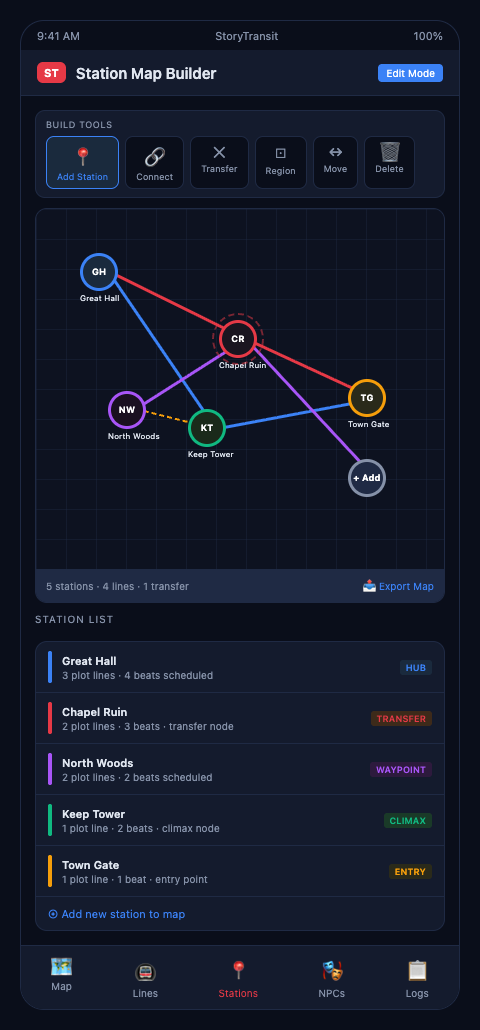
The plot station map solves this by merging narrative and spatial information into a single visual. Each story beat is a named station on the map, positioned at its actual location on the venue, color-coded to its plotline, and annotated with its NPC requirements. Story station design and event plot mapping are the same discipline applied at different scales: you are deciding where narrative events live in physical space, and the narrative station layout is what makes that decision legible to every runner and dispatcher on your team. StoryTransit's mapping layer handles the LARP visual planning side—each station record carries both its plot-line color and its venue position, so the operational and narrative views are always in sync.
Chamber larp principles from Nordic Larp Wiki describe how chamber-format events use a contained physical layout as the design constraint that makes story management tractable. The plot station map extends that principle to larger venues: it takes the sixty-acre site and gives every active story beat a precise location on a visual grid.
Profound Decisions at Empire LARP coordinates 400+ crew across multiple active plot stations for 3,500-player events. That coordination requires exactly the kind of spatial-narrative map described here.
Building the Station Map in Four Steps
Step 1: Define your stations. For each plotline in your event, list every story beat that requires a physical location or an active NPC. Give each station a short, unambiguous name. "Altar Reveal," "Campfire Curse," "Council Chamber Vote." These names will be used in every brief, every radio call, and every runtime log entry—clarity matters.
Step 2: Position the stations. Place each station at its venue location on the map. Use your site layout as the base layer. For stations that can move (NPCs who roam rather than stand fixed), note the range and anchor point. For stations that are fixed (the prop altar isn't moving), mark them precisely.
Step 3: Color-code by plotline. Each plotline gets a color on the transit mapping concept framework. Apply that color to every station on that plotline. When you stand back and look at the full map, you should be able to see the geographic distribution of each plotline—which areas of the venue are dense with blue-line stations, which areas are only served by the red line.
Step 4: Annotate NPC requirements. For each station, note the NPC assigned to it and their scheduled arrival window. Stations with no NPC assigned are immediately visible as uncovered. Stations with two NPCs assigned simultaneously flag a potential conflict.
Step 5: Add player group routing. For each major player group or faction, draw their intended path through the station map as a dashed line. This shows you, before event day, whether each group has a clear sequence of stations to hit, whether any groups share too many stations (creating bottlenecks), and whether any stations are intended for player groups who can't realistically reach them given the venue geography.
Transit map layout research shows that color, node naming, and spatial logic are the three core design principles that make transit maps usable at a glance. Your plot station map uses all three: color for plotline identity, node names for station clarity, and spatial positioning for venue accuracy.
The Pre-Event Map Review
Before the event starts, run your complete station map through a three-part structural review.
First, the coverage review: every station on the map has an NPC assigned or a props-only trigger. Any station without coverage is marked in red. You either find coverage before event day or restructure the station.
Second, the venue feasibility review: every NPC can physically reach their assigned stations within the available travel time. On a sixty-acre site, the travel time between the east section and the west section is significant. A volunteer with two consecutive stations on opposite ends of the venue needs either a travel window built into their schedule or a station reassignment.
Third, the sequencing review: for each plotline, read the station sequence aloud in order and check whether the narrative logic holds. "Players encounter the bloodstain, then meet the NPC who placed it, then confront the faction responsible" is a coherent sequence. "Players confront the faction responsible, then meet the NPC who placed the bloodstain, then encounter the bloodstain" is not. Sequencing problems discovered in the map review are fixable in pre-production. Discovered at runtime, they're usually unrecoverable.
Using the Station Map as an Information Radiator
An information radiator, as Agile Alliance defines it, makes parallel workstream status visible at a glance, reducing coordination overhead. That's the function your plot station map serves at the dispatch station.
When the map is displayed visibly at your command post, every runner who walks by can see the current state of all active plotlines simultaneously. Completed stations are marked. Active stations are highlighted. Uncovered stations are flagged. No radio call required to understand the current state.
Kanban visual management works on the same principle: visual representation of parallel workstream status reduces the communication overhead needed to coordinate across teams. For a LARP event with a large crew, the plot station map is the kanban board for your parallel plotlines.
The connection to 48-hour plot beats is direct: when your station map includes time windows for each station, you can see at any point in the event which stations are on schedule, which are behind, and which have expired.
Advanced Station Map Techniques
Dormant station notation. Mark buried subplots as dormant nodes on the map—greyed out, with their activation conditions noted. When the activation condition is met at runtime, the station activates and its NPC assignment becomes live. The map shows the organizer which dormant stations are approaching their activation window.
Transfer station design. Where two plotlines share a physical location for a scene—the council chamber is simultaneously a red-line and blue-line station for the Sunday climax—mark it as a transfer station with both plotline colors. This is the single most important design decision in a multi-plotline LARP: where are your lines designed to converge, and are those convergence points physically and logistically viable?
NPC zone coverage check. Once all stations are mapped, draw the geographic range of each NPC—the area they can cover given venue size and travel time. Stations that fall outside any NPC's coverage area are logistically uncoverable unless you reassign an NPC or adjust the station location. Catching this before event day is significantly less expensive than catching it at runtime.
Plot and Character Design from Nordic Larp notes that plot beats are scheduled on a physical plan of the day and adjusted for NPC availability. The plot station map makes that scheduling explicit and visual rather than distributed across multiple documents.
The LARP design document framework specifies that production maps with prop lists and spatial arrangements are a required component of complete event documentation. The plot station map is the runtime-usable version of that production map.
Updating the Station Map During the Event
A plot station map that's only accurate at event start is half a tool. The map has to be updated as the event runs. Stations that complete get marked. Stations that activate out of sequence get noted. Stations that are skipped get flagged.
The update protocol should be embedded in the radio call structure. Every NPC check-in includes a station status report. Every runner check-in confirms current player group locations relative to the nearest pending station. Every fifteen minutes at dispatch, the map gets a visual review: which stations have changed since the last check, and which ones are overdue.
This real-time updating is what converts the plot station map from a planning artifact into a dispatch tool. A planning artifact describes what should happen. A dispatch tool shows what's happening. The update protocol is the mechanism that keeps the map in the second category throughout the event.
The Map as Post-Event Documentation
At event close, the annotated station map—with completions, skips, timing notes, and improvisation flags—is the primary post-event documentation artifact. It shows the organizer exactly how the event deviated from the plan, station by station and line by line.
That record supports two downstream uses. First, the event debrief: when players report that they felt disconnected from the major storylines, the map shows which stations they never reached and why. The conversation moves from "players didn't engage" to "players in the north section missed four blue-line stations because the NPC was pulled to cover the red line." That's actionable.
Second, next event planning: the annotated map becomes the design input for the next iteration. Stations that consistently went uncovered suggest an NPC assignment problem. Lines that consistently ended without resolution suggest a station count problem. Lines that ran ahead of schedule suggest the need for more dormant stops.
For organizers building their first plot line map in any storytelling format, the station-based approach translates directly: place your beats, connect them in sequence, mark the shared nodes.
StoryTransit is built for LARP event organizers who need a visual plot station map that functions as both a planning document and a runtime dispatch tool. LARP organizers running weekend events with parallel plotlines are the intended users—join the waitlist to get early access to the station mapping and venue layout tools.