Building Your First Plot Line Map: A Dungeon Master's Walkthrough
The Map You Already Need But Haven't Built
A 2016 DM survey found that 22% of dungeon masters spend no time on worldbuilding between sessions — not because they don't care about their homebrew worlds, but because the prep overhead already feels unmanageable. A plot line map sounds like more overhead. It isn't — built correctly, it's what makes every other prep task faster by giving you a clear view of where your campaign's narrative currently stands.
D&D campaign planning without a visual story map means prepping from memory and scattered notes. The map converts that scattered information into a structure you can navigate. Homebrew design decisions that feel arbitrary in isolation — which thread to advance, which dormant subplot to reactivate — become obvious choices once the full network is visible. You see which lines have been idle longest, which transfer stations are most congested with converging arcs, and which threads are naturally approaching a payoff station. The map doesn't replace creative judgment; it gives that judgment accurate information to work from.
Harry Beck's London Underground map — the design that sold 850,000 copies in its first two months — was not a geographic map. It was a topological map: it showed which stations connected to which, which lines transferred where, and what direction to travel. It stripped out everything that didn't help a rider navigate. A campaign plot line map does the same thing: it strips out session-by-session detail and shows only the story's connective structure — which threads exist, where they've been, where they intersect, and which ones have gone dormant.
Research on mind mapping and visual learning confirms that structured visual representations improve comprehension of complex material and support long-term recall — the exact two benefits a DM needs when managing a multi-year homebrew campaign with dozens of active threads.
This walkthrough builds a working plot line map in five steps, starting from wherever your campaign currently is.
Step One: Identify Your Lines
Pull out whatever notes you have — session summaries, a campaign wiki, a folder of scratch documents, even just memory. Your goal in this step is to name every distinct plot thread your campaign has introduced, regardless of whether it's currently active.
A thread qualifies as a line if it involves an ongoing tension, a promise to the players, or a relationship that hasn't fully resolved. The guild war in the capital is a line. The player character's missing father is a line. The prophecy fragment found in Session 8 is a line. The slowly deteriorating mental state of the wizard NPC is a line.
Write each line as a one-line description. Don't elaborate. If you have 40 lines listed, that's fine — this is your full inventory, not your active map. A typical multi-year campaign with 60+ sessions will have 15-35 active or dormant lines. That number is manageable when it's listed; it's unmanageable when it lives only in the DM's head.
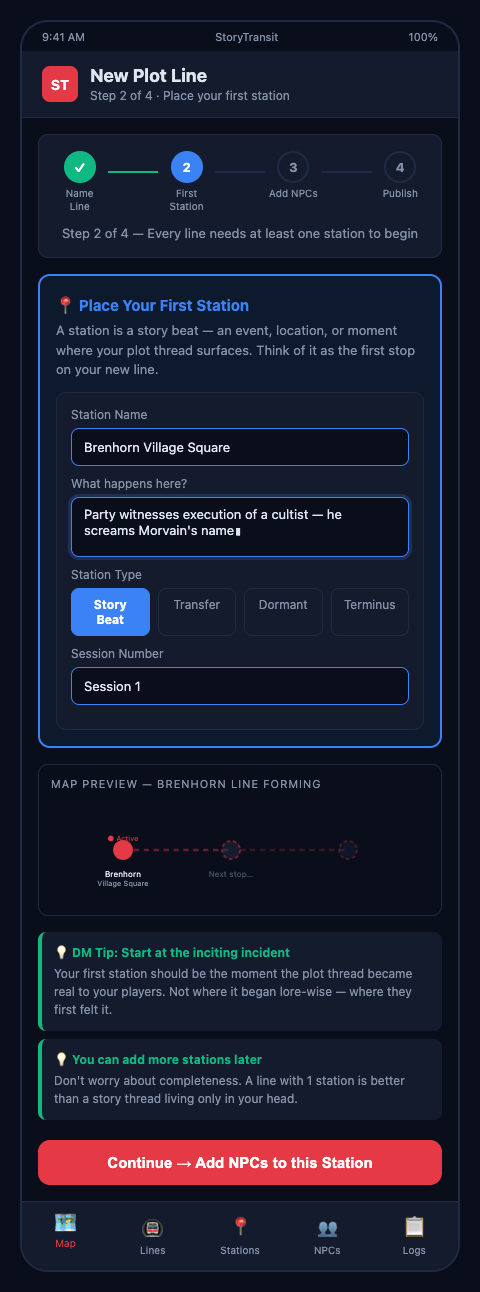
Step Two: Place Your Stations
For each line, identify the sessions where that thread had a meaningful moment of consequence — where it advanced, where a player made a decision that affected it, where a key NPC in that thread appeared, or where a reveal happened.
Each of those sessions is a station on that line. You don't need to map every session — just the ones where the thread actually moved. A line with 8 stations across 60 sessions is normal. A line with 2 stations in 60 sessions is either a slow burn or a dormant stop.
Label each station with: session number, a one-phrase description of what happened (e.g., "party discovers guild has double agent"), and the current narrative status of that station (open, resolved, or escalating).
Visual maps increase recall and motivation when learners need to connect concepts across time — exactly the structure a campaign plot line map creates. Once you see Session 12's discovery linked to Session 34's revelation linked to Session 61's confrontation on a single line, the thread's trajectory becomes legible in a way scattered notes never permit.
Step Three: Find Your Intersections
Now look across all your lines for shared elements: an NPC who appears in two threads, a location that multiple lines pass through, a player character whose personal arc crosses a faction's agenda. These are your transfer stations.
Transfer stations are high-value story real estate. A single scene set at a transfer station can advance two or three threads simultaneously — which is how experienced DMs create sessions that feel dense and consequential without requiring massive prep. Mark every transfer station on your map and note which lines it connects.
This is also where you'll discover structural patterns in your campaign you may not have consciously noticed: which NPCs are central connective tissue, which locations generate story density, and which plot threads are actually isolated dead ends with no intersection points.
Step Four: Flag Dormant Stops
Any station whose most recent event is more than 10-12 sessions ago is a dormant stop. Flag these explicitly. They represent two categories: threads you've deliberately paced slowly, and threads you've accidentally forgotten.
The distinction matters. A deliberately slow thread should have a planned reactivation point somewhere in your prep. An accidentally forgotten thread is a narrative liability — it may resurface unexpectedly when a player invokes it, and you'll need to reconstruct its state on the fly.
For converting handwritten notes into visual story maps, the dormant stop flagging step is often where the most valuable information surfaces — you find threads you completely forgot you'd introduced.
Step Five: Set Foreshadowing Payoff Receipts
The final step of the initial build is to log any future-facing commitments on your map. If you planted a story seed two sessions ago — a suspicious merchant, a coded letter, a recurring dream — add it as a station on the relevant line with a target payoff window attached.
StoryTransit calls these foreshadowing payoff receipts: a record of what was promised and a rough window for when it should be delivered. The promise is part of your campaign's structural contract with the players. Without a receipt, you're hoping you'll remember the commitment when it becomes relevant. With a receipt, it surfaces automatically when the payoff window approaches.
For player backstory transit lines, foreshadowing payoff receipts are especially valuable: a backstory hook planted in Session Zero can sit dormant for 20 sessions before it becomes the most emotionally resonant moment in the campaign — if you haven't lost track of it.
The pbp story mapping approach for forum-based games uses similar station-and-line logic to manage slow-paced, asynchronous campaigns — evidence that the transit map framework scales across very different play formats.
From Blank Page to Working Map
Building a plot line map for the first time takes 60-90 minutes for a campaign with 30-60 sessions of history. That's a one-time investment that pays back in every session you run afterward — because you'll prep from a clear map rather than from scattered notes, and you'll catch dormant subplots before players invoke them.
Two things typically surprise DMs when they complete the initial map. First, the number of dormant stops: most campaigns with 40+ sessions have six to ten threads that were seeded and quietly stopped receiving attention. Second, the transfer station density: the map usually reveals that several active threads share NPCs or locations you hadn't consciously recognized as connective tissue. Both discoveries are immediately useful. The dormant stops give you a reactivation queue — sorted by how long they've been idle, which tells you which ones are closest to becoming broken promises. The transfer stations give you high-leverage session design opportunities: a single scene in the right location can advance three threads simultaneously.
That's what a visual story map provides that no flat list of plot notes can: spatial and relational awareness of the campaign's structure. After the initial build, maintain the map by adding a new station to the relevant line after each session. Five minutes of maintenance per session is what keeps the map current without turning it into a separate prep project.
Dungeon masters running long-term homebrew campaigns now have a purpose-built tool for exactly this structure. StoryTransit's plot line map builder is designed for DMs who have been managing campaign continuity the hard way — and who want a visual story map that actually reflects what their campaign has become over 200 hours of play.
The waitlist for homebrew D&D DMs is open. If the walkthrough above described a problem you've been working around for years, StoryTransit's campaign transit map is the infrastructure you've been building by hand.