The PbP Game Master's Introduction to Story Mapping
Why PbP Demands a Different Kind of Map
A homebrew campaign run at a weekly table has a clear anchor: each session ends, you write notes, you prep the next one. The timeline is sessions. The archive is your notes folder.
A play-by-post campaign has no such anchor. Your archive is a forum. Your timeline is thread pagination. Your "session" is an IC post that one player wrote at 11pm while another player is asleep in a different timezone and won't respond for eighteen hours. The campaign doesn't stop between posts — NPCs are still doing things, subplots are still accumulating, and the forum archive is quietly growing deeper.
Play-by-post role-playing game – Wikipedia notes that pbp campaigns can span years and hundreds of forum pages. That scale creates a specific cognitive problem: as character counts, event counts, and thread counts grow, the cost of tracking narrative rises steeply. Neural substrates of narrative comprehension and memory – PMC confirms this — readers build "situation models" of narrative, and complexity in the model imposes measurable cognitive load. At eighty in-character posts across six threads, that load becomes unmanageable without external structure.
The standard responses — a pinned OOC summary thread, a Google Doc with session recaps, a wiki entry for each NPC — all address the same problem from the wrong angle. They store information. A story map represents structure. The difference is significant.
Tabletop RPG Industry Statistics – WorldMetrics puts global TTRPG players at over 50 million in 2024. A meaningful portion of those players run or participate in forum-based pbp campaigns — and nearly all of them are storing their campaigns rather than mapping them.
The Transit Metaphor Explained
A Survey on Transit Map Layout (Wiley) describes how transit maps schematize complex networks into navigable visual structures. The same principles that make a subway map readable at a glance — color-coded lines, named stations, visible transfer points — apply directly to the structure of a pbp campaign.
Here's the translation:
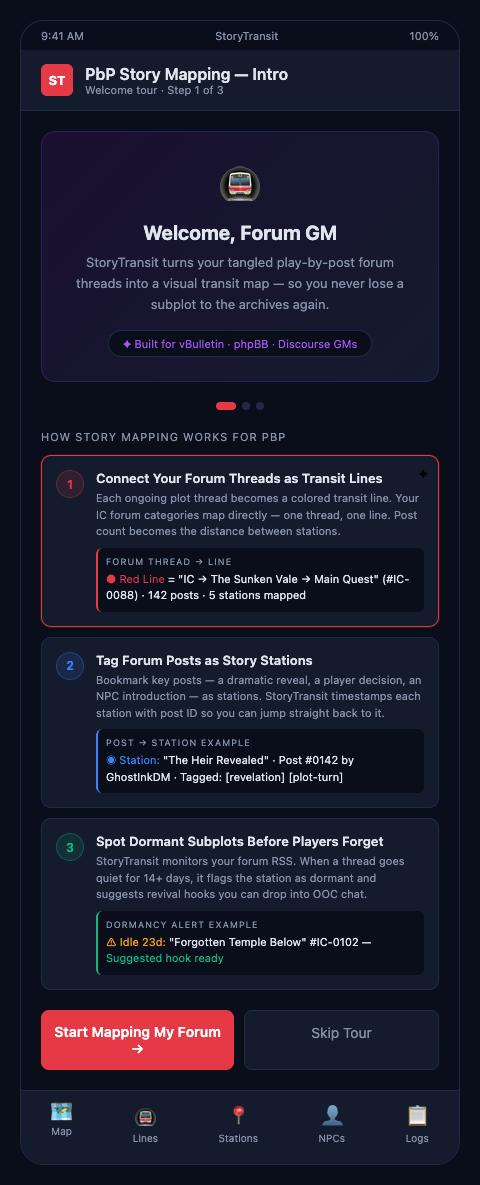
Plot threads become transit lines. Each active narrative arc is a line on the map. The poisoning arc is the Red Line. The faction war is the Blue Line. The character backstory thread is the Green Line. Lines have colors, names, and a clear direction of travel.
Story beats become stations. Each meaningful moment where the plot advanced — a revelation, a confrontation, a decision that changed the trajectory — is a station on its line. Stations have timestamps: both the IC post reference (thread name, page number) and the real-world date.
Character arcs become routes. Each player character travels through the campaign along a route that crosses multiple lines. A character might board the Red Line in week two, transfer to the Blue Line at a crisis point, and currently be riding the Green Line. Seeing the full route makes it obvious which lines that character could logically re-engage with.
Dormant subplots become dormant stops. A subplot that's gone inactive isn't erased from the map. It's marked as a dormant stop: still part of the network, still accessible, but not currently running service. The GM can see dormant stops at a glance and decide which ones are candidates for revival.
This is the foundation of StoryTransit. For GMs building this structure for the first time, the first pbp framework post covers campaign setup in detail. The transit metaphor works for pbp specifically because it's designed for a network that has to stay legible even when parts of it go inactive. A subway system where some lines are suspended is still a coherent map. A pbp campaign where some threads have been dormant for eleven weeks is still a coherent story — as long as you have a narrative map that shows you where they are.
Building Your First PbP Story Map
Cognitive and Neural State Dynamics of Narrative Comprehension – PMC shows comprehension peaks when past events are causally connected to present ones. Your story map is the tool that makes those connections explicit — so you can use them in your next IC post rather than vaguely remembering they existed.
Start with five elements:
Active lines only. Don't try to map everything your campaign has ever touched. Start with the two or three threads you know are currently active. Give each one a label and a color.
The last three stations on each line. For each active thread, identify the three most recent story beats that moved it forward. Log each with a thread reference (subforum name, page number, post number) and a date.
Dormant stops. Any subplot you introduced more than four weeks ago and haven't touched since is a dormant stop. Log it: line, last station, date it went dormant, one-sentence revival trigger.
Transfer points. Identify any moment where two active lines intersected. That scene is a transfer station. Note which lines it connects.
Character routes. For each player character, list which lines they've traveled. You don't need the full history — just the last two lines they were active on and any dormant stop they passed through.
That first map will take about an hour to build for a campaign that's been running three months. The payoff is immediate: the next time you write an IC post, you can open the map and see in thirty seconds which threads are active, which are dormant, and which character has a natural reason to reactivate a buried subplot.
If you're already past setup and want the full GM toolkit, the forum GM toolkit post covers intermediate thread management in detail.
GMs running table-based homebrew campaigns work with an analogous structure — the first plot line map walkthrough covers the same concepts for dungeon masters managing multi-year arcs without forum pagination.
Common Mapping Mistakes and How to Avoid Them
Mapping too much detail. The most common first-attempt mistake is treating the story map as a comprehensive campaign wiki. Every NPC, every world detail, every piece of lore gets a node. The map becomes unmanageable within three weeks because it takes longer to update than it takes to write an IC post. The fix: map only story beats that advance a named transit line. Background worldbuilding belongs in a wiki or lore document — the story map is for narrative momentum tracking only.
Failing to close completed lines. A transit line that has reached its convergence station should be closed — not deleted, but explicitly marked as complete. Leaving it as "active" creates visual noise on the map and makes it harder to distinguish the lines that actually need attention. A closed line is a completed arc; it's part of the campaign's history and can be referenced but no longer needs monitoring.
Treating transfer stations as optional. Many forum GMs map their lines but skip transfer station tracking, considering it overhead. The cost becomes visible when an arc needs revival: without documented transfer points, you have to reconstruct which other lines touched this arc from memory or by reading the archived threads. Transfer stations are the revival infrastructure of your campaign map. Build them as you go.
Inconsistent naming conventions. If your poisoning arc is called "Poisoning Arc" in some log entries and "Red Line" in others and "Merchant Quarter Subplot" in a third, searching the map becomes unreliable. Establish names for each line before you log the first station, and use them consistently.
The Map as a Living Document
The story map is not a reference document you build once. It updates with every meaningful IC post. A new station gets logged when a plot beat lands. A dormant stop gets a revival date when you bump it back into play. A new line gets added when you introduce a subplot.
The discipline of updating the map is lower than it sounds: one line per IC post, at most. "Red Line / Station 5 / Merchant Quarter Thread #3 / Page 7 / Post 112 / 2026-04-14: Noble patron identified by name." That's the entire log entry. The value accumulates over weeks, and by the time a subplot has been dormant for three months, the log entry is the only reason you'll remember its exact state.
The story map also functions as a communication tool when new players join a campaign already in progress. Instead of asking a new player to read eighty in-character posts to catch up, you can share the map: here are the active lines, here's the current station on each one, here are the dormant stops with revival triggers. A new player who understands the transit structure is ready to write an IC post in thirty minutes rather than three hours.
StoryTransit automates this logging for play-by-post forum GMs who are already managing enough overhead in their IC and OOC threads. Join the Waitlist for Play-by-Post GMs to access a purpose-built narrative map that grows with your campaign rather than requiring manual maintenance in a separate document.