Setting Up Your First PbP Campaign: A Beginner's Framework
What You Decide in Week One Determines Month Six
Every forum GM running a successful long-term play-by-post campaign made a set of structural decisions early on that aren't obvious until you've run a campaign without them. The thread that goes missing on page fourteen of an archived subforum, the subplot that was seeded in week two and never paid off, the player who quietly stopped posting because they couldn't find the context anymore — all of these trace back to setup decisions made before the first IC post.
A Beginner's Guide to Play-By-Post Roleplay — Knights of the Braille covers the basics: platform choice, pacing expectations, tone-setting. What it can't cover is the structural layer below those choices — the thread organization and story logging framework that determines whether your campaign is findable, revisable, and recoverable six months in.
The global TTRPG market reached approximately $2B in 2024 with over 50 million players worldwide. Tabletop RPG Market 2024 Analysis – RPGDrop captures this growth, and a meaningful share of those players are running or joining their first pbp campaign right now. Most of them will make the same setup mistakes because nobody told them what to build before they started.
This is the framework you build before your first IC post.
The Thread Architecture
Your forum campaign needs at minimum four thread types from day one, not one.
The main IC thread is where the in-character story happens. This is the thread most beginners think of as "the campaign." It's necessary, but it's not sufficient.
A dedicated OOC thread is where logistics, questions, scheduling, and meta-discussion live. The New Player's Guide to Play-By-Post – StartPlaying.games makes the IC/OOC separation foundational — it's not optional housekeeping, it's the boundary that keeps character and player voices from contaminating each other. The OOC thread is also where your player community stays cohesive during slow IC periods.
A lore and context thread is a pinned reference post (or small thread) that contains current-state summaries: who the active NPCs are, what the party knows, what the current situation is. This is not a full recap — it's a one-screen snapshot. New players and returning players both need it, and it needs to be current. Update it every two to three weeks.
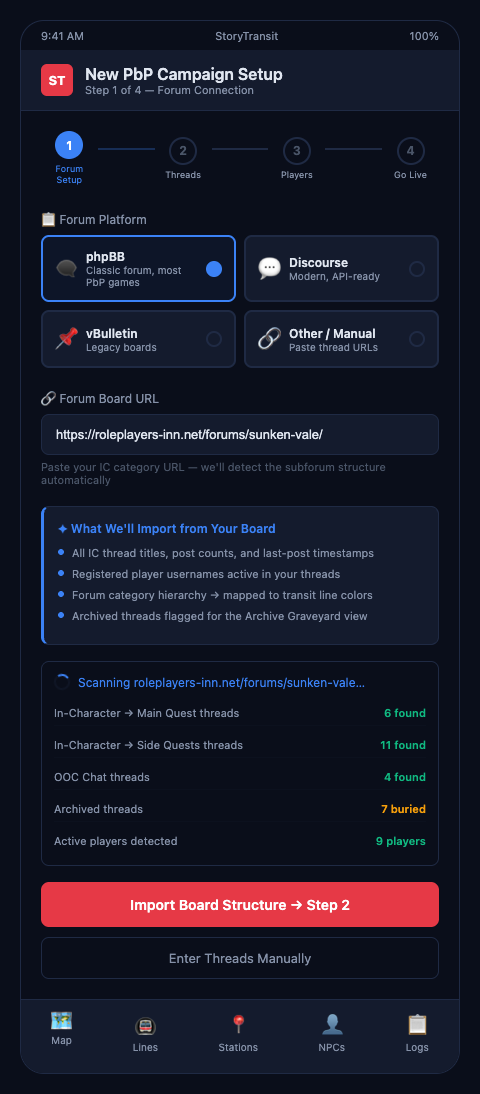
A GM tracking thread or off-forum document is where you log your plot threads as transit lines, your story beats as stations, and your dormant subplots as dormant stops. This is invisible to players. It's your map. StoryTransit is built for exactly this layer — the structural record that sits beneath the IC threads and gives the GM a navigable reference for the full campaign, not just the latest posts. Organizing RPG Prep Notes – SlyFlourish.com recommends date-based filing with structured folders for NPCs, sessions, and maps — the same principle applied to a forum campaign becomes a dated log of which thread, page, and post number each story beat occupies.
Building Your Story Map From Day One
The single most valuable thing a first-time forum GM can do is start a story map before the first IC post. Not a detailed one — a seed.
Your seed map has three elements: the name and color of each plot thread you're planning to introduce in the first month, the name of each opening story beat (station) on those threads, and a list of dormant stops — subplots you're seeding in the background that won't be active yet but that you want to be able to find later.
This seed map takes thirty minutes before your first IC post. It grows naturally from there: each time you write an IC post that advances a plot thread, you add a station. Each time you introduce a new subplot, you add a line. Each time a thread goes inactive for more than three weeks, you mark the most recent station as dormant.
Coordinating Collaborative Writing in an Online Environment – Springer found that async writing participants rely heavily on both text-related and task-coordination strategies to stay aligned. Your story map is the task-coordination layer of your forum campaign — it's what lets you write an IC post that references something from month one without re-reading sixty posts to find it.
pbp story mapping covers the full conceptual framework for this approach in more detail. For the setup-stage GM, the key principle is this: document the structure, not just the content. Notes about what happened are content. A map of which threads are active and which are dormant is structure.
Practical Thread Organization for the First Month
Name your threads with searchable titles. "The Merchant Quarter – IC Thread #1" is searchable. "Thread" is not. Every forum thread you create should have a name that includes the subforum context and a sequence number. When you're on page fourteen of an archived subforum eight months from now, that naming convention is the only thing that makes the thread findable without scrolling.
Post a thread index in your OOC. A simple numbered list of all active threads — name, subforum, current page, last IC post date — pinned to the top of your OOC thread. Update it every two weeks. This takes five minutes per update and saves everyone hours of searching across the life of the campaign.
Set explicit post frequency expectations. Not aspirational ones — realistic ones. DH's Guide to Play By Post Gaming – Paizo Forums is community-sourced guidance that consistently identifies post frequency expectations as the first-month decision that determines whether players stay engaged. "We aim for one post per day, and the GM will advance the scene if a player misses three consecutive days" is a policy. "Post when you can" is not.
Build dormant stops before you need them. In your first month of IC posts, plant at least two subplots you don't intend to pursue immediately. Write them into the background: an NPC with a suspicious motivation, a location with unexplained details, a reference to an event that predates the campaign. Log these in your tracking document as dormant stops with revival triggers. They're your reserves — the subplots you pull from when month three arrives and you need new material.
For the IC OOC integration layer of your campaign map, the beginner framework here provides the foundation. LARP organizers setting up their first multi-plot LARP use a structurally similar approach — parallel plot threads, documented transfer points, and dormant subplots managed as reserved material.
Platform Choice and Its Effect on Setup
The framework above applies across forums, but platform choice affects how much of it you need to build manually. Dedicated pbp platforms like RPoL – RolePlay onLine have built-in private threads, dice rollers, and game management tools that reduce some setup overhead. General-purpose forum platforms require more manual infrastructure but offer more flexibility.
What no platform automates is the story map layer — the transit line tracking, dormant stop registry, and thread index. That documentation lives outside the platform itself, regardless of which forum you use. The platform hosts the IC and OOC threads. You maintain the map.
For GMs using a platform with limited thread organization (many general forums have flat subforums), the naming convention for threads matters even more. "IC-01: Merchant Quarter Opening" is searchable and sortable; "Thread" is neither. Every thread name should include a prefix indicating whether it's IC or OOC, a sequence number, and a location or topic identifier.
The Thirty-Day Setup Checklist
Before you post your first IC line: create your four thread types (IC, OOC, lore reference, GM tracking), name all threads with searchable titles, seed your story map with three active lines and two dormant stops, set explicit post frequency expectations in the OOC, and post a thread index in the OOC.
By the end of month one: update the lore reference thread with current state, add a station to each active line in your map for every meaningful IC post, move any thread with no activity for more than two weeks to dormant status, and update your thread index.
That structure takes about two hours of total setup time. It's the difference between a campaign that has a map and a campaign that doesn't — and by month three, that difference determines whether you're still running.
The infrastructure investment compounds. The two hours you spend on setup aren't the ceiling — they're the seed. A story map that has been maintained for four months contains four months of indexed plot history, retrievable in under two minutes per query. That's worth hours of re-reading archived threads per month avoided, and it's what allows the forum GM to write IC posts with confidence that they're not inadvertently contradicting something they seeded three months ago.
New players who join a well-structured campaign have a qualitatively different onboarding experience than those joining an unstructured one. The lore reference thread catches them up on world state. The thread index shows them which threads are active. The story map (shared at GM discretion) gives them the structural overview. A player who joins mid-campaign and is up to speed within an hour is a player who starts contributing IC content quickly, which is the lifeblood of a forum campaign's momentum.
StoryTransit is designed for play-by-post forum GMs who want this infrastructure built into their workflow rather than maintained manually. Join the Waitlist for Play-by-Post GMs to access the purpose-built campaign framework that grows with your threads instead of falling behind them.