Designing Your First Multi-Plot LARP: A Beginner's Framework
Why 73% of First-Time Organizers Cite Plot Scope Mismatch
The research is blunt: survey data from Leaving Mundania shows that 73% of first-time LARP organizers identify plot scope mismatch as the primary cause of their debut event's failure. They designed for twelve plotlines and had the crew for three. Or they designed one central plotline and ran out of story by Saturday afternoon because players moved through it faster than expected.
Both versions of the problem trace back to a missing framework. Every first LARP organizer faces the same event design basics problem: the beginner LARP framework doesn't exist yet, so they build rooms and write character sheets before they've verified that the underlying story architecture is coherent. Multi-plot LARP design requires the structure to precede the content—map your lines and stations before you write a single NPC brief.
The Nordic Larp Design Glossary establishes the vocabulary that makes multi-plot design tractable: storyline, plot beat, NPC role, arc. These aren't just terms—they're the units of a system. When you design a multi-plot LARP using this vocabulary consistently, you can count your components, check your ratios, and identify gaps before you've invested weeks of writing.
Start With Chamber Scale
Chamber larp is defined as a short larp in a small venue with up to twenty players and structured, minimal-rules design. It's the ideal format for a first multi-plot LARP not because it's easy, but because its constraints are honest. You can't hide scope problems at chamber scale. When you have twenty players and three plotlines, the math is visible: that's six or seven players per line, and you need at least one NPC available for each line at any given time.
The chamber format forces you to answer the questions that larger events defer: How many story beats does each plotline need to feel complete? How many of those beats require an active NPC? Which beats can players trigger themselves with props and environmental cues? How long will players stay engaged with a single story thread before they need a new beat?
Once you've answered those questions at chamber scale, you have a framework that scales. Chamber LARP visuals show how the same mapping approach that works for a twenty-person event translates to a hundred-person weekend.
Building the Story Map Before the Plot Bible
The framework error that most first-time organizers make is writing the plot bible before drawing the story map. They start with characters, relationships, and scene descriptions—the narrative content—and only discover the structural problems when they try to schedule NPCs and realize two arcs require the same person at the same time.
Build the story map first. Here's the sequence:
Step 1: Name your plotlines. Give each parallel arc a one-sentence description and a color. Keep it to three or four lines for a first event. The NERO LARP plot database approach of assigning characters to specific plotlines first, then writing their content, is the right order of operations.
Step 2: Map the stations. For each plotline, list the story beats in sequence. Each beat is a station: a named moment that moves the arc forward. Aim for five to eight stations per line for a one-day event.
Step 3: Mark transfer points. Identify where two plotlines will deliberately intersect. These are your designed collision points—scenes where characters from different arcs meet and both lines advance. Mark them explicitly.
Step 4: Check the ratios. Count your stations, count your NPCs, count your available hours. If the math doesn't work, cut stations before you write content for them.
Step 5: Design the transfer stations intentionally. Don't let plotline intersections happen by accident. For each pair of arcs that share thematic territory, design at least one station where they deliberately converge. A transfer station where the merchant conspiracy's NPC and the werewolf faction's NPC both have reasons to appear is more valuable than two separate scenes covering similar ground. The transfer station does double narrative work.
7 Steps to Build Better Plot from LARPortal recommends connecting unrelated plotlines via shared NPCs or clues as a tested technique for multi-plot design—which is the same as designing transfer stations on your story map. These intersections are what make a multi-plot event feel like a coherent world rather than separate parallel games.
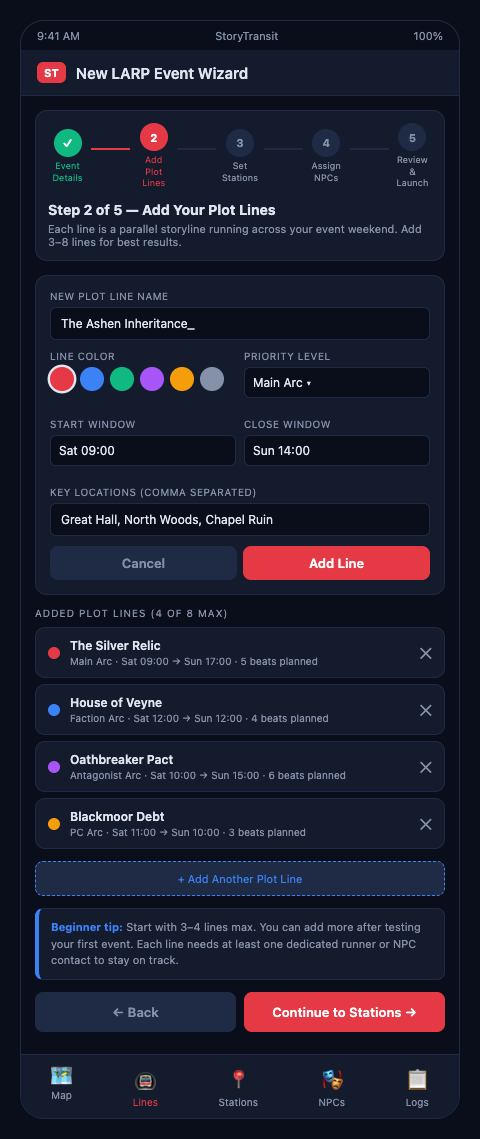
The NPC Assignment Check
Before event day, your story map needs to pass one test: every station that requires an active NPC must have a named NPC assigned to it, and no NPC should be assigned to two simultaneous stations.
The LARP design document framework from Nordic Larp Wiki specifies that a complete design document must capture all parallel plotlines, NPC briefs, and production notes in one place. For a first-time organizer, that document is the story map with NPC assignments attached.
Run the assignment check by listing every station on your map in chronological order, with the assigned NPC next to each. Then read through the list looking for any NPC who appears twice in the same hour. Every double-booking is a station that won't get covered. Fix the map before you write the brief.
PC goal integration is the next layer: once your station map is solid, you can start assigning player characters to specific plotlines and verifying that every character has a clear path through at least two stations.
The Beginner's Pre-Event Checklist
First-time organizers often feel ready the week before the event, then discover on the day itself that critical pieces weren't connected. Before you run your first multi-plot LARP, run through this structural checklist against your story map.
Every plotline has a named arc and a sequence of at least five stations. If a plotline only has three stations, it will be exhausted in the first two hours of a four-hour event and leave those players without story momentum.
Every station has an NPC assigned or a props-only trigger. A station that requires an NPC but has no one assigned is a dead story beat. A station that can be triggered by a physical prop—a found letter, a marked door, a staged scene—can run without NPC coverage as a backup.
At least one transfer station exists between each pair of major plotlines. If your three plotlines never intersect, you have three separate games happening simultaneously rather than one coherent event. Transfer stations are the connective tissue that makes players feel they're in a shared world.
You have a runtime dispatcher role assigned. On the day of the event, someone needs to be watching the story map and routing NPCs. That person should not also be playing a character. Their job is the map.
You have at least two dormant stations per plotline. Dormant stations are your flexibility reserve. When players burn through a line faster than expected, you activate a dormant station to extend it. When they're slow, you skip it.
What to Cut When the Map Is Too Big
First-time organizers routinely over-build. The story map reveals scope problems that the plot bible hides. When your map shows twenty-eight stations and six plotlines for a one-day event with eight available NPCs, you have a math problem, not a storytelling problem.
The cut order: first cut dormant stations from plotlines with the most of them, keeping only the best two per line. Then cut the plotlines that are most similar to each other in theme—two political intrigue lines can often be merged. Then cut stations from the surviving plotlines that are narrative detours rather than necessary beats.
What you should never cut: the opening station for each plotline (players need an entry point), the transfer stations between plotlines (you need intersections), and the closing stations for each arc (players need resolution). Everything else is eligible.
Plot structure analysis from CRO Larper establishes the act structure for LARP: campaign, arc, event, module. For a first multi-plot LARP, you're designing at the event level. Expect that roughly thirty percent of your station plan will change during the event. Design for that by building two or three dormant stations per plotline—beats that can activate if players move faster than expected, or that can be skipped if they move slower.
Learning From the First Run
After the event, the most valuable document you have is your story map with actual runtime states marked on it. Which stations fired on schedule. Which were skipped. Which activated out of sequence because players improvised their way there. Which plotlines resolved cleanly and which ones were still running when time was called.
That document is the foundation for your second event design. Most first-time organizers improve dramatically between their first and second events—not because they got better at writing, but because they could see, concretely, what failed and why. Multi-thread storytelling at live events gets clearer when the visual map becomes the post-event record—not just a planning artifact but a documented account of where the story actually went. StoryTransit is built specifically to make that record automatic: the same dashboard you use to dispatch NPCs during the event becomes the annotated post-event log when the weekend closes.
The organizers running first pbp frameworks in forum games face similar scope-matching problems with their first multi-thread campaigns—and the same advice applies: start smaller than you think you need to, with a visual map of your threads, and let the structure scale with your experience.
StoryTransit is built specifically for LARP event organizers at every experience level, from first-time designers running chamber events to veterans managing weekend-long parallel-plotline events. The waitlist is open—join to get early access to the visual story mapping tools designed around how LARP events actually work.