Converting Chamber LARP Rules Into Visual Story Structures
Why Chamber Rules Resist Direct Visualization
Chamber LARPs are designed to minimize rules friction. The rules are few, the venue is small, the player count is low. But "minimal rules" doesn't mean "simple story structure." A chamber LARP with twenty players and three plotlines can have a narrative architecture as intricate as a weekend event with a hundred players—compressed into ninety minutes and two rooms.
The Nordic Larp Wiki definition of chamber larp specifies short duration in a small venue with structured, minimal-rules design. That structure is the key phrase. Minimal rules doesn't mean unstructured story—it means the structure is embedded in character design, relationship maps, and scenario parameters rather than explicit game mechanics.
Converting that embedded structure into a visual framework surfaces what the rules actually commit you to. When you draw the story map for a chamber event, you discover that the "minimal" ruleset actually implies a specific sequence of emotional beats, a set of required NPC-player contact points, and a convergence structure for the finale. Those implications were always there in the design. The visual makes them explicit. The handwritten notes to visual story maps transition in tabletop campaign management follows the same logic: the story exists in documents and memory, and the visual map makes it navigable at runtime rather than reconstructed from notes.
Academic research on LARP control tools shows that large LARPs require several groups of control tools, and chamber events are no exception — the translation between ruleset and playable narrative structure is what separates events that run on rails from events that collapse mid-scenario. The ruleset existed. The story existed. The translation between them didn't.
The Translation Process: From Rules to Stations
Converting chamber LARP rules into a visual story structure proceeds through three translation steps.
Step 1: Extract the implied beats. Read your ruleset and identify every moment the rules require to happen for the game to work. In a chamber LARP with relationship mechanics, every relationship that's designed to reach a crisis point is an implied story beat. Every secret that's written to be revealed is an implied station. List them all. This is your raw station inventory.
Step 2: Sequence the stations. Arrange the implied beats in the order they need to happen for the narrative to make sense. Some will be mandatory in a specific order—the betrayal must be revealed before the confrontation that responds to it. Others can float. Mark the mandatory sequences as directed paths on your visual framework; mark the floating beats as optional nodes.
Step 3: Assign plotline colors. Group the stations by the narrative arc they serve. In a chamber LARP with three interwoven plotlines, you'll likely find that most stations belong primarily to one arc but have connections to at least one other. Color-code each station with its primary plotline color, and draw connector lines to any secondary plotline it affects.
When the color-coding is complete, step back and look at the distribution. A well-structured chamber LARP visual framework will show roughly equal station counts across plotlines, with connection points distributed across the timeline rather than clustered at the end. If all the cross-plotline connections are in the last third of the framework, you have an event that runs as parallel games until a forced convergence—which tends to feel artificial rather than earned.
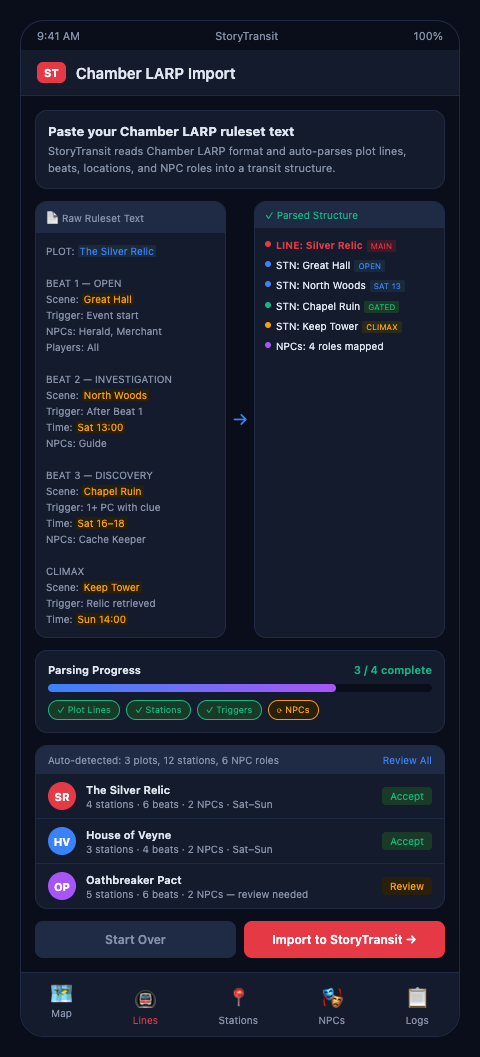
The result is a visual narrative framework that represents what your chamber LARP rules actually imply, in a format your facilitators can reference during the event. LARP ruleset conversion into station sequences is the core of chamber event design: you are translating design intent embedded in rules text into a visual story structure your whole team can use at runtime. StoryTransit's station-building tools are designed to make this translation explicit—each station record carries its source in the ruleset alongside its operational fields, so the connection between the design choices and the runtime structure stays visible throughout the event.
The Mixing Desk of Larp design theory maps LARP design parameters visually, showing how rules translate to experiential structures. The transit map approach extends this: not just parameter visualization, but a full station-based narrative diagram that follows from the rules.
Validating the Framework Before the Event
Once the chamber LARP visual framework is complete, run a brief validation pass before distributing it to facilitators.
The first check: every plotline has at least one station where it intersects with another plotline. A chamber event where three arcs run in complete isolation isn't a chamber LARP—it's three short scenarios happening simultaneously in the same room. The intersections are what create the sense of a shared world.
The second check: the finale station is accessible to all player groups, not just the ones who followed their plotline faithfully. The chamber format works best when the ending scene brings the full player population together into a shared moment. If your visual framework shows that only players who completed all stations on one line can reach the finale, you've designed an ending that will play to half your room.
The third check: each player character has at least three named stations on their path through the framework. A player who has only one or two designed beats will improvise their way through the rest of the event—which is fine, but it means the structure isn't carrying them. Chamber LARPs work because the structure is tight enough to generate momentum. Three beats per character is the minimum for that momentum to work.
What Nordic and Chamber Rules Require Differently
Nordic LARP principles from What is Nordic Larp? emphasize immersion and collaborative storytelling with minimal mechanical intervention. Converting Nordic rules to a visual framework means preserving that immersion-forward design intent—the visual structure should describe narrative flow, not mechanical outcomes.
A Nordic chamber LARP visual framework looks different from a campaign LARP's story map. The stations aren't "combat encounter" or "skill check"—they're "first acknowledgment of the betrayal," "moment of forgiveness offered," "final choice point." The sequence is emotional, not procedural.
This distinction matters for how you brief your facilitators. A facilitator reading a Nordic-style station map needs to understand that each station represents an emotional beat to create conditions for, not a scripted scene to execute. The visual structure tells them the sequence; their job is to guide players into each beat through the minimal, immersion-focused tools the Nordic tradition provides.
Managing plot structure in character-based interactive narratives shows that graphical authoring interfaces let designers convert narrative rule systems into interactive story diagrams—the academic equivalent of what the chamber LARP visual framework achieves practically.
Scaling the Chamber Framework Upward
The chamber LARP visual framework is a valid starting point for scaling up to larger events. When you've run a chamber event with twenty players and verified that your visual story structure accurately reflects how the rules play out, you have a proven template for the narrative architecture of a larger event.
The scaling process adds station count and plotline count, but the structural logic stays the same. A weekend LARP with a hundred players and ten plotlines is ten interwoven chamber frameworks running simultaneously—with transfer stations where the arcs intersect and a dispatch system to manage NPC assignments across the full map.
First multi-plot LARP frameworks often begin at chamber scale precisely because the constraint forces explicit structural thinking before the event complexity outpaces the organizer's ability to track it.
PC goal integration is the layer that connects the visual story structure to individual player experience: once you have the station map, you assign characters to specific paths through it, ensuring every player has a clear route through at least the core story beats.
Facilitator Briefing From the Visual Framework
Once the chamber LARP visual framework is complete, it becomes the primary briefing document for your facilitation team. Instead of reading through the full scenario document, facilitators read the map: here are the lines, here are the stations in sequence, here are the transfer points where you'll need to actively manage player convergence.
A facilitator who understands the visual framework can improvise within it. When a player goes off-script and takes a scene in an unexpected direction, the facilitator knows whether that direction is heading toward a transfer station, away from one, or into narrative territory the map hasn't addressed. They can encourage movement toward the station sequence or catch the improvised direction and weave it back in.
This is the difference between a facilitator who is managing a scenario and one who is navigating a structure. The map gives them the navigation context that a script can't provide—because a script tells you what to do, and a structure tells you where you are.
The Visual Framework as a Reusable Asset
The small-venue interactive event market reached $3.8B in 2024, with chamber LARP as a fast-growing adjacent segment. Organizers running chamber events repeatedly benefit from treating the visual story framework as a reusable template—not starting from scratch with each new scenario.
When your visual framework captures not just the station sequence but the structural principles of your ruleset (the emotional arc types your chamber LARP aims to create, the required contact points, the convergence patterns for finales), it becomes a design template for future events. New scenarios populate that template with new content while maintaining the structural integrity that made previous events work.
The template also serves as a knowledge transfer tool when you bring in new facilitators. Instead of briefing them on the full scenario document, walk them through the station types your ruleset reliably generates: the early-game relationship-reveal station, the mid-game confrontation cluster, the finale convergence point. A facilitator who has run one chamber event with this framework can step into a new scenario with a different cast and different story content, because the structural patterns are already familiar. That institutional knowledge transfer is what lets organizing teams grow beyond one experienced lead.
From Chamber Framework to Weekend Event Architecture
The journey from chamber LARP to weekend event organizer typically spans several events. The visual framework is what makes that journey iterative rather than starting-from-scratch with each scale increase.
When you've run a chamber framework successfully three times and understand how your ruleset maps to station sequences, you're ready to build a multi-line story map. You take the single chamber framework and add two or three additional lines with their own station sequences. You design transfer stations between them. You staff each line with its NPC assignments. The chamber framework becomes one line on a larger map.
Analog Game Studies research on the Mixing Desk of Larp as a design theory shows how ruleset conventions evolve into documented, repeatable event structures over time. The visual framework is the documentation mechanism that makes that evolution explicit and transmissible to other organizers rather than held in the memory of a single designer.
StoryTransit is built for LARP event organizers who need visual story structure tools that work from chamber scale to full weekend events. If your chamber LARP design process currently lives in documents that don't connect to each other, the waitlist is open—join to get early access to the visual ruleset conversion and story mapping features designed for chamber and multi-plot LARP organizers.