Integrating Player Character Goals With Parallel Event Plots
When Player Goals and Event Plots Pull in Opposite Directions
You spent months writing a plot bible. Political intrigue in the northern keep, a werewolf curse spreading through the eastern camps, a buried relic three factions are hunting. Then the event starts and half your players are chasing goals you never accounted for — one wants to publicly expose an NPC who doesn't exist in any of your threads, another needs to broker a trade deal that crosses Plot F and Plot M simultaneously.
This is not a design failure. It is the defining condition of character-driven LARP. Research on player agency in interactive narrative confirms that when players feel their choices shape outcomes, engagement climbs — but misalignment between what characters want and what the event offers creates a specific frustration that no amount of immersion can paper over. Player Agency in Interactive Narrative: Audience, Actor & Author
The deeper problem is structural. Most organizers build plots in one direction: event-down. The plot bible contains factions, triggers, and beats. Player character goals are treated as flavor text on character sheets rather than as inputs to the story system. That mismatch means a player pursuing a legitimate, well-written goal can walk through an entire runtime without touching a single meaningful story beat. LARP Design: Factions and Goals – Brandes Stoddard
The fix is not to control what players want. It is to map what they want before the event starts, then route those goals through your existing plot infrastructure.
Consider what happens at a sixty-player event with six NPC encounters scheduled across the first runtime block. If you have documented your player character goals pre-event and mapped them to your plot lines, your costumed volunteers know which players are likely to arrive at each scene with specific intentions — not just curiosity. The werewolf volunteer at the campfire knows that a player character from House Valdris has a personal score to settle with the werewolf bloodline. That knowledge lets the volunteer deliver a scene with genuine stakes rather than a generic introduction.
Without the mapping, the volunteer plays to a generic audience. The player from House Valdris gets a story beat designed for everyone, which means it was designed for no one in particular. That character's goal thread goes dormant without a clear activation point, and by day two you have a frustrated player who feels invisible to the story — even though the event around them is running well. Sarah Lynne Bowman's research on immersion and shared imagination documents this as a primary break point: immersion survives structural rough edges, but it does not survive the feeling that your character's history isn't being woven into the shared narrative.
Using Transit Mapping for Goal-Plot Alignment
StoryTransit uses the logic of a city transit system. Each named plot thread is a line — the Werewolf Line, the Relic Line, the Political Succession Line. Each story beat is a station on that line. Character arcs are routes that passengers travel between stations, sometimes switching lines, sometimes riding one to its terminus.
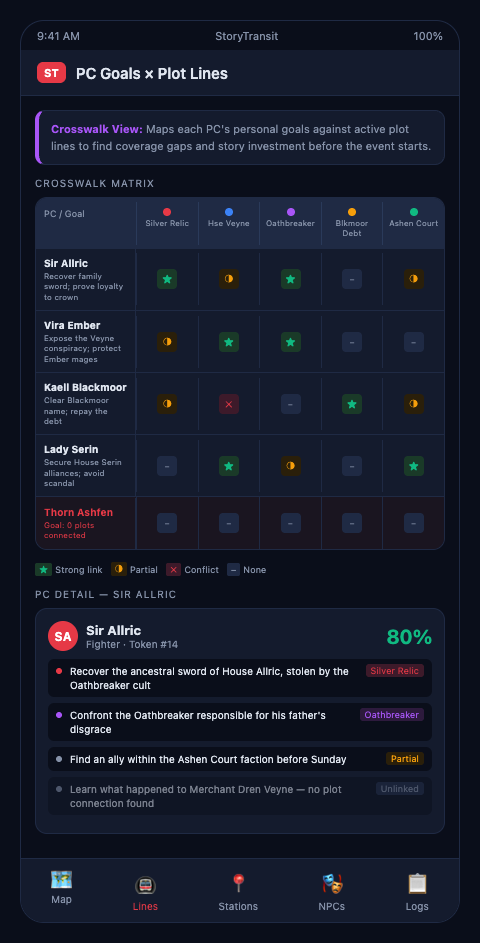
PC goals fit into this model as scheduled express routes. When a character wants to expose corruption, that goal is a train. The question becomes: which station does it board at, and which existing lines does it cross?
Mapping the routes before the event means your runners are not discovering goal-plot intersections in real time — they have already built the connectors. Every station record in StoryTransit can carry a field called "active PC goals" that lists which character objectives are served by that beat. When the beat fires, the runner knows whose personal story arc is in play, not just which faction is involved.
Here is the practical pre-event workflow for goal-plot alignment:
Step 1 — Collect PC goals before the event. Send every player a brief intake form. Two fields: primary ambition and secondary ambition. Keep answers to two or three sentences each. You are not asking for essays — you are looking for named nouns, factions, objects, relationships that you can map to your transit grid.
Step 2 — Categorize by plot-line affinity. Group PC goals beside the named event lines. Some goals will map cleanly: a character who wants to infiltrate a noble house slots straight into the Political Succession Line. Others will be orphaned — no existing line serves their destination. Flag those separately. They represent either new micro-stops you need to add or re-routing opportunities you can build into NPC briefings.
Step 3 — Build goal-to-station connectors. For each mapped PC goal, identify one station on an existing line where that goal becomes active. The character hunting the relic? They enter the Relic Line at the station where the first fragment is found. Design one NPC encounter at that station that addresses both the event beat and the character's personal stake. This is parallel plot weaving done architecturally rather than by improvisation.
Step 4 — Handle orphaned goals with transfer stops. A goal with no natural line affinity does not have to be abandoned. Introduce a single NPC — a costumed volunteer briefed on the character's objective — who provides a connection to a real plot thread. Think of this as a transfer station: the character boards a new line they did not know was running. Emergence, Iteration, and Reincorporation in Larp
This process turns parallel plot weaving from an accident into architecture. It also feeds your backstory weaving live documentation, where character histories attach to active station records rather than sitting in a separate file no runner reads during the event. For organizers still building their first multi-plot LARP, the overhead of pre-event intake feels heavy — but even collecting goals from 40% of players generates enough mapping data to prevent the most common goal-plot collisions.
Advanced Tactics for Mid-Event PC Integration
The pre-event intake handles predictable misalignments. Runtime is messier. Players abandon stated goals, form unexpected alliances, and pivot to ambitions that only emerge from in-game events. You cannot plan for all of it — you can design a system that absorbs it.
Station tagging for spontaneous routing. Before the event, tag every station on every line with goal archetypes it can serve: revenge, rescue, exposure, possession, alliance. When a runner notices a player pursuing an uncharted goal mid-event, they look up nearby open stations and radio a costumed volunteer to become a live connector.
Dormant stops for character-driven reactivation. Not every station needs to fire on schedule. Build two or three dormant stations into each line — beats that only activate if a PC goal intersects with them. A buried subplot about a hidden lineage sits dormant until a character with the matching backstory arrives in that area of the venue. This is the transit equivalent of a mothballed route: infrastructure exists, passengers appear, service resumes. Bleed: The Spillover Between Player and Character
Live goal tracking in the plot dashboard. Run a status column in StoryTransit for PC goal routes alongside your event beats. Mark each goal-route as active, on-hold, or resolved. When a runner radios in that a character achieved their objective, log it. This matters at the end of the weekend when you are doing story reconciliation and trying to account for which arcs reached meaningful endings.
Delegation by goal cluster. If you have multiple runners on a large event, assign each runner a cluster of PC goals that share plot-line affinity. The runner handling the Relic Line also monitors all characters whose goals intersect it. They become the traffic controller for that transit corridor. Live Action Role-Playing Games (ResearchGate)
Post-beat goal status updates. After each major story beat fires, check which PC goal routes were served by that station and update their status in the plot dashboard. A goal that was "active" might move to "partially resolved" — the character got useful information but has not reached their objective yet. A goal that was "active" might move to "abandoned" if the player redirected mid-event. Tracking this in real time prevents the end-of-weekend scramble where runners try to reconstruct which character arcs closed and which were left hanging.
The character arcs mapping approach used by episodic storytellers — tracking how individual arcs relate to multi-episode narrative infrastructure — translates directly to the LARP context. A season's character arc and a weekend's goal-route follow the same structural logic. The primary difference is that LARP goal routes are updated in real time rather than in post-production, and the organizer can actively redirect them while the story is still running rather than editing around gaps after the fact.
Build Your Routes Before Setup Day
LARP event organizers who integrate PC goals into parallel plot weaving before the weekend begins report fewer "dead zone" complaints from players and fewer scramble moments for runners. The payoff is not that your weekend goes exactly as planned. It is that when it doesn't, you have a transit map that shows you where the next stop is.
The pre-event timeline matters here. Goal-to-station connectors built two weeks out give you time to revise NPC briefs, adjust station sequencing, and add a transfer stop for any goal that doesn't fit cleanly onto an existing line. Goal routes built the night before setup day are connectors in name only—there is no time to brief the relevant volunteers, and runners discover the orphaned goals the same way players do: at runtime, when nothing connects. Treat the goal-route mapping as part of your station map work, not as an addendum to character sheet delivery. If intake forms go out thirty days before the event, the goal mapping can be done with three weeks still on the clock.
StoryTransit gives LARP organizers a shared dashboard where goal routes live beside event lines, dormant stops are visible to every runner, and status updates flow in real time rather than through radio telephone. If you are running weekend-long live-action events with dozens of parallel plotlines, join the waitlist for LARP organizers and get early access before your next event weekend.