Expert Methods for Weaving Player Backstories Into Live Plots
The Backstory Gap
Players write backstories. Organizers file them. Events run. Players spend the weekend hoping their character's history will surface—and mostly it doesn't.
The Brandes Stoddard analysis of backstory engagement documents this directly: 58% of LARP players report their submitted backstory never appeared in live plot. That's more than half your attendees playing a character whose pre-event investment went nowhere. The downstream effect is predictable—lower satisfaction scores, reduced return rates, and a community reputation that your events don't reward player investment in character history.
The failure isn't usually negligence. Organizers read the backstories. They have good intentions and sometimes genuine enthusiasm for the hooks players have created. The problem is structural: backstory hooks live in individual player files while plot assignments live in a separate system, and there's no mechanism that connects them during runtime. A costumed volunteer running an NPC in Zone 4 has no way to know that three players in that zone have backstory hooks directly relevant to the faction they're playing. The connection that should produce a memorable live plot personalization moment simply never fires.
Research on immersion in LARP by Sarah Lynne Bowman confirms what organizers observe anecdotally: immersion deepens significantly when character history is woven into shared narrative. When a player's past appears in the game world—when an NPC references their character's history, when a story beat they didn't expect turns out to be directly about them—the feeling of being genuinely present in the world intensifies. Live plot personalization isn't a premium add-on for boutique events. It's a core engagement mechanic for any backstory-driven event that wants players to feel invested in more than just their combat sheet.
The LARP market reached $1.4B in 2024, with character-driven backstory integration commanding premium pricing in boutique events. The market is already pricing in backstory integration as a value differentiator. Events that deliver on it charge more and retain players better than ones that treat character histories as optional flavor text.
The Transit Approach to Backstory Integration
Treating backstory hooks as dormant transit stops is the most operationally useful framing for large events. Every player who submits a backstory has introduced one or more potential story beats into your event's network. Those beats are waiting to be activated—but they'll remain dormant stops unless you build the activation mechanism into your plot system before runtime.
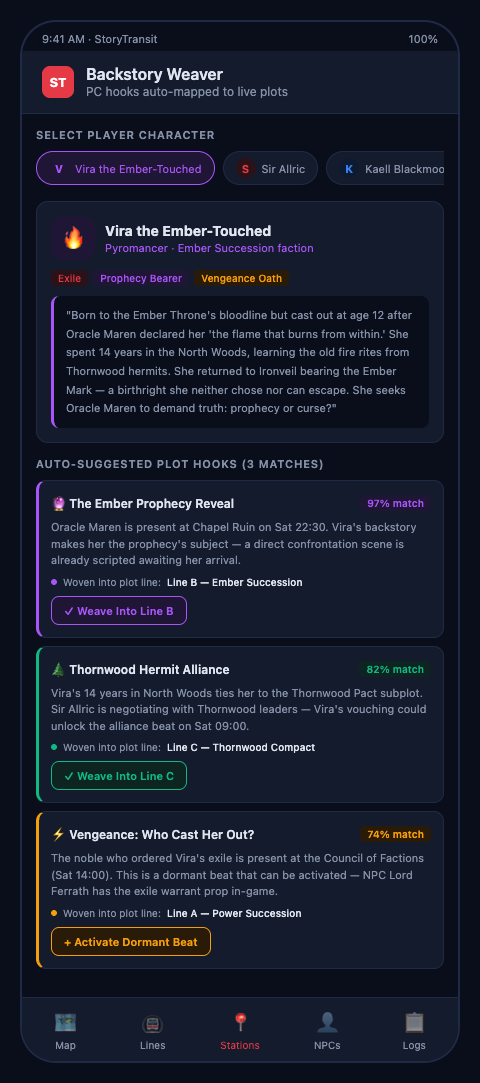
In the StoryTransit model, backstory hooks map onto the character arc layer of the transit network. A character's history becomes a route with defined entry points into the main storyline. Organizers designate which existing plot stations can activate a given backstory hook, and which NPCs are responsible for delivering that activation when the right player enters the zone.
This approach transforms backstory weaving from an art form requiring perfect organizer memory into a logistics problem with a clear, systematic solution. Each backstory hook has a trigger condition, a zone assignment, and an NPC responsibility. The plot dashboard shows which character arcs have been activated and which remain dormant. Before Saturday evening, the radio dispatcher can see which players still haven't had their backstory touched and redirect costumed volunteers to ensure coverage before the weekend closes.
Kanka's character entity system illustrates the technical side of this: when plot staff can search and filter player characters by backstory element, faction affiliation, or character hook, they can cross-reference those histories against active zone assignments in seconds rather than hours of manual review. The backstory becomes a searchable asset rather than a buried document.
LarpManager's character progression tracking extends this logic across multi-event campaigns: when a character's backstory hook was first activated, how it developed across events, when it reached resolution—all documented and queryable when planning the next event's plot structure.
Expert Methods for Backstory Weaving
The hook extraction template. Don't accept freeform backstory submissions and hope to find the relevant hooks buried in five pages of character history. Give players a structured template with three required fields: the central unresolved conflict from their character's past, one person from their history they expect or fear might appear at this event, and one secret their character is protecting. This three-item structure gives plot staff the specific, deployable hooks they need without requiring them to parse lengthy narrative documents. Players who want to submit longer backstories can still do so, but the three-item template is the operational input for plot planning.
Anchor hooks to existing plot stations. Before the event, spend twenty minutes per character mapping each submitted hook against your existing story beats and physical plot stations. Identify two or three stations where a given character's history could naturally surface. Assign an NPC at each of those stations to know the hook and have a prepared activation line. This investment—roughly twenty minutes per player backstory—is the operational price of running a backstory-driven event that actually delivers. At thirty players, that's ten hours of prep. At sixty players, it's twenty. Build this time into your event prep schedule rather than treating it as optional.
Tiered backstory activation. Not all backstory hooks should activate in the first session block. Designate early hooks (should activate in hours one through four, while players are still orienting), mid-event hooks (should activate in hours five through eight, when character relationships are established and players are ready for deeper engagement), and late-event hooks (designed for climactic moments in the final session block). This prevents backstory overload in early sessions while ensuring every character history gets at least one moment before the weekend ends.
The NPC briefing card system. Every costumed volunteer running an NPC should receive a card listing the backstory hooks relevant to their character. When a player enters their zone, the NPC scans the card for relevant history and activates the appropriate line. This card system is the operational link between the pre-event backstory files and the live event runtime—the mechanism that converts good intentions into actual live plot personalization. Without the card, the connection depends entirely on whether the plot runner remembered to brief the NPC directly. With the card, it's self-contained.
What Happens When Backstory Integration Scales
The methods above work at events up to about sixty players. Above that threshold, individual character attention starts to compress. Organizers with eighty or more registered players can't run a twenty-minute backstory mapping session for every character. They need a triage system.
Backstory triage at scale means identifying the twenty to thirty percent of player characters whose backstory hooks are highest-priority for plot integration—typically faction leaders, characters with long attendance histories, and characters whose hooks intersect with major planned story beats. These characters receive the full hook extraction and mapping treatment. The remaining characters receive a lighter-touch integration: their backstory is reviewed for any elements that intersect with existing plot stations, and a single activation opportunity is designed for each.
This tiered approach isn't ideal—every player deserves full backstory integration. But it's honest about what's achievable at scale, and it delivers a substantially better outcome than making no systematic effort at all. Characters who receive light-touch integration still have at least one moment where their history matters. Characters who receive no integration are the 58% that Stoddard's research documents.
Tracking Backstory Integration in Real Time
A backstory hook that was designed in pre-event prep is only valuable if it fires during the weekend. The final piece of the expert backstory weaving system is runtime tracking: a mechanism for monitoring which player backstories have been activated and which remain dormant as the event progresses.
In the StoryTransit transit model, each backstory hook is a dormant stop on the character arc transit line. The plot dashboard shows its status: pending, activated, or resolved. When Saturday afternoon arrives and the dashboard shows twelve character backstories still marked pending, the radio dispatcher has actionable information: which characters need attention, which plot zones contain the relevant NPCs, and which costumed volunteers are available to deliver activation moments in the remaining session blocks.
Without runtime tracking, backstory follow-through depends entirely on plot runners remembering which characters haven't had their history touched—an unreliable mechanism at any scale above thirty players. With runtime tracking, the backstory coverage gap is visible, measurable, and addressable before the weekend ends.
Backstory integration tracked across multiple events also builds a significant long-term asset. When a player returns for their fourth event and their character's history has been consistently woven into the live plot at each event, that player is one of your most valuable community assets—deeply invested, highly likely to return, and likely to recruit new players through their enthusiasm.
Integrating backstory with PC goals requires a system that can hold both simultaneously—the post on PC goal integration covers how to weave personal character objectives into parallel plotlines so that backstory activation and goal progression reinforce each other. The specific challenge of scheduling costumed volunteers to serve backstory activation moments across a multi-day event is addressed in the NPC schedules festival post. For a cross-format perspective on how character histories function as structural elements in other narrative systems, backstory transit lines explores the same concept mapped to tabletop campaign design.
The effects of character customization on intrinsic motivation in roleplay have been studied in MMORPG contexts with directly applicable findings: when players feel that their character customization choices—including backstory—affect their experience, intrinsic motivation and long-term engagement both increase significantly. LARP backstory integration is the live-action equivalent of that mechanic.
StoryTransit gives LARP event organizers the tools to make backstory-driven events a consistent operational reality rather than an aspirational goal. The character arc layer of the transit dashboard tracks which player histories have been activated and which remain dormant stops in real time. Join the Waitlist for LARP Organizers and bring live plot personalization to every player at your next weekend event.