Mapping Player Backstories as Transit Lines on Your Campaign Map
Why Backstories Stay Buried in Your Notes
A player spends three hours writing a rich origin for their half-elf bard — estranged from a merchant family in Brenhorn Village, carrying a cursed lute that once belonged to a rival bard who vanished under suspicious circumstances. You read it, nod appreciatively, and file it away. Forty sessions later, the bard's player still hasn't seen a single Brenhorn reference. That backstory is now a broken promise.
According to Geek & Sundry's guide to backstory integration, backstory hooks create instant player engagement and personal investment in campaign events — but only when the DM actively deploys them. The challenge isn't motivation; it's architecture. Most DMs store backstories in character sheets or session notes without linking them to the places, factions, and subplots they could naturally intersect.
DMDavid's analysis of backstory use in campaigns adds a crucial constraint: the character's core belongs to the player, so DM backstory use must preserve player authorship while still weaving those threads through the world. You're not writing their story for them — you're building a world that responds to who they already are.
Research into how humans remember narratives reinforces the cost of ignoring this. A large-scale PMC study on narrative memory found that causal connectedness is the strongest predictor of what audiences recall across sessions. When backstory elements connect causally to current plot events, players remember both more vividly. Disconnected backstory is invisible backstory.
The homebrew D&D dungeon master prep problem isn't effort — it's structure. You need a framework that makes player backstory integration and homebrew narrative weaving a natural part of campaign design, not an afterthought. Treating D&D character arcs as first-class story objects — mapped alongside the main plot threads, not filed separately in a character sheet — is what separates campaigns where backstory pays off from campaigns where it quietly disappears.
The Transit Line Framework for Backstory Mapping
Think of your campaign as a city transit system. The main story arc is your central subway line — the one that runs through every major station. But a real transit system has multiple lines that branch, cross, and feed into each other. Player backstories are those branch lines.
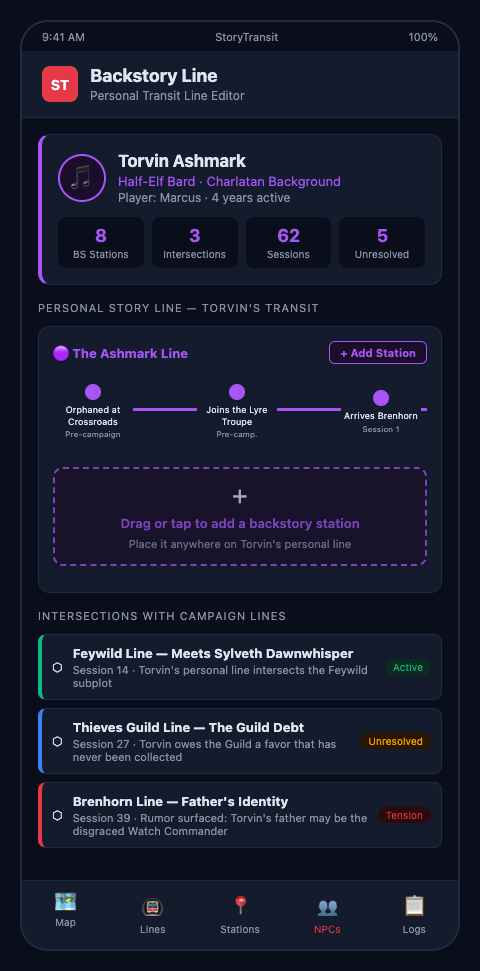
Each character gets their own transit line. The line starts at the backstory origin point — Brenhorn Village, the ruined temple, the mercenary company that betrayed them — and runs forward through time toward the present. Every significant backstory element becomes a station on that line: the cursed lute, the missing rival, the estranged family.
The critical move is plotting where those backstory lines intersect with your main campaign map. If the party is heading toward a merchant guild conspiracy, and your bard's family runs a merchant operation in Brenhorn, that's an intersection point. A new station appears on both lines simultaneously. Neither the main plot nor the backstory drives that scene — the intersection does.
This approach also handles what the transit metaphor calls dormant stops. Many backstory stations won't become active for dozens of sessions. The curse on the bard's lute might sit dormant for 30 sessions before the party stumbles across the rival's fate in a completely unrelated dungeon. That's not failure — that's a dormant stop reactivating. The system knew it was there the whole time.
For parallel party splits, the transit framework scales naturally. Each split group carries a subset of the active backstory lines, and those lines continue accruing new stations even when that character is off-screen. When the party reunites, you have documented which backstory threads advanced in their absence and which are ready for a payoff.
Weaving many NPCs into backstory lines is where this framework earns its value. Rather than tracking NPCs in isolation, you assign each significant NPC to one or more backstory transit lines. The bard's estranged father isn't just "a merchant" — he's a node on the bard's family line, with edges connecting to the merchant guild conspiracy line and the Brenhorn regional politics line.
StoryTransit maps this structure visually, letting you see at a glance which backstory lines are dormant, which are approaching an intersection, and which are overdue for a station event.
Building Your Backstory Transit Map
Start with a single session of backstory transit mapping and audit. Pull every character's background and extract discrete elements: named locations, named NPCs, unresolved conflicts, open questions, and emotional wounds. Each element becomes a potential station. Dungeon master prep that includes explicit backstory line review before each session is what keeps these threads from disappearing into the same folder where character sheets go after Session Zero.
Then sort those stations into three categories. Active stations are elements currently relevant to the ongoing campaign — the bard's rival bard is relevant now because the party is investigating a disappearance. Dormant stations are elements with clear payoff potential but no current hook. Buried stations are elements you haven't found a natural intersection point for yet.
Set a rule: every five sessions, at least one dormant station must reactivate. This creates a predictable pressure to consult your backstory map and find intersection points before prep, not after.
Document intersection points as you find them. When the party heads toward Brenhorn Village, that's an intersection alert for the bard's family line. Note it before the session. Decide whether to activate it now or let it be a background detail that seeds a future payoff.
Track station history in your backstory transit map. Don't just mark what's active — record when each station was first introduced, when it was first activated, and how many sessions elapsed between the two. This history tells you your average dormancy window, which is a useful calibration tool. If you consistently let backstory threads sit dormant for 30+ sessions, you're creating an unreasonably large gap between player investment and world response. Aim for no more than 15 sessions of dormancy before any backstory station gets at least a minor activation — even something as small as a name dropped in passing dialogue.
The TTRPG market data supports investing this effort: the global TTRPG market reached $2.3 billion in 2024, with backstory integration features cited as a driver of weekly player retention. Players who see their character histories reflected in the world stay at the table longer and engage more deeply with every session. Backstory transit mapping is player retention work as much as it is narrative craft.
Advanced Tactics for Backstory Transit Mapping
Cross-character intersections. The most powerful moments happen when two player backstory lines intersect each other before either connects to the main plot. The bard's missing rival turns out to be the fighter's estranged mentor. Neither player knew this at character creation — you built it by looking at both transit lines side by side and finding a station that could belong to both.
The cognitive map research in Nature Neuroscience explains why this works so well for player memory: hippocampal cognitive maps support navigation of abstract relational structures, not just physical space. Players who have built mental maps of their character's relationships will immediately recognize and remember a cross-character connection.
Foreshadowing receipts. For each backstory station you activate, log the session number and the specific trigger that woke it up. Session 87, Brenhorn Village, innkeeper mentions a lute maker who went missing three years ago — that's your foreshadowing payoff receipt for the bard's rival thread. These receipts let you measure how long threads stay dormant and whether you're over-indexing on some backstories while neglecting others.
Backstory line velocity. Some backstory lines move fast — they keep intersecting with current events and building toward a natural climax. Others stall. If a backstory line hasn't had a new station in 15 sessions, that's a flag. Either schedule an intersection or acknowledge the thread is becoming a dead end and retire it gracefully. Retiring a line isn't failure; it's narrative hygiene.
Player backstory weaving across different formats. For DMs who also run events or tabletop adjacent experiences, player backstory weaving in LARP contexts offers a different perspective on the same challenge — how do you honor character histories in real time, without the ability to prep intersections in advance?
LegendKeeper and Obsidian both support visual interlinking of campaign notes for tracking character-to-world connections, and either tool can hold a backstory transit map if you tag entries consistently. The tool matters less than the discipline of mapping intersections before they happen rather than reacting when they're missed.
StoryTransit takes this further by treating backstory lines as first-class objects in your campaign's transit system — giving each one a color, a status, and a list of upcoming intersection opportunities based on where your main plot is heading.
Start Mapping Today
Most homebrew DMs have five to seven unactivated backstory threads sitting in folders right now. They're not forgotten — they're dormant stops on lines that haven't been mapped yet. Plot those lines before your next session, mark three upcoming intersections with current events, and watch how quickly player investment spikes when their half-elf bard finally hears their rival's name spoken aloud in a tavern they had no reason to visit.
StoryTransit is built specifically for homebrew D&D dungeon masters who are tired of backstories that disappear into prep notes. Join the waitlist to be first to map your characters' arcs as the transit lines they've always been.