Best Practices for Managing Parallel Party Splits in Long Campaigns
The Split That Broke Session 47
At Session 47, the party split into two groups after a catastrophic argument over whether to evacuate Brenhorn Village or push forward to the lich's sanctum. Two players took the evacuation route. Three pushed on. The DM ran it confidently — but by Session 52, the evacuation group's subplot had accumulated five unresolved threads, a rotating cast of NPCs, and a faction decision that contradicted something the other group had agreed to in Session 49. The campaign almost collapsed.
Parallel party splits feel manageable in the first session. They become a documentation emergency by session four. The cognitive load of maintaining two separate information states — what each group knows, what each group has decided, what each group's NPCs have committed to — is beyond what a single DM can hold without external structure. This isn't a skill problem; it's a capacity problem. The DM who built no split tracking system before Session 47 is now building one in crisis mode, while also running two simultaneous storylines, while also managing player expectations about when the groups will reunite.
EN World's analysis of campaign longevity confirms that most campaigns end early, and complexity from splits is a leading contributor to group attrition. When a DM loses track of two parallel threads, prep time doubles, inconsistencies multiply, and players in one group feel their storyline matters less than the other. That perception — even if wrong — poisons sessions.
The cognitive science here is unambiguous. A PMC study on the working memory costs of multitasking found that simultaneous task tracking creates a processing bottleneck — attention to Task 2 waits until Task 1 resolves. When you're running split narratives, your brain isn't actually processing both in parallel; it's switching rapidly between them and paying a cognitive cost at every transition. External systems aren't a luxury here; they're how you avoid the bottleneck entirely.
Parallel vs. linear storylines boost player agency and create memorable campaign moments — but only when the DM has the tools to keep both threads consistent. Without those tools, parallel splits become the leading cause of homebrew campaign implosion.
The Transit System Approach to Split Narrative Management
A city transit system runs multiple lines simultaneously. The Red Line and the Blue Line share some stations and diverge completely at others. Trains on different lines don't interfere with each other — they run on separate tracks, on separate schedules, and meet only at designated transfer stations.
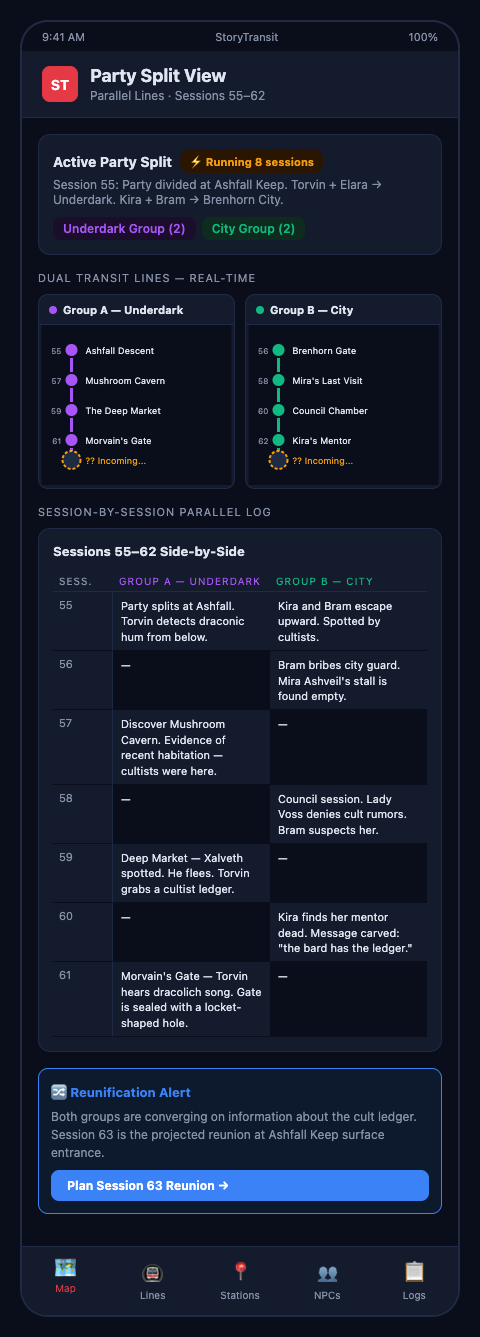
Parallel party splits work the same way. Each split group runs on its own line. Group A's line tracks their route, their NPC continuity, their subplot status, and their information state — what they know vs. what they don't. Group B's line does the same. Those lines exist independently until the party reconvenes at a transfer station.
The key insight is that each line needs its own documentation discipline. For Group A, maintain a live subplot tracker: active threads, dormant stops, pending NPC decisions. Do the same for Group B. Never merge these documents during the split, even if you know the two threads will converge. Merging too early causes exactly the kind of contamination that led to Session 52's contradiction problem above.
Multiple parties in a shared homebrew world face the most complex version of this challenge — not just one split within one campaign, but entirely different adventuring groups operating simultaneously in the same world with different information states. The transit line metaphor scales to that scenario because each group is simply another line on the same map.
For DMs who also manage the chaos of west marches threads, parallel party splits are a permanent structural feature rather than an occasional dramatic choice. West Marches games run multiple rotating groups through the same world, making the split narrative documentation discipline mission-critical from Session 1.
World Anvil's campaign manager supports multi-party tracking with interlinked NPC, location, and session records, which is one practical way to maintain separation between split group states.
StoryTransit treats each split group as a distinct transit line with its own station log, its own dormant stops, and its own transfer schedule back to the main line.
Building Your Parallel Split Tracking System
Before any split happens, set up your documentation infrastructure. Create a split-group log template with four fields: current location, active subplots, NPC states, and information held. Run the template for both groups from the moment of the split.
During split sessions, run one group at a time rather than alternating every 20 minutes. Rapid alternation maximizes cognitive switching costs and minimizes narrative depth. Run Group A for a full session, then Group B for a full session, then reconvene when the in-game timelines align.
Assign a subplot priority tier to each thread in each group's tracker. Tier 1 subplots must be advanced or resolved this session. Tier 2 subplots should be touched. Tier 3 subplots are dormant stops that stay on the map but don't require attention. This prevents the common failure mode where one group's split session becomes a sprawling mess of every pending thread.
Campaign Mastery's analysis of the Levitz approach recommends ranking plots by focus tier and promoting a secondary plot when the main one resolves. That principle maps directly to split group management: when one group's Tier 1 subplot resolves, promote a Tier 2 thread immediately so momentum doesn't stall.
Collaborative note-taking research from Springer Nature shows that sharing documentation tasks across group members reduces individual cognitive load while improving collective recall. For split party management, this principle suggests distributing the record-keeping — one player in each group writes a brief expedition log after each split session, capturing their group's information state from their perspective. The DM reconciles both logs against the ground-truth operations document. This cross-checking frequently catches inconsistencies before they become session-to-session contradictions.
Decide your split group session cadence before the split begins, not during it. Running Group A for three consecutive sessions before switching to Group B creates large in-game time disparities that are difficult to reconcile. Alternating groups every session keeps the timelines synchronized and makes the transfer station reunion easier to choreograph. The long campaign management best practice is equal session distribution between split groups wherever the in-game timeline allows.
One additional prep requirement before any split: write each group's information state explicitly. What does Group A know that Group B doesn't? What does Group B suspect that Group A hasn't considered? These asymmetries are narrative assets — they create the dramatic irony that makes reunion scenes powerful. But only if you've documented them. Without a written record of each group's knowledge state at the point of the split, those asymmetries collapse into confusion when players who remember different things start contradicting each other at the reunion table.
Finally, set a hard cap on split duration. Splits that extend beyond six to eight sessions lose narrative momentum regardless of how well-documented they are. Players in the off-screen group start missing the table, engagement drops, and the reunion session faces the challenge of re-energizing two groups who have diverged significantly in attachment to their separate storylines. D&D party tracking works best when the split has a visible endpoint — a known convergence trigger that both groups are working toward, even if they don't know the other group is moving toward the same point.
Advanced Tactics for Long Campaign Splits
Information asymmetry tracking. The most valuable data in a split narrative is what each group doesn't know. Group A discovered that the merchant guild is behind the attacks on Brenhorn Village — but Group B is still operating on the assumption that local bandits are responsible. That asymmetry is a storytelling asset. Track it explicitly in each group's information-held field, and protect it until the party reconvenes.
NPC continuity across groups. NPCs who interact with both groups during a split are the highest continuity risk. If the innkeeper in Brenhorn meets Group A on Monday (in-game) and Group B on Thursday, their behavior in both encounters must be consistent with a single person's actual knowledge and agenda. Maintain a separate NPC continuity sheet that tracks every NPC's last known state, last interaction, and any commitments made.
Transfer station preparation. The moment of party reunion is a dramatic peak — but only if you've prepared it. Build the transfer station before either group arrives. Know what each group brings to the reunification: what they've learned, what they've lost, what decisions they've made that the other group will have to live with. Reunion sessions fall flat when the DM improvises this moment rather than designing it.
Podcast producers who track active arcs across long-form actual play shows face the same parallel narrative problem. The difference is that in actual play, listeners can't ask questions — so the asymmetry between what different characters know must be carefully managed for audience comprehension. The discipline is identical to split party management.
The dungeon master best practices for split narratives all reduce to a single principle: treat each thread as a complete, independent story that happens to share a world with the others. The transit system does the work of keeping those lines from crossing where they shouldn't.
Stop Running Splits from Memory
Parallel party splits are where long campaigns either earn their complexity or collapse under it. The DMs who make them work aren't running more sessions — they're running better-documented ones. Build your split tracking system before you need it, maintain separate state for each group, and use a transfer station protocol to turn reunion sessions into the dramatic peaks they should be.
The pre-split documentation setup is the most overlooked part of the process. Before the party walks through the door they're about to argue about, spend ten minutes writing the split-group log template for both groups: current location, active subplots (list the three you expect each group to engage with), NPC states for any character both groups have contact with, and the information each side holds that the other doesn't. That last field — the asymmetric knowledge log — is the one that pays off most dramatically at the reunion. Write it before the split, not after, because once the sessions begin you'll be running two narratives simultaneously and won't have the bandwidth to reconstruct what each group knew at the starting point.
StoryTransit's split narrative tools were built specifically for homebrew D&D dungeon masters managing the documentation complexity of long-running campaigns. Join the waitlist and stop losing threads the moment your party argues over which door to take.