Integrating IC and OOC Threads in Your PbP Story Map
Why IC and OOC Contamination Kills Your Story Map
Open a typical forum game that's been running six months and you'll find it: plot-critical exposition buried in an OOC thread, a retcon debate in the IC post thread, a player asking about initiative rules three pages after the poisoning arc's first clue. Separating IC and OOC is the single most important structural decision in any PbP setup, according to veteran forum GMs — yet most campaigns drift toward contamination within the first month.
The problem isn't that GMs don't know IC and OOC should stay separate — even beginner pbp guides cover it. It's that the separation breaks down silently. A player types "((quick OOC: can I attempt the perception check here?))" directly into an IC post. You answer in-thread. Another player picks up the double-bracket convention and starts using it for all coordination. Six months later, your IC archive is 40% logistics noise. Research on online forum behavior confirms that mixing communication channels raises cognitive load and disrupts narrative coherence in collaborative threads.
The downstream effect on your pbp story map is severe. When you try to reconstruct the slow-burn poisoning arc from April — eighty IC posts across six threads — you're sifting through bracket clutter to find actual in-character continuity. Plot beats that should be visible at a glance are buried under scheduling conversations and rules questions.
Blurring the IC/OOC line is the #1 source of player conflict in collaborative online roleplay, and it compounds: once players normalize mixed threads, metagaming follows. Characters start behaving on OOC information because it was never clearly partitioned.
The Transit System Approach to Thread Integration
StoryTransit models your forum game as a city transit network. In that metaphor, IC threads are your passenger lines — the routes that carry story. OOC threads are the maintenance tunnels: necessary infrastructure, never visible to riders. This structural map complements the intermediate forum GM toolkit — the toolkit gives you thread-level tactics like templates and tagging conventions, and the transit map gives those tactics a campaign-level organization to hang on.
The structural rule is strict: IC threads carry only character voice and narrative action. OOC threads carry everything else — scheduling, rules questions, player check-ins, retcons. The two never merge.
Here's how to apply that separation to your pbp story map:
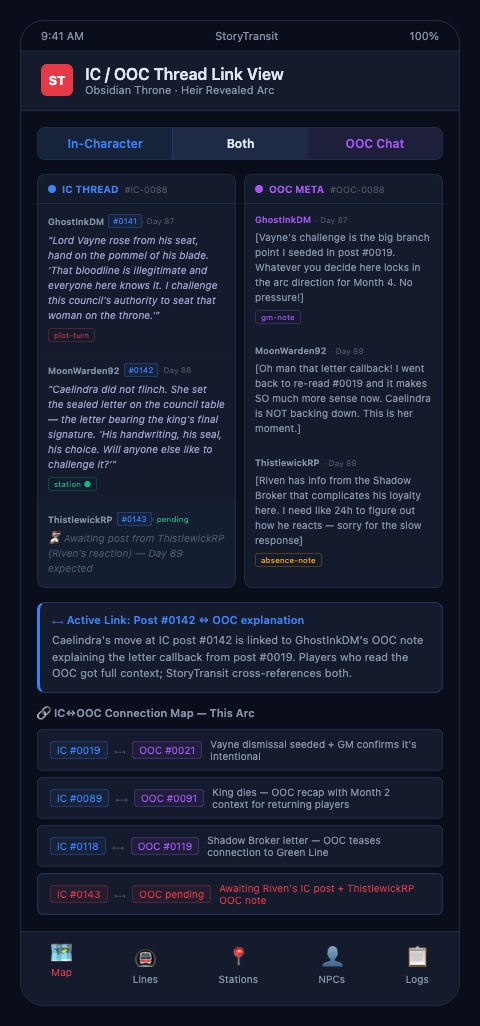
Station tagging across thread types. Every major story beat — a duel, a revelation, a faction meeting — gets tagged as a station on both the IC route and the OOC maintenance log. Your IC post records the narrative event. Your OOC thread records the mechanical decisions that produced it. StoryTransit links these as parallel records of the same station, so you can read either layer without contaminating the other.
Color-coded route lines. Assign each major plot thread a route color. The Merchant Quarter betrayal arc is the Red Line. The political marriage subplot is the Blue Line. When you post to IC, you tag the post to its route. When you post to OOC, you tag the ruling to the same route. Cross-referenced by color, you can reconstruct either the narrative arc or the mechanical history of any subplot — even on page fourteen of an archived subforum.
Dormant stop protocol. When a subplot goes quiet — a character disappears, a faction stops appearing — mark it as a dormant stop rather than closing the line. Your OOC thread records the last mechanical state. Your IC thread records the last narrative beat. Both are preserved. When you're ready to reactivate, you know exactly where to re-board.
Synchronization posts. At the start of each new IC scene, drop a brief OOC synchronization note: which story beats carried over from the last scene, which player characters are present, which unresolved threads are in play. This is the forum GM equivalent of a transit system's real-time status board — players who missed a session get oriented in one post rather than scrolling through archive pagination.
Advanced Tactics for the Long-Running Forum Game
Once your IC/OOC separation is structurally sound, the harder challenge is maintenance across platform resets. Forums auto-prune, threads get locked, pagination splits long scenes across multiple pages. The transit map you built at campaign start will lose stops to archive decay unless you actively preserve them.
Build an OOC archive index thread. Its only job is to list every closed IC thread with its story-map tag, the date it closed, and a link to the last plot state. When a host auto-prunes threads older than a year, you've already captured the narrative record in the index. You can rebuild the IC route from the index without touching the pruned content.
For session notes integration across campaign types, the same approach applies — if you run a podcast alongside your forum game, you'll find the thread structure described in session notes integration for podcast producers maps directly to IC/OOC separation for forum GMs.
Beyond the three-month mark, that structural discipline stops being optional — without concrete thread templates, post tagging conventions, and wiki structures, even well-intentioned GMs drift back toward mixed threads as campaign complexity compounds.
Tracking separation also prevents a specific failure mode that hits GMs running multiple pbp games simultaneously: when you're managing separate parallel campaigns, IC/OOC discipline in each keeps campaign content from bleeding across games. The play-by-post forum workflow collapses fastest when OOC logistics from one game start contaminating the IC posts of another.
Retroactive cleanup is harder than it sounds. If your campaign has already drifted into contamination, the instinct is to do a bulk audit — find every bracket comment, every rules discussion embedded in IC, and move it to OOC. This rarely works at scale. After six months, the contamination is structural: the IC archive has been read and responded to in its mixed state, and players have built their mental model of the story around that mixed record. A better approach is a prospective cutoff: announce clearly in OOC that starting from a specific date, all logistics discussions move to OOC and bracket conventions are retired. Then enforce it consistently. Players adapt quickly when the expectation is clear and the GM models it themselves.
Why the separation matters most at scene transitions. The moments where IC and OOC contamination is most damaging are scene openings and closings — exactly the moments where the in-character out-of-character boundary should be sharpest. When a new scene opens with an OOC scheduling question embedded in the first IC post, you've undermined the dramatic momentum before it starts. When a scene closes with rules clarifications tangled in the final IC post, the narrative beat that should register as meaningful is buried in logistics. StoryTransit's synchronization post model addresses this directly: every scene transition gets a clean OOC station marker, separate from the IC post that closes or opens the scene.
What players actually need from OOC. The play-by-post forum workflow succeeds when players treat OOC as a functional partner to IC, not as its inferior. A well-maintained OOC thread should contain: session logistics (scheduling, absences, post frequency), rules clarifications, character check-ins, and GM announcements. Each of these belongs in OOC for the same reason it belongs there — it's coordination infrastructure, not story. Players who understand this distinction post to OOC without prompting, because they recognize it as the tool that keeps IC clean enough to read.
One tactic that scales well: a thread manifest. A single pinned OOC post that lists every active IC thread by arc name, current station, and last active date. Players check the manifest before posting rather than scrolling through pagination. GMs update it after each major scene closes. It takes five minutes per update and prevents hours of archive archaeology.
Get Your Forum Story Map Out of the Archives
If you've been running a PbP forum game for more than three months, your IC/OOC separation has probably eroded in at least two places. The threads are still there — but the map of what actually happened is scattered across mixed archives and buried bracket conversations.
The thread manifest is the fastest single tool to implement from this post: a pinned OOC post listing every active IC thread by arc name, current station, and last active date. Creating it for an existing campaign takes about 20 minutes — open your IC threads, identify the last meaningful plot beat in each, and record it. That pass often surfaces a dormant stop you'd forgotten about: an arc that last moved three months ago and has been sitting without acknowledgment while you ran other threads. Prospectively, the manifest takes five minutes to update after each scene closes, which keeps it useful as a navigation tool rather than an outdated reference that players learn to ignore. A forum game where players can check one post to orient themselves before posting is a forum game where players actually post consistently.
StoryTransit gives play-by-post forum GMs a structured way to rebuild that map: tag IC beats and OOC rulings to the same story stations, preserve dormant stops before they're pruned, and maintain a navigable record of every plot thread regardless of how deep the pagination goes. Join the waitlist for play-by-post GMs to see how the transit-system model applies to your forum game's specific structure.