Integrating Session Notes With Your Podcast Story Map
When Session Notes and Story Maps Live in Separate Worlds
A GM wraps a five-hour session, fires off a text dump of raw notes, and assumes the production team has what they need. The editor gets the recording and a Notion link. The producer gets a shared Google Doc that hasn't been touched since episode three. By the time post-production begins, nobody is certain which threads from this session were callbacks to something established in episode seven and which were entirely new.
This breakdown is not a failure of effort — it's a failure of structure. Roleplay Tips describes session notes as memory aids for GMs tracking NPCs, plot threads, and campaign facts. The problem is that those aids are written for the GM's memory, not for a producer's workflow. When a show reaches 20 or 30 episodes, session notes written for one person become noise for everyone else. The post-production workflow — which runs separately, sometimes days later — needs a structured handoff, not a brain dump.
Sly Flourish's Lazy DM framework recommends capturing only what can't be remembered. That's fine advice for a GM running a home game. For a podcast story map tied to a published episode feed, the threshold is different: if it's on the recording, it needs to be documented. The editor can't reconstruct narrative intent from audio alone, and the producer can't rebuild context from a bullet-point list that was written at midnight after a long session.
The gap between session and post-production is also a time gap. When editing begins three or four days after recording, the GM's specific intentions for any given scene have already started to blur. The note that says "cursed compass — big deal later" doesn't specify whether "later" means next episode or season three. That ambiguity, multiplied across twenty active threads, creates the kind of production confusion that causes editors to make cuts they'll regret and producers to spend hours reconstructing context that should have been documented at source.
The Transit Handoff: Notes as Inbound Trains
StoryTransit maps your podcast's narrative the way a city maps its transit system. Plot threads are lines. Story beats are stations. Character arcs are routes. Session notes are the inbound trains — they arrive loaded with new passengers and have to be processed at the depot before they can connect to the broader network.
The integration workflow has three stages.
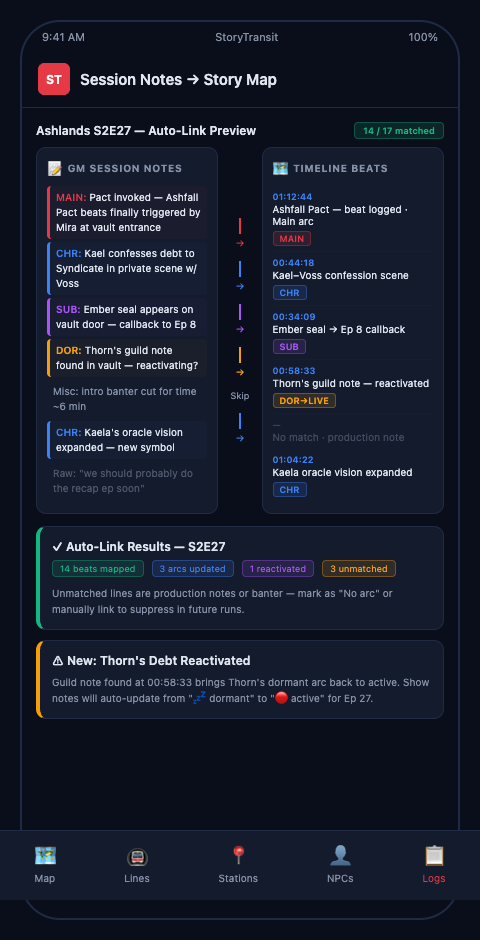
Stage 1: Triage at the depot. Before a single audio file goes to the editor, run the session notes through a classification pass. Sort raw GM notes into three bins: new threads (stations not yet on any line), updates to existing threads (new stops on an established route), and dormant thread activations (stops that were built but hadn't seen traffic). This triage step takes fifteen minutes but eliminates the most common source of editor confusion — not knowing whether a scene is a callback or a new arc launch.
This triage pass requires someone who knows the current story map. For small teams, that's the producer. For larger operations where the producer isn't in every session, this might be a dedicated story coordinator who reviews both the session notes and the current StoryTransit map state before classifying the incoming material. The point is that triage is a distinct step — not folded into the edit, not left to the editor to figure out, but completed before the audio changes hands.
Stage 2: Station mapping. Once classified, each note item gets placed on the StoryTransit map. A new thread becomes a new line with a provisional terminus. An update to Lord Thadderon's arc becomes a new stop added to an existing route. A dormant stop — say, the cursed compass mentioned in episode four and untouched since — gets reactivated with the current episode's context attached. Buzzsprout's show notes guide notes that timestamped key moments help listeners navigate episodes. The same logic applies internally: producers need anchored context, not floating references.
Station mapping also catches inconsistencies that would otherwise go unnoticed. If the session notes reference Kaelith's vow from episode nine but the producer's map shows that arc as resolved at episode twelve, there's a discrepancy that needs to be addressed before post-production begins — either the arc wasn't fully resolved, or the GM is referencing the wrong thread. Catching this during station mapping is far less costly than catching it after the episode is edited and nearly published.
Stage 3: Pre-edit handoff packet. The editor receives a one-page handoff document derived from the updated map, not from the raw session notes. That document lists which lines are active, which stations appear in this episode, and which threads are flagged as unresolved. The editor no longer has to decode GM shorthand — they have a structured brief that connects the raw recording to the larger story system.
The handoff packet is also a permission structure. It tells the editor which scenes are load-bearing (cannot be cut without producer sign-off) and which are freely editable based on runtime needs. An editor who knows which moments are flagged as dormant thread activations can protect those moments proactively, without having to interrupt their workflow to check with the producer on every borderline cut.
Building the Integration Habit
The hardest part of this workflow is not the tool — it's the timing. Session notes are most useful when they're processed within 24 hours of recording, before the GM's memory of intent fades. Successful podcasters maintain systematic episode documentation workflows, and the producers who do this consistently treat note processing as part of the session, not an afterthought before post. For teams building their first actual play map, the first actual play map guide establishes the station-mapping conventions that the integration workflow populates from session notes.
Practical tactics for actual play podcast producers:
Use a shared note template. Give the GM a structured form: one column for new threads, one for existing thread updates, one for dormant activations. Free-form notes are fine for a solo game, but a podcast with an editor, a producer, and a post-production schedule needs structured input. Otter.ai can auto-transcribe session audio and generate summaries, which can seed that template when the GM doesn't have time to write detailed notes. Even a rough transcript gives the producer something to cross-reference during triage.
Build a session-to-station log. For each episode in your back catalog, maintain a one-line entry per thread: what happened, which station it maps to, and whether the thread is live, dormant, or resolved. This becomes your reference layer when mid-series listeners ask "wait, wasn't the cursed compass a bigger deal?" and you need to trace when it was last activated. The session-to-station log is also the foundation of any recap episode or show notes summary — structured episode documentation is reusable content infrastructure.
Flag pre-edit vs. post-edit thread status. Mark each thread's status before the edit and update it after. Audio post-production workflows require structured documentation at every handoff stage. If a scene that carried a dormant thread activation gets cut for runtime, that thread needs to be re-flagged as still dormant — not silently treated as resolved. This post-edit reconciliation closes the loop and keeps the story map accurate as the canonical reference for future sessions.
Schedule the triage window. The biggest reason teams skip the integration workflow is that it doesn't have a scheduled time in the production calendar. Put the triage and station mapping step on the calendar as a fixed block, the day after recording. Twenty minutes at a scheduled time is more likely to happen than an open-ended task that competes with editing, publishing, and the next session prep.
As your operation grows, these integration habits feed directly into your producer editing toolkit — which relies on clean thread data to make structural edit decisions confidently. Producers running hybrid formats may also find parallels in how IC OOC integration works across play-by-post systems, where the same separation between in-fiction and out-of-fiction documentation creates similar handoff challenges.
Making the Handoff Stick
The session notes integration problem is ultimately a trust problem. Editors don't trust raw GM notes because they're written for someone else. GMs don't write structured notes because nobody showed them how it connects to post-production. The story map is the bridge.
When your podcast story map is the canonical reference — the system both the GM and the editor look at — session notes stop being a dumping ground and start being a structured input. Archivist AI auto-captures D&D session notes, quest tracking, and campaign history from recordings, which shows where the industry is heading: automated ingestion into a structured map. Until that pipeline is fully automated for your show, the triage-map-handoff workflow described here closes the gap.
Trust also has a practical production benefit: fewer revision cycles. When the editor has complete context before the cut, they make better first-pass decisions. When the GM knows their session notes will be processed into a structured handoff, they invest more care in documenting intent. When the producer has a current story map to reference, they can approve or flag scenes quickly rather than chasing down context. Every link in that chain gets stronger when the session notes integration workflow is working.
StoryTransit is built around this integration loop. The episode documentation that enters your map as session notes becomes the spine of every editorial decision downstream — from cold open structure to show notes copy to the recap episode you'll eventually need to write. The post-production workflow that was fragmented across three different documents and two people's memories becomes a single, legible system.
Actual play podcast producers on the StoryTransit waitlist get early access to the session integration templates and the station-mapping reference guide. Join the Waitlist for Actual Play Producers to secure your spot before public launch.