Why Weekend-Long LARPs Need Story Transit Mapping
Why the Plot Bible Fails at Scale
Ask any experienced LARP event organizer how they tracked plot during their last weekend event. Most will describe something like an 80-page plot bible, a shared Google Doc, a whiteboard at the NPC staging area, and three runners with radios doing their best to relay which scenes are active.
That system works at thirty players. It starts cracking at one hundred. It fails at three hundred, and it collapses somewhere around the scale of events like Empire LARP, which runs 3,500 players with 400+ crew requiring simultaneous plot coordination across multiple active storylines—as documented in the Profound Decisions Wikipedia entry. The problem isn't effort. The problem is format. A linear document cannot represent a non-linear, parallel, multi-thread event structure.
The Nordic Larp Domino Effect describes how one popular storyline sweeps an event when there's no mechanism to balance attention across parallel threads. Once that happens, your carefully designed B-plots go dark. Your costumed volunteers for the secondary plotlines stand around waiting for player contact that never comes. Your sixty-acre venue has three hundred people all chasing the same story beat.
Story transit mapping addresses this by treating the event structure the same way a city transit authority treats its network: as a set of parallel lines that can be monitored, adjusted, and balanced from a single visual display.
What Story Transit Mapping Actually Is
The transit mapping concept applied to LARP event structure treats each parallel plotline as a named route with color-coded stations. Here's how that translates operationally for a weekend LARP:
Route definition. Before the event, you assign each parallel plotline a color and a station sequence. The red line is the werewolf faction arc. The blue line is the noble court intrigue. Each station on the line is a named story beat—a scene, a revelation, or a player decision point—in the order it's intended to occur.
Node naming. Each station gets a short, unambiguous name: "First Curse," "Council Betrayal," "Relic Found." These names appear on the map and in every NPC brief. When your radio dispatcher calls for an NPC to cover a scene, they call the station name, not a description.
Transfer stations. Where two plotlines intersect by design—a scene where the werewolf faction confronts the noble court—you mark an explicit transfer station. Both lines stop there. Players can move between arcs. NPCs serving both plotlines converge. This is not a coincidence at runtime; it's a designed node on the map.
Dormant stops. Any buried subplot or secondary storyline that isn't active at event start appears on the map as a greyed-out node. It has its activation conditions noted. When the conditions are met at runtime, the stop activates and the NPC assignment flows automatically.
Research on managing plot structure in character-based interactive narratives shows that drama management in multi-agent systems requires exactly this kind of explicit structural tracking to sustain complex branching narratives over time. The transit map format is the LARP organizer's version of that system.
Transit map schematic design principles confirm why this works visually: schematics simplify complex multi-route networks into intuitive structures that operators can read at a glance. Your dispatch station at a weekend LARP needs the same kind of at-a-glance clarity.
The Structural Advantages of Transit Mapping for LARP
When you switch from a plot bible to a plot station map, three things change in how you run the event.
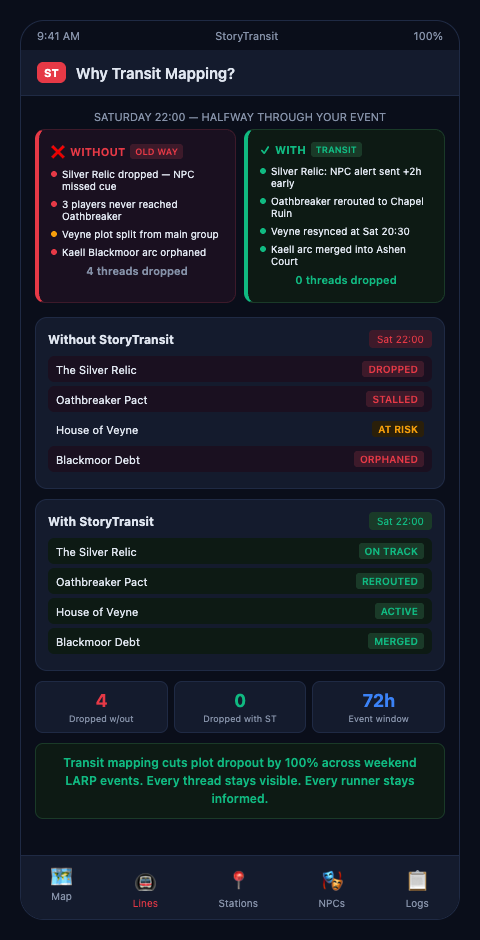
First, your runners have a shared reference. Every person with a radio is looking at the same map. When a station goes active, every runner sees it. When a station is at risk—the NPC isn't in position, or the players are four stations ahead of schedule—everyone with radio access can see that too. No more "I didn't know plot B was running" moments.
Second, your NPC dispatching becomes systematic. On any given evening of a weekend LARP, you have a finite number of costumed volunteers available at any hour. The transit map shows you which stations are scheduled in the next block, which NPCs are assigned to those stations, and which assignments are uncovered. You're staffing routes, not improvising.
Third, you have a runtime record. At the end of a weekend event, your map shows exactly which stations were completed, which were skipped, and which player groups never hit the story beats intended for them. That record is the foundation for your post-event review and your next event's design.
Scaling From Small Events to Large Ones
The transit map format scales cleanly with event size. For a chamber LARP with twenty players and three plotlines, your map has three lines and maybe thirty stations total. For a weekend-long multi-plot event with a hundred players and fifteen plotlines, you have fifteen lines and potentially two hundred stations.
The visual logic stays the same at both scales. What changes is the operational depth: at larger events, you need sub-maps for specific venues or time blocks, and your dispatch station needs dedicated map monitors rather than a single organizer checking in every thirty minutes.
Nordic LARP tradition, as documented in What is Nordic Larp?, emphasizes collaborative multi-thread storytelling as a core design value. The transit map format respects that: it makes all threads equally visible, which means all threads get equal operational attention. The design documentation imperative—described in Documentation of Larp Design—requires capturing the full event vision including all parallel storylines. The transit map is the format that makes that documentation runtime-usable rather than reference-only.
For organizers familiar with how campaign transit maps work in tabletop campaign management, the conceptual leap is small. The core logic—plot threads as lines, story beats as stations—applies directly to live events, with the added layer of physical venue mapping and real-time NPC dispatch.
Scheduling your 48-hour plot beats in transit map format is where the operational payoff becomes concrete: you can see at a glance whether your Saturday night climax has the right number of active lines converging.
The Dispatch Station in Transit Map Format
The transit map doesn't live only in the planning phase. During the event, it lives at the dispatch station—the table, the whiteboard, the screen where the organizer with the radio can see all active lines simultaneously.
At dispatch, the map performs a specific function: it answers the question "what should be happening right now?" at any moment during the event. When the werewolf NPC calls in and asks which player to curse next, the dispatcher looks at the red line, finds the active station, sees which player group is assigned to that station, and gives a direct answer. No improvisation. No radio silence while someone checks the plot bible.
The dispatch station version of the story map is deliberately simplified: station names, not full scene descriptions. NPC names, not full character briefs. Status indicators, not narrative notes. Everything narrative lives in the separate NPC briefs and scene documents. The map is the operational layer, not the storytelling layer.
Common Mistakes When Building the First Transit Map
The first story transit map that most LARP organizers build has two recurring problems: too many lines and no transfer stations. StoryTransit addresses both with a pre-event structure that caps active lines at a manageable count and flags missing transfer stations before event day—so the plot visualization your dispatch team depends on isn't overwhelmed with noise before the event even starts.
Too many lines happens when organizers map every subplot and secondary arc as an independent plotline. The result is a map with fifteen lines, most of which have only two or three stations, and no NPC coverage. A better approach: group related subplots into a single line with optional branch stations. The werewolf arc, the pack hierarchy dispute, and the curse ritual preparation are one line—the red line—with branching stations that activate depending on player choices.
No transfer stations happens when organizers build each plotline in isolation, then wonder why their event feels like separate concurrent games rather than a single coherent world. Transfer stations are not just scenes where different player groups happen to meet. They're designed collision points where the story logic of two arcs intersects and both lines advance. Every story transit map should have at least one transfer station per pair of major plotlines.
Building the Map Before Event Day
The transit map is most valuable when it's built before the event and updated in real time during it.
Start with your anchor plotlines—the two or three arcs that carry the majority of player investment. Map their full station sequences. Then add the secondary arcs, mark their transfer points with the anchor lines, and populate NPC assignments for each station. Narrative management at weekend LARP planning scale is not about controlling every scene—it is about maintaining enough visibility into the full system that you can intervene when a line goes cold or a transfer station gets congested.
When you step back and look at the full map before event day, you should be able to answer three questions: Which plotlines share transfer stations, and are those stations logistically feasible at the venue? Which NPC is covering each station, and does any NPC have a coverage gap or a double-booking? Which player groups have a clear path through at least three stations of their primary plotline?
If any of those questions returns a "not sure," the map needs another pass before event day. That uncertainty is the pre-event equivalent of a runtime emergency—catch it now.
The LARP Events market, valued at $1.42B in 2024 and growing at 9.3% CAGR, reflects an industry where event quality increasingly drives repeat attendance. Organizers who can run coherent parallel plotlines across a full weekend are the ones building loyal player communities.
StoryTransit is purpose-built for LARP event organizers managing parallel plotlines across weekend live-action events. If your current system is a plot bible and a prayer, the waitlist is open—join to get early access before your next event weekend.