How to Map a Multi-Year D&D Campaign Like a Transit System
The Problem with Managing 200 Hours of Campaign History
At Session 87 of a long-running homebrew campaign, a player pulled out a note from 47 sessions ago: a half-elf bard in Brenhorn Village had promised to deliver a message to the thieves' guild. Nothing had ever happened with it. The DM had three seconds to decide whether the guild had received the message, and what consequence that had on the current arc. Whatever the answer, one thread in a web of dozens had just frayed.
This is the defining pressure of D&D continuity management for any dungeon master running a serious homebrew worldbuilding project: each session adds new threads faster than the prior ones get resolved. The campaign transit map is the tool that makes the difference between a DM who can see every thread and one who can only guess.
This is not an unusual failure. According to a 2016 survey by SlyFlourish, 55% of DMs run personal campaign settings and the majority run continuing campaigns every week — which means they are personally responsible for maintaining every established fact, dormant subplot, and NPC relationship across sessions that can span years. The cognitive load is real: research published in PLOS ONE found that people forget roughly 70% of new information within 24 hours without active retention strategies. A DM running weekly sessions accumulates new material faster than unaided memory can hold.
The TTRPG hobby has grown sharply. Industry data shows 42 million active players worldwide and the market valued at $2.3B in 2026, with D&D interest up 85% since 2020. More DMs are running longer, more ambitious homebrew worlds than ever — and more are hitting the same wall: the campaign outgrows any single human's ability to track it without a system.
The conventional answer is a campaign wiki, a folder of session notes, or an ever-expanding spreadsheet. These work up to a point. But they share a structural flaw — they store information without revealing the shape of the story. A list of NPCs doesn't show you which subplots are dormant. A folder of session notes doesn't tell you which plot station has been waiting 12 sessions for a train to arrive.
Treating Your Campaign as a Transit Network
Harry Beck designed the London Underground map in 1933 by doing something counterintuitive: he stripped out geographic accuracy entirely. The result was 850,000 copies printed in two months because riders didn't need to know where the stations sat on a real map — they needed to know which lines connected, which direction to travel, and where to transfer. Beck's insight was that topology beats geography for navigating complex networks.
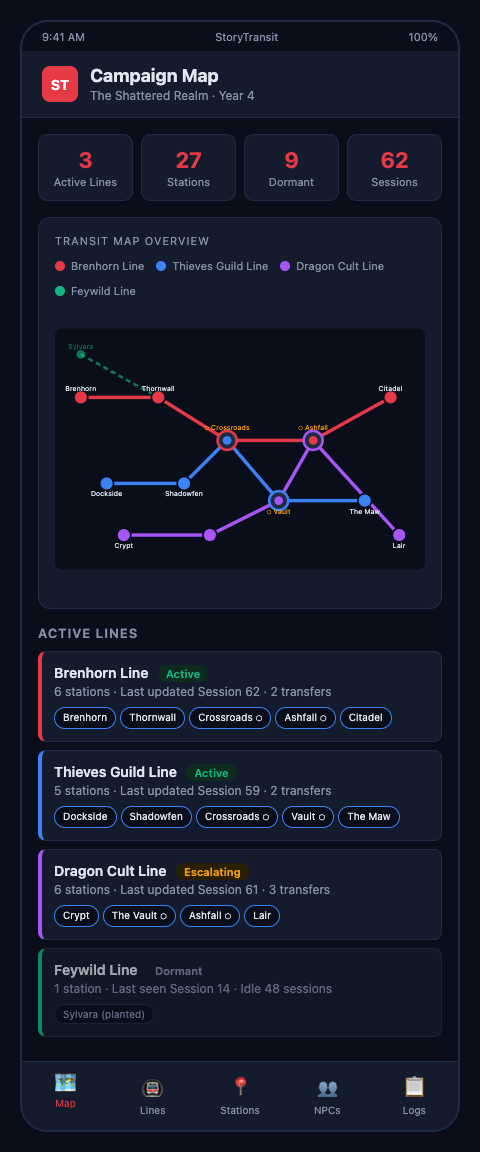
Your homebrew campaign has the same structure. The plot threads are transit lines. The story beats — the sessions where a thread becomes active, advances, or branches — are the stations along each line. A character arc is a route a specific NPC or player character travels across lines. And a dormant subplot is a station that has been built, named on the map, but hasn't had a train stop there in 40 sessions.
This is the core metaphor behind StoryTransit: applying transit-map logic to campaign continuity. Research on transit map design confirms that schematized maps improve comprehension of complex networks by reducing visual noise and surfacing topology. The same cognitive benefit applies to story structure. When you can see all your plot threads as lines on a map, with their stations labeled and their connections visible, you can immediately identify which threads are active, which are approaching a payoff station, and which have been sitting dormant long enough to need attention.
To build your first version of this map:
Step 1 — Identify your main lines. Pull out your existing notes and list every distinct plot thread that has been introduced in your campaign. A faction's political maneuver is a line. A player character's personal revenge quest is a line. The mystery of the cursed artifact found in Session 12 is a line. Name each line.
Step 2 — Place stations. For each line, identify the sessions where that thread had a moment of consequence — where it advanced, was referenced by a player, or produced a tangible story beat. Each of those sessions is a station on that line.
Step 3 — Mark dormant stops. Any station that was established but hasn't been visited in more than 10 sessions is a dormant stop. These are your buried subplots waiting to be reactivated. The promise to the Brenhorn Village thieves' guild is a dormant stop. The half-elf bard who made that promise is a character whose route has been suspended. Plot thread tracking at this level — marking exactly which threads are dormant and for how long — is the discipline that separates campaigns that honor their promises from campaigns that quietly forget them.
Step 4 — Map intersections. Where two plot threads converge — where a player character's arc crosses a faction's machinations, or where two subplots share an NPC — those are transfer stations. Transfer stations are your most valuable story real estate because they let you advance multiple lines simultaneously in a single session beat.
When you can see your first plot line map laid out this way, the shape of your campaign becomes legible in a way raw notes never allow.
Advanced Tactics for Long-Running Campaigns
Once your transit map is live, the real operational payoffs begin.
The dormant stop audit. Before each session, scan your map for any dormant stop that has been idle for 15+ sessions. A thread that was planted and never paid off isn't just a missed opportunity — it's a broken promise to your players. The audit forces you to either schedule a return visit or formally close the thread with a low-key resolution that doesn't require a full session arc.
The transfer station principle. When designing upcoming sessions, look for transfer stations — moments where two or more lines can intersect. If your players are heading into a political summit in the capital, check which plot threads involve any of the attending factions, NPCs, or locations. A single scene can advance three lines simultaneously when you've mapped the intersections.
Cross-campaign lore preservation. For DMs running campaigns in the same homebrew world across multiple years and parties, the transit map becomes your cross-campaign lore infrastructure. Backstory transit lines from one campaign become established stations in the next. The thieves' guild that received the Brenhorn Village message in Campaign 1 becomes a named faction with a known history that Campaign 2 players can encounter.
The foreshadowing payoff receipt. When you plant a story seed — a strange symbol on a temple wall, a merchant who knows too much — log it as a station on its line with a target payoff session range. This is what StoryTransit calls a foreshadowing payoff receipt: a documented promise with a planned delivery window. Without it, the seed either gets forgotten or pays off in a way that feels disconnected from the original plant.
Line retirement. Not every plot thread deserves to run indefinitely. When a line has reached a natural terminus — the faction was defeated, the arc resolved — close the line on your map with a resolution note. This keeps your active map uncluttered and prevents you from chasing subplots that your players have already moved past.
The parallels to actual transit operations run deeper than metaphor. Organizers of parallel LARP plotlines face the same topology problem: too many simultaneous threads, too many intersecting character routes, and the need to keep participants engaged across an event without any single thread being dropped.
The mistake most DMs make when they first build a campaign map is trying to document everything retroactively in one sitting. That produces a map so overwhelming it never gets used. Start with just the five most active threads from your last five sessions. Build the dormant stop list from memory, then cross-check against old session notes. The goal isn't a perfect archive — it's a working transit map that helps you run better sessions next week.
Getting Your Campaign on the Map
Homebrew D&D dungeon masters running multi-year campaigns have a tool problem that wikis and spreadsheets haven't solved: they need to see the shape of their story, not just store its contents. StoryTransit is building that tool specifically for this audience — dungeon masters with 200+ hours of campaign history who need to rescue every subplot their campaign ever promised.
The transit map approach works at any campaign stage, but it pays back fastest for DMs who are already mid-run. If you start at Session 1, you build the map as you go — one station per session, one line per thread. If you're starting at Session 60 with years of accumulated history, the first pass focuses on the five most active threads and the three most overdue dormant stops. You don't need a complete map before the approach becomes useful; you need a map that covers the threads your players are currently pulling on. That minimal starting point is where most DMs see the first concrete payoff: arriving at a session knowing exactly which dormant stops have been idle longest, and having a reactivation plan ready before anyone asks.
If you're running a multi-year homebrew and you've felt the moment where a player asks about a thread you dropped, StoryTransit was built for that exact moment. Join the waitlist for homebrew D&D DMs at StoryTransit and be first to access NPC continuity sheets, foreshadowing payoff receipts, and a full transit system of interconnected plot stations for your campaign.