How to Map Parallel LARP Plotlines Across a Weekend Event
The Problem With Twenty-Three Parallel Plotlines
You built the plot bible. Sixty-three pages covering the werewolf factions, the merchant conspiracy, the cursed relic, and fourteen other active storylines. Your NPCs have their briefs. Your runners have their radios. You've done everything right.
Then Saturday afternoon hits, and the werewolf plotline explodes. Every player on your sixty-acre venue wants a piece of it. Your costumed volunteer at the campfire is asking over the radio which player to curse next, but half the named characters are already three scenes deep into a different arc they weren't supposed to reach until Sunday morning. Meanwhile, plot B players walked past the bloodstain that was supposed to trigger the merchant conspiracy—and nobody noticed.
This is the standard failure mode for weekend LARP events running parallel plotlines. The Nordic Larp Wiki's entry on plot structure describes how different LARP traditions assign overlapping meanings to "plot," "sub-plot," and "storyline"—and that definitional ambiguity compounds in runtime. When you're managing twenty-three parallel plotlines across a multi-day event, the GM overview problem is structural, not personal. Live action role-playing game research on Wikipedia documents that LARP GMs "seldom have an overview of everything happening" when numerous participants interact simultaneously. That's not a planning failure. It's a visualization failure.
The answer isn't a longer plot bible. It's a different kind of map.
Story Mapping as a Transit System
The transit metaphor works because city transit systems solve exactly the problem you're facing: multiple routes, shared stops, finite crew, and passengers who don't follow the schedule.
In transit mapping, each route is a distinct line with a color, a set of named stops, and a sequence that runs regardless of what happens on adjacent lines. Routes share transfer stations—points where passengers (or players) can move between lines. Some stops are terminus points. Others are waypoints. Dormant stops exist on the map but only activate when conditions are met.
Apply that to a weekend LARP event and the structure snaps into place:
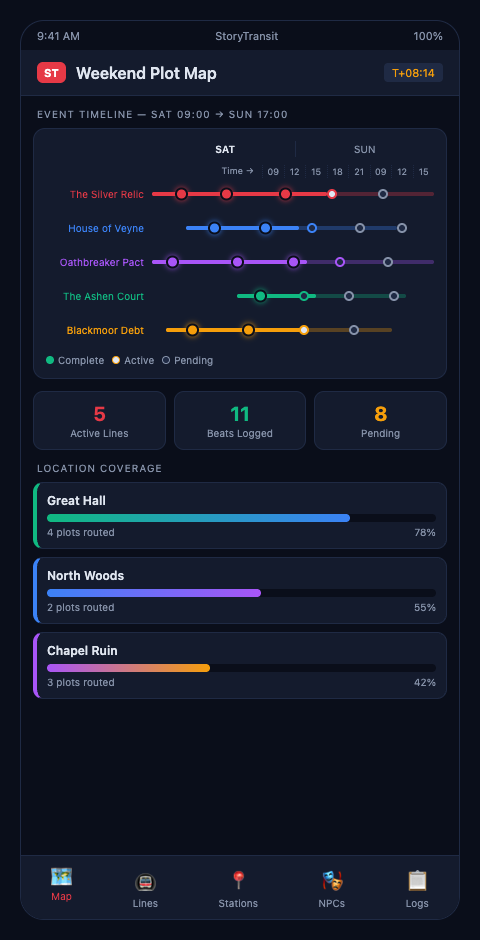
- Plot lines become transit lines. Each of your parallel LARP plotlines gets a color and a sequence. The werewolf arc is the red line. The merchant conspiracy is the blue line. The cursed relic is the gold line.
- Story beats become stations. Every scene, revelation, or NPC encounter that moves a plotline forward is a named stop on that line. "Player learns bloodstain identity" is a station. "Werewolf chooses its curse target" is a station.
- Character arcs become routes. Individual player characters travel along specific routes. A character in the merchant faction rides the blue line with possible transfers to the gold line. You can see exactly which stations they've passed through.
- Buried subplots become dormant stops. That secondary betrayal plotline you built but haven't introduced yet? It's on the map as a greyed-out station, waiting for activation conditions to be met.
Research on branching story graphs from Georgia Tech formalizes what LARP organizers already know intuitively: parallel narrative threads require explicit structural tracking or they collapse into a single dominant thread. The Nordic Larp Domino Effect article documents exactly this—one popular storyline sweeps an entire event when there's no system keeping the other lines running.
The transit map format solves that by making all lines equally visible. When you can see the red line dominating, you also see which blue-line and gold-line stations are going cold. StoryTransit builds on this exact logic: each parallel LARP plotline becomes a named transit line, each story beat a station, and the dashboard shows all lines simultaneously so a saturated arc never blinds you to the ones going dark.
What the Map Lets You Track in Real Time
A well-built story map for a weekend LARP event is not a static document. It's the runtime view your radio dispatcher uses to route NPC calls, reassign costumed volunteers, and flag which stations are overdue.
For each plot thread, the map shows:
- Which stations have been triggered (marked as active)
- Which stations are pending (scheduled but not yet reached)
- Which stations are at risk (the NPC isn't in position, or the players are in the wrong location)
- Transfer points where player groups from different arcs will converge
Transit map layout research shows that schematic design—simplifying complex multi-route networks into navigable visual structures—is what makes large transit systems usable at a glance. The same principle applies to story mapping. You don't need geographic accuracy. You need relational clarity: which stations are connected, in what sequence, and what are the transfer points.
For runner coordination across a large venue, this visual format reduces the radio call from "I need to find someone to run the bloodstain reveal" to "blue line, station four, assign the NPC from the campfire." Everyone is reading the same map. Plot thread tracking at a live-action roleplay of this scale only works when every runner shares the same visual reference—otherwise each person's mental model of the event diverges from the others by hour two.
Advanced Tactics for Multi-Day Events
Once your story map is built, the real runtime tools come from how you design the connection points between lines.
Transfer station design. Every weekend LARP event has moments where two plotlines collide—by design or by player initiative. Build these as explicit transfer stations on your map. When the werewolf arc and the merchant conspiracy need to intersect at Sunday's climax, mark that intersection as a mandatory shared station. Both lines stop there. If one line is running late, you know before the scene starts.
Line suspension protocols. When a dominant plotline is pulling all attention, you need a mechanism to pause it without killing it. In transit terms: express the dominant line past its next few stops and hold the others. In LARP terms: advance the werewolf plot to its next major reveal, then send the NPCs back to cover the stations the blue and gold lines need. Mark the suspended stations as delayed, not cancelled.
Dormant stop activation. The buried subplots on your map aren't filler—they're pressure release valves. If the primary plotlines are running hot and players are burning through stations faster than expected, you activate a dormant stop to extend the event. If players are slow, you skip dormant stops and tighten the sequence. Your transit mapping concept gives you that flexibility because you can see the whole system at once.
The Larp Design Glossary from Nordic Larp defines the core vocabulary—storyline, plot beat, NPC role—that makes this map legible to your entire organizer team. When your staff all share that vocabulary, the map becomes a communication tool, not just a planning document.
If you're familiar with how pbp plot threads are tracked across long-running forum games, the challenges are structurally similar: parallel threads, asynchronous participants, and no single view of what's active. The transit map approach scales to both formats.
The Map as a Communication Tool
Beyond runtime dispatch, the story map solves a communication problem that every multi-organizer LARP team faces. When three people are writing plot and two more are coordinating NPC schedules, everyone maintains a different mental model of which threads are active, which stations have been written, and which arcs need coverage. The map externalizes that mental model into a single shared artifact.
When a new runner joins your team two weeks before the event, you don't hand them the 80-page plot bible and hope they absorb it. You walk them through the map: here are the lines, here are the stations on each line, here are the NPCs assigned to each station. A runner who understands the map can function at the event. A runner who has only read the plot bible cannot.
For weekend events running across multiple sessions—Friday arrival, Saturday full day, Sunday close—the map also serves as the handoff document between organizers who are spelling each other. The Saturday morning organizer hands off to the Saturday night organizer with the map annotated: here's what fired, here's what's pending, here's what drifted. That handoff takes five minutes with a map and thirty minutes without one. Weekend event planning at this scale depends on a shared artifact that everyone reads the same way—and the transit map is that artifact.
Making the Map Legible to Your Whole Team
A story map that only makes sense to the lead organizer is a planning document. A story map that every runner, dispatcher, and NPC team lead can read at a glance is a runtime tool.
Making the map legible across your team requires three decisions before event day. First: standardize the station naming convention. Every station name should be short, unambiguous, and meaningful to someone who hasn't read the full plot bible. "Altar Reveal" works. "Scene 4a, Part 2 (alternate version)" does not.
Second: decide which information lives on the map versus in the supporting documents. The map shows routes, stations, NPC assignments, and transfer points. Character backstory, scene dialogue, and relationship history live in the separate briefs. If your map requires a key to decode its abbreviations, it has too much information on it.
Third: brief every runner and dispatcher on the map before event start. A fifteen-minute walkthrough—here are the lines, here are the stations in sequence, here are the transfer points, here's how to report status—is the investment that makes the runtime dispatch system function. Without it, runners are using the map they think they understand rather than the map as designed.
The Larp Census 2014 documents that weekend multi-day events are the primary format for a global community of 29,751 larpers. Organizers who invest in making their story maps legible to their full team are the ones running events that players travel to repeatedly.
Start With Three Lines
The mistake most first-time LARP organizers make is building the full map before the event and never updating it during runtime. The transit map is only useful if it reflects actual state.
Start with your three highest-traffic plotlines. Map their stations, mark their transfer points, and assign an NPC to each active station. Run the event with that map visible at your dispatch station. At every radio check-in, update the station status. By Sunday morning, you'll have a runtime record of which story beats landed, which ones were missed, and which player groups need a redirect to hit the climax you've planned.
StoryTransit is built specifically for LARP event organizers running this kind of parallel-plotline event. The waitlist is open for organizers managing weekend live-action events—join to get early access and shape the tooling around how your events actually run.