How to Run a Play-by-Post Game Without Losing Plot Threads
When Plot Threads Disappear Into the Archive
A slow-burn poisoning arc from April, seeded across eleven IC posts in the Merchant Quarter subforum, goes eleven real-world weeks silent. Not because you forgot it — you remember planting the clue — but because on the day you needed to reference it, it lived on page fourteen of an archived thread, buried under sixty-three subsequent posts. You searched. You scrolled. You gave up and retconned it as a rumor.
This is the defining failure mode of play-by-post campaigns. PbP games originated on 1980s university BBS networks and have hosted campaigns spanning hundreds of pages over years. Play-by-post role-playing game – Wikipedia documents the format's long history; what it doesn't capture is how many of those campaigns ended not with a dramatic finale but with a GM who lost the thread — literally. Research shows people forget roughly 70% of new information within 24 hours. Replication and Analysis of Ebbinghaus' Forgetting Curve – PMC confirms this forgetting curve flattens only with deliberate re-exposure. In a one-post-per-day pbp campaign, you never get that re-exposure organically.
The problem compounds as your forum archive grows. Pew Research: When Online Content Disappears found that 38% of links from 2013 no longer work at all. Forum threads don't just get hard to find — they get deleted. And a plot thread that exists only in an archived subforum your host auto-prunes after a year is already on a countdown clock.
Forum GMs managing parallel forum storylines across large groups face a version of this at every session boundary. The question is how to build a system that keeps every thread visible before it becomes invisible.
The Transit Map Model for PbP Plot Tracking
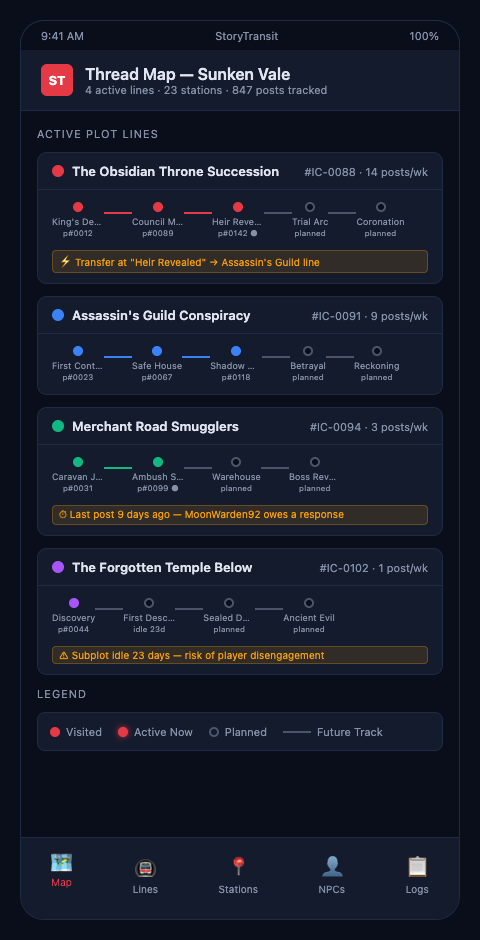
Think of your campaign as a city transit system. Every plot thread is a transit line. Every story beat — the moment the merchant's death got pinned on a guild member, the night the poisoning arc escalated — is a station on that line. Character arcs become routes that passengers (players) ride across multiple lines. And buried subplots are dormant stops: they exist on the map, they're officially part of the network, but no train currently runs through them.
This is the logic behind StoryTransit. Instead of storing your campaign in a flat OOC thread or a notes document that grows linearly, you represent it as a network. When you open the map, you see every active line (running threads), every dormant stop (subplots waiting for revival), and every transfer point (scenes where multiple arcs intersected). You can immediately spot when a line has had no station activity in eight weeks.
The transit metaphor works because it encodes both structure and status. A conventional story outline tells you what's planned. A transit map tells you what's active, what's paused, and what connects to what — exactly the information a forum GM needs at the start of a new IC post.
Neural substrates of narrative comprehension and memory – PMC shows that cognitive tracking of narrative rises steeply as character and event counts grow. At eighty in-character posts across six threads, no GM can hold the full picture in working memory. The story map offloads that cognitive work.
Practically, building this map means four things:
Assign every plot thread a line color and a clear label. The poisoning arc is the Red Line. The guild succession conflict is the Blue Line. Each gets named when you introduce it, not after it's gone cold.
Log story beats as stations with timestamps. Not summaries — just the beat and the IC post reference. "Red Line / Station 3: Apothecary hints at noble patron / Thread: Merchant Quarter #12, Post 47." The forum archive pagination number goes in the log.
Mark dormant stops explicitly. When a thread goes eight weeks without activity, it doesn't disappear from the map — it gets marked dormant. Dormant is not dead. It's a stop the train skipped.
Track transfer points. Any scene where two plot lines intersect is a node that affects both lines. The moment your poisoning arc and the guild succession arc crossed — that's a transfer station.
Advanced Thread Recovery Tactics
Once your map is running, you gain capabilities that flat documentation can't offer.
Cross-reference by character route. Every player character has a route — the sequence of plot lines they've touched. When you're writing today's IC post and want to reward a player who's been active on the Blue Line, check their route on the map. You'll see they brushed through the Red Line's Station 2 seven weeks ago. That gives you a clean IC hook to reactivate the dormant arc without it feeling arbitrary.
Use the gap as a narrative signal. Eleven real-world weeks of silence on a thread reads differently depending on how much in-game time passed. The transit map lets you annotate each dormant stop with both the real-world gap and the in-game time elapsed. A thread silent eleven weeks that represents three in-game days has a very different revival texture than one representing six in-game months.
Build a weekly status check. Before each new IC post, scan the map for any line that's had no new station in three or more weeks. That's your list for the week's OOC thread. Guide to PBP/PBEM – Roleplaying Tips notes that pbp games stall most often when a single player goes silent and takes a thread with them — the map surfaces that problem within days.
Maintain a revival queue. Some dormant stops are candidates for reactivation; others belong to story beats that have resolved. Keep a short list of threads that have dormant stops with clear revival conditions — specific player actions or in-game events that would logically restart them. This prevents treating all dormant threads as equally inactive.
The same spatial logic applies across campaign formats. When forum archive subplots accumulate over months, the difference between campaigns that survive and those that collapse is usually whether the GM built a structural check before it became urgent. GMs who prefer table-based play use a campaign transit map to manage continuity across multi-year arcs — the structural problem is identical, only the posting cadence differs.
Getting Started Before Your Next IC Post
The first version of your map doesn't need to be complete. Start with the two or three threads you know are active right now. Assign them line colors, write down the last station on each, and mark any thread that's gone more than three weeks without activity as dormant.
That first draft takes about thirty minutes. By your next IC post, you'll already know which dormant stop deserves a scheduled departure.
What the map tells you before you write. Opening your transit map before each IC post takes thirty seconds. You scan for: which line has the longest gap since its last station, which dormant stops have revival triggers that match something currently happening in an active thread, and which character route intersects the most dormant material. Those three data points change what you write. Instead of defaulting to whichever thread is freshest in memory, you're writing with awareness of the whole network.
When to expand the map. Your map should grow to reflect the campaign's actual complexity, not stay minimal. Once you have four or more active lines running simultaneously, add a "transfer station log" — a separate list of every point where two lines have crossed. Transfer stations are your most powerful revival tools: when a dormant line shares a transfer station with an active line, you can restart dormant service without introducing new narrative elements. The connection is already established in the fiction.
Quarterly review. Every three months, run a full map audit. Look for lines with no station activity in more than eight weeks. Evaluate whether each dormant stop still has a plausible revival trigger given where the campaign now stands. Some dormant stops will have been overtaken by events — the subplot they belonged to is no longer relevant, or the NPC at its center has been killed or resolved. Mark these closed. Closed is not the same as dormant. A closed stop is one you deliberately retired; a dormant stop is one you intend to reactivate.
The campaign transit map doesn't require sophisticated tooling to start. A spreadsheet, a text document, even a handwritten index card per line works as a first iteration. What matters is the discipline of maintaining it: one update per IC post that advances a thread, one scan per IC post you write.
StoryTransit is built specifically for play-by-post forum GMs who are tracking slow-burn arcs across months of thread pagination. If your pbp campaign is running on one-post-per-day cadence and you have more than four active subplots, you're already losing threads you don't know you've lost. Join the Waitlist for Play-by-Post GMs and get early access when StoryTransit opens — built for the forum GM's workflow, not the tabletop one.