Why PbP Players Forget Your NPCs (and What to Do About It)
The NPC Recall Problem in Forum Games
A player at a physical tabletop has multiple anchors for NPC recall: your voice, your body language, the miniature you placed, the location they're associated with. In a forum game, your NPC is a text description and a post history. Players encounter them once, across five IC posts, and then don't see them again for four weeks — the same memory-gap problem that hits players returning after a two-week posting gap, compounded over a longer window.
Character name recall drops significantly in long narratives. Readers summarize roles rather than retain specific identifiers — which means your players remember "the corrupt guard captain" but not "Captain Sereveth Aldric." They remember "someone owed us a favor" but not which faction or what the specific obligation was. When Aldric reappears in month three with the debt now payable, players don't know who they're reading.
Readers remember character goals and motivations more reliably than names or physical descriptions in long narratives. This is actually useful information: your NPC documentation should foreground motivation and goal over name and appearance. The player who forgot "Aldric" will recognize "the guard captain who's been skimming from the Merchant Guild and needs to make it disappear" — because that's what they encoded.
Episodic memory organizes characters by event, not name. Players who interacted with an NPC in the context of a specific scene will recall both better when you reference the scene. "The captain you bribed during the Ember Gate incident" retrieves both the character and the context, even when the name alone retrieves nothing.
The structural implication: PbP NPC documentation can't work the way tabletop NPC sheets work. A name, a stat block, and a physical description are the least memorable things about a forum game character. Including NPC entries in your dormant stops section — with motivation rather than name as the primary identifier — does more for NPC documentation than a standalone wiki entry ever will.
Building NPC Documentation That Works for Forum Games
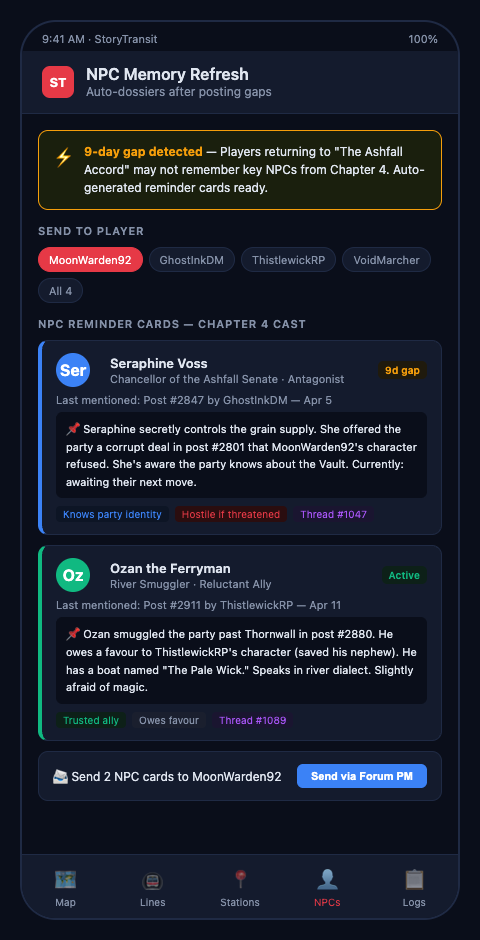
StoryTransit treats NPCs as stations on the story map, not as free-floating characters. Each NPC is anchored to the scenes where they appeared, the plot lines they're involved in, and the story obligations they carry. When players encounter them, the station reference brings context — not just the character.
Motivation-first entries. Every NPC entry in your documentation leads with what this character wants, what they're afraid of, and what they owe the player characters. Name and physical description come after. This mirrors how players actually encode characters: emotional resonance and player agency interactions are the strongest drivers of character memorability in games.
Scene cross-references. Log every IC thread where an NPC appeared, with a one-sentence summary of what happened in that scene. When an NPC returns, you can reference the scene directly in your IC post: "The same dockworker who warned you about the midnight shipment now stands at your door." Players retrieve the scene; the NPC comes with it.
Recurring detail cues. Pick one distinctive detail per NPC — a speech pattern, a physical habit, a specific phrase they use — and use it consistently every time they appear. Distinctive speech patterns and mannerisms anchor NPC identity in player memory more than backstory. The GM who writes "Aldric taps the table with his ring finger, twice, before speaking" every time Aldric appears is doing more for NPC recall than five lines of physical description.
Player-facing NPC reference. A shared document — pinned in OOC or maintained in a player wiki — that players can consult without asking you. Tools like LegendKeeper's NPC system with player-visible fields give forum GMs a shareable recurring-character reference that updates as NPCs evolve. Players who forget a name can look it up without interrupting the IC thread.
StoryTransit's NPC station records integrate these elements: motivation, scene history, recurring cue, and current story obligation. The documentation serves both GM reference and player recall rather than functioning as a private asset list.
Advanced Tactics: Structural NPC Recall Systems
Documentation alone doesn't fully solve the recall problem. Players who don't consult documentation still encounter NPCs without context. Two additional tactics close the gap.
Reintroduction hooks. Every time a named NPC reappears after more than two weeks of absence, your IC post includes one contextual anchor — a brief, natural reference to a previous scene. Not a recap: a hook. "Aldric doesn't look up from the ledger. He's still using the same quill you watched him snap in half during the Ember Gate interrogation." The player who remembers that scene now has Aldric's full context. The player who doesn't has a vivid detail to anchor the new encounter.
For new players joining mid-campaign, mid-campaign onboarding covers how to transfer NPC documentation and campaign history so new players arrive with working recall rather than building it from scratch through the forum archive. The same logic applies to returning players coming off a posting gap — they're not just missing NPC context, they're missing scene context too, and the reintroduction hook above is what re-anchors both at once.
For multi-cast NPC management in live events, NPC team communication addresses how LARP organizers maintain character consistency across a volunteer NPC team — a different format but the same underlying documentation challenge.
One forum-specific tactic: the NPC reappearance calendar. When you know an NPC will return in a future scene, schedule a brief player-facing mention of them in your OOC thread one week before. Not a story spoiler — just a reminder that this character exists and is about to be relevant. The one-week preview activates the player's existing memory rather than requiring them to reconstruct it from scratch at the moment of encounter.
NPC documentation density. In a long-running forum game, the number of named NPCs that have appeared in IC posts typically outpaces the GM's ability to maintain detailed documentation for each one. The practical solution is tiered documentation: a full entry (motivation, scene history, recurring cue, story obligation) for the eight to twelve NPCs who are currently active in storylines; a minimal entry (name, last appearance, one-sentence status) for NPCs who have appeared but are currently dormant; and no entry at all for background characters who had a single IC appearance with no story significance.
The threshold for promoting a minimal-entry NPC to a full entry is simple: the moment a player character has a meaningful interaction with them, or the moment you plan to make them plot-relevant. Until then, a one-line status record is sufficient. Over-documenting background NPCs creates maintenance overhead without corresponding retrieval benefit — the GM who has a detailed wiki entry for every tavern keeper in the campaign has spent time that would have been better used maintaining accurate documentation for the NPCs who actually matter.
The first-appearance hook. Player recall for NPCs is front-loaded: the strongest encoding happens at first encounter. Everything that happens in an NPC's introductory IC post will be better remembered than anything that happens in their fourth appearance, because the player's attention is highest when the character is new. This means your NPC's first IC post is the most important one for long-term recall — it should establish the motivation, demonstrate the distinctive detail, and connect the character to a plot thread the player already cares about, all in one post. An NPC introduction that delays those elements until the second or third appearance is fighting the memory curve rather than working with it.
Stop Letting Your NPCs Become Strangers
NPC documentation as an onboarding tool. The NPC quick reference document has a second function beyond serving existing players: it's the most valuable component of your mid-campaign onboarding package. A new player joining a campaign eighteen months in can't be expected to remember fifty NPC names and their complex interrelationships — but they can read a twenty-entry quick reference and have enough context to post without embarrassing themselves in the first session. The motivation-first format described above is especially useful here: a new player who knows "the corrupt guard captain who needs to make a problem disappear" can recognize and respond to that character appropriately even before they've read the IC threads where the character's history was established.
This dual-use design principle — documentation that serves both existing players and newcomers — is worth building in from the start rather than retrofitting when the first new player joins.
The NPC recall problem is structural, not attentional. Players aren't forgetting your forum game characters because they're disengaged — they're forgetting them because the format strips away the contextual anchors that drive human character memory. The documentation systems described here rebuild those anchors in the format's native medium.
StoryTransit gives play-by-post forum GMs NPC station records that cross-reference characters with their scenes, motivations, and story obligations — so every reappearance is a retrieval, not a reintroduction from scratch. Join the waitlist for play-by-post GMs to see how the NPC station model handles your campaign's recurring cast.