Communicating Plot Status to Your Volunteer NPC Team
What Happens When NPC Briefing Breaks Down
Your werewolf volunteer has been waiting at the campfire for forty minutes. They were briefed this morning that the players from Plot B would arrive, ask about the curse, and receive a specific piece of information that would activate the next story beat. It is now mid-afternoon. Four different player groups have stopped by. The volunteer has improvised four different versions of the scene because they had no way to know which group was "the Plot B players" or whether the beat had already been triggered by someone else.
Meanwhile, a runner two kilometers away made an adjustment to Plot B at noon. That branch update never reached the volunteer.
This is not an unusual scenario. Research on knowledge management in production environments documents that 38% of staff face excessive communication volume while simultaneously missing the specific updates they need — the classic symptom of a system that distributes noise rather than signal. Knowledge Management Strategies for Combatting Information Overload For LARP events, the consequence is not a missed email — it is a volunteer delivering the wrong scene to the players who arrived specifically to trigger a major story beat.
Undocumented larp designs cannot be replicated or properly briefed; without written records accessible during runtime, crew members operate from partial information. Documentation of Larp Design The fix is not sending more messages — it is building a single-source-of-truth plot status system that every costumed volunteer can query before entering a scene.
Think about the operational picture at a sixty-acre venue with twenty-three parallel plotlines and a volunteer NPC team spread across multiple camps and buildings. Your radio dispatcher is routing six NPC encounters simultaneously. Your runners are managing story beat activation across a dozen stations. In this environment, any information that travels only through human memory and verbal relay is information that will degrade before it arrives.
Good NPC team coordination is a production communication infrastructure problem, not a briefing quality problem. Your costumed volunteers may be excellent performers with strong improvisational instincts. But they cannot deliver accurate plot status updates to players if they do not have accurate plot status information themselves.
A Transit Model for NPC Team Coordination
StoryTransit models plot status the way a transit authority models service status. Every line has a current state — running normally, delayed, rerouted, terminated early. Every station has a status — open, visited, bypassed, closed. Volunteer NPCs are the rolling stock: they carry plot content from one station to the next, but only when the line tells them the platform is clear.
In this model, NPC briefing is not a one-time event at the top of the day. It is a continuous feed. Here is how to build it:
Create a plot status board accessible to all volunteers. Before the event, every station that involves an NPC gets a corresponding card in StoryTransit: what the NPC says or does, what triggers the scene, what state the scene should leave behind. Volunteers check the board before they go on shift, not just at the morning brief. This is the transit equivalent of checking the departure board — the information is current as of the last runner update, not as of 8 a.m.
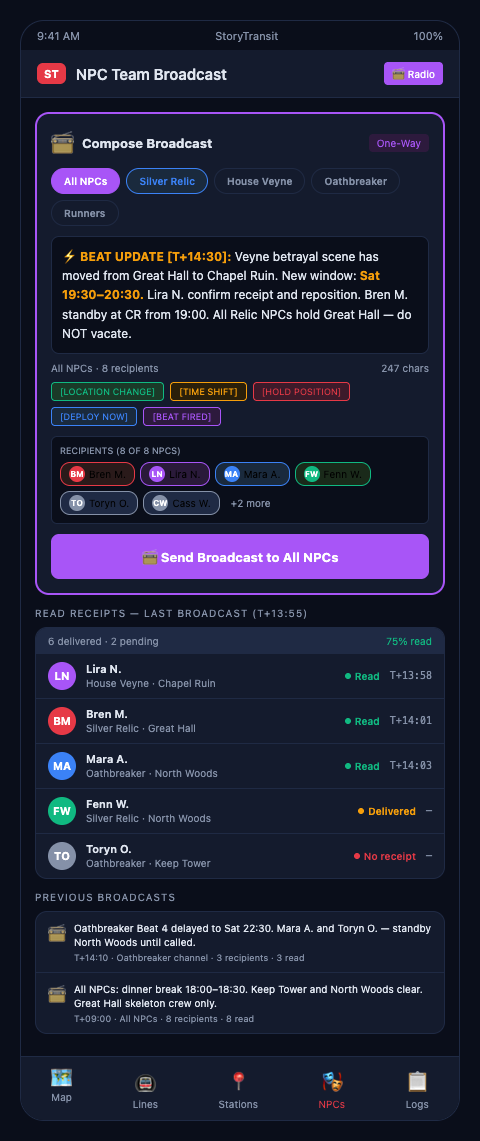
Establish a radio dispatch channel specifically for NPC updates. Separate from logistics radio and runner coordination radio, this channel carries only plot status updates to costumed volunteers in the field. Multi-Agency Command: ICS for Festivals When a story beat activates, fires, or gets bypassed, the radio dispatcher broadcasts a brief status call on this channel: "Plot B station three is live — werewolf scene is go." Every volunteer on Plot B hears it. Nobody else's channel gets cluttered.
Log every status update with a timestamp. Systems modeled on computer-aided dispatch log every communication with time and actor. Computer Aided Dispatch Systems – DHS TechNote In a LARP context, this means your StoryTransit dashboard records when each station status changed and which runner made the update. When a volunteer asks "is this scene still active?" the answer is in the log, not in a runner's memory.
Require written debriefs after each major scene. NPCs should provide a brief written debrief after each significant encounter — not an essay, just a two-sentence status update: what the players did, what information they received, what the NPC left as the scene outcome. Musings from Bristol #21: Briefing and Debriefing – RPGnet This debrief goes into the station record in StoryTransit, making the scene outcome visible to the entire runner team. The next volunteer to interact with the same players is not starting from zero.
For larger events where NPC management extends across multiple days, the foundational work of assigning NPCs to plots before the event is what makes runtime communication functional. An NPC who does not know which line they are running cannot receive plot status updates meaningfully. The communication system depends on the assignment system being solid first. You also need to think ahead about NPC schedules festival management for extended events, where shift rotations mean status updates must reach volunteers who were off-shift when key scenes fired.
Building a Volunteer NPC Communication Protocol
Good NPC briefing protocols share three properties: they are pre-written, they are layered, and they are updated in real time.
Pre-written means the volunteer never has to ask a runner for basic information. Their scene notes, character information, and plot triggers are documented and available before they go on. The CotV LARP NPC guide makes this explicit: NPCs must arrive early, read all character and plot information in advance, and debrief Plot after each scene. CotV LARP – NPC Guide This is a production communication standard, not a courtesy.
Layered means each volunteer receives only the plot status information relevant to their assigned line. A volunteer running a subplot in the eastern camp does not need full visibility into the northern keep intrigue. Give them a filtered view of their own stations and the adjacent stops that might affect them. Information overload produces the same failure mode as information scarcity: volunteers stop trusting the system and start improvising from memory.
In practice, this means building your NPC briefing documents at two levels. The full station record — available to runners and line leads — contains everything: triggers, contingency branches, post-scene status expectations, and cross-line dependencies. The volunteer brief is a condensed version that contains only what the volunteer needs to execute their scene. Keeping these as separate documents within StoryTransit ensures that volunteers are not accidentally briefed on plot information they are not supposed to carry — which protects both story integrity and the NPC's own immersion in their role.
Updated in real time means the status board is live during runtime, not frozen at morning brief. When runners bridge recording to post production in audio production, the equivalent of this problem is editors receiving outdated session notes. The parallel holds: a communication system that stops updating during the event is not a system — it is a snapshot.
A final practice worth building into your NPC briefing framework: the fifteen-minute sync window before each major story beat block. Gather all active volunteers, walk the current station status for their lines, confirm which scenes are queued, and update any branch notes from the previous block. This is the equivalent of a transit authority's service status call before the morning rush — brief, structured, and focused on changes since the last check.
The sync window also serves a secondary function: it is the moment when volunteers who experienced something unexpected in the previous block can flag it for the runner team. If a costumed volunteer encountered a player group doing something that did not match any of the scripted approaches, that observation needs to surface before the next beat block activates. A structured sync creates the space for that information to move from the field into the runner team's planning, rather than staying with the individual volunteer who encountered it.
Make Plot Status Visible Before Volunteers Go On
LARP event organizers who build structured NPC team communication protocols consistently report fewer improvised scenes, fewer status collisions between volunteers, and more story beats that fire as intended. The operational logic is simple: your costumed volunteers are executing the plot bible in real time across a sixty-acre venue, and every gap in their information is a gap in the story.
The visibility principle applies before the event as well as during it. Volunteers who can review their station records and current plot status the evening before the event starts arrive on Saturday morning already oriented—not reading their briefs for the first time while simultaneously getting into costume. Build a pre-event check-in into your production timeline: twenty-four hours before event start, the plot status board reflects all finalized station assignments, NPC briefs are distributed digitally, and volunteers are confirmed for their shifts. Any gaps surfaced in that pre-event window can still be patched before the first scene activates. Gaps discovered at Saturday morning check-in cannot.
StoryTransit gives volunteer NPC teams a live plot status feed that runners can update from anywhere on the venue. If you are managing an NPC team across a weekend-long live-action event, join the waitlist for LARP organizers and get early access to a tool built around how production communication actually works during runtime.