How to Assign NPCs to Plot Lines Before Event Day
The Saturday Afternoon Crunch
Your weekend LARP runs smoothly through Friday night. Saturday morning, the plot threads are firing on schedule. Then Saturday afternoon hits, and you have six NPC encounters scheduled across four parallel plotlines—and five available costumed volunteers.
One volunteer is playing two characters in different arcs. Another is scheduled for back-to-back scenes with no travel time between plot stations on a sixty-acre venue. A third got the wrong briefing and doesn't know their scene has been rescheduled. By the time you've sorted out the afternoon assignments over the radio, you've missed two story beats that were supposed to set up Saturday evening.
This is the standard NPC scheduling failure, and it happens because NPC assignment is treated as an afterthought to plot design rather than a constraint that shapes the design. Plot and Character Design from Nordic Larp documents that NPC availability is a core scheduling constraint—the same crew often plays multiple roles across plot stations, and that reality has to be modeled before event day.
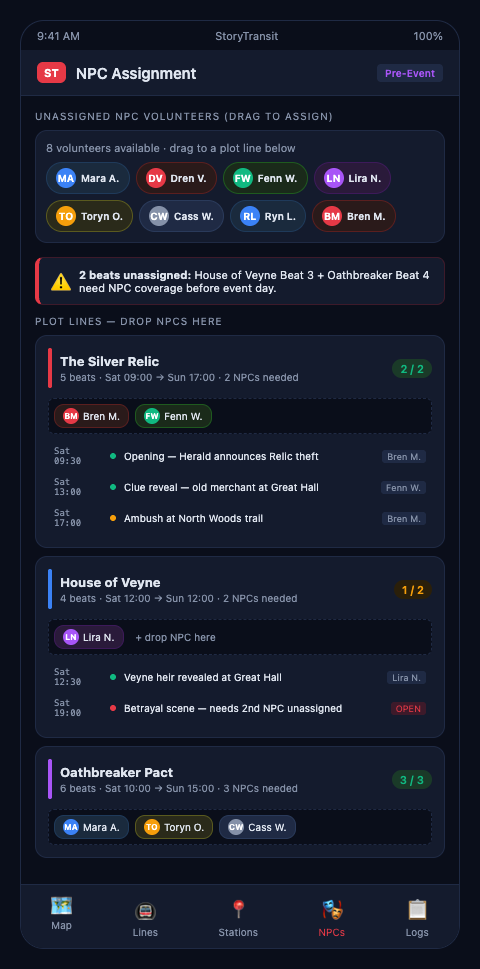
The pre-event NPC assignment process is the mechanism that converts your story map from a design document into an executable event plan. Pre-event plot preparation at this level of detail—plot line staffing reviewed before a single volunteer sets foot on site—is what separates LARP NPC management that runs smoothly from the kind that requires constant radio triage. StoryTransit's assignment layer makes this process systematic: every station gets a volunteer record, every volunteer gets a shift map, and the collision audit runs automatically before you finalize the plan.
NPC Assignment as a Story Map Operation
Every plot station on your story map has two properties: a scheduled time window and an NPC requirement. Pre-event NPC assignment is the process of filling in the NPC requirement for every station, then checking for collisions.
Work through the assignment in three passes:
Pass 1: Anchor assignments. Start with your highest-priority stations—the story beats that cannot be skipped or compressed without breaking a plotline. These are typically the major reveals, the faction confrontations, and the scenes that set up the climax. Assign your most reliable volunteers to these stations first, and protect their schedules. Nothing else gets scheduled in their assignment window.
Pass 2: Secondary coverage. Fill in the remaining stations with available volunteers, tracking each assignment on the story map. For volunteers playing multiple characters across arcs, mark each assignment in a different color corresponding to the plotline. When you can see a volunteer's full Saturday afternoon in color, the double-booking problems become visible immediately.
Pass 3: Collision audit. Read through every volunteer's assignment list and check for any station overlap within a reasonable travel window. On a sixty-acre venue, a volunteer cannot be at the east meadow at 2 PM and the west forge at 2:15 PM. Every collision you find in the audit is a station that will go uncovered at runtime unless you reassign it now.
Pass 4: Workload balance check. After collisions are resolved, look at each volunteer's total assignment count across the full weekend. An NPC with nine assignments across two days has a workload problem that won't show up in a collision audit—the assignments don't conflict, they just exhaust. Redistribute before event day by moving low-priority stations from heavy-loaded volunteers to lighter ones.
The four-pass assignment process takes longer than the typical approach of "assign as you write each scene." But it surfaces every structural problem in your NPC plan before event day, when it can still be fixed without radio calls and improvised coverage decisions.
An Empirical Exploration of Volunteer Management Theory confirms that assignment clarity is the highest-impact variable in volunteer performance—not motivation, not training, but clarity about what they're supposed to do and when.
Building the NPC Brief From the Station Map
Once your assignments are complete, the NPC brief for each volunteer derives directly from their station assignments on the story map. The brief answers four questions: Which plotline am I serving? What is the story beat I need to deliver? What do I need from the player to trigger the scene? What information do I provide when the scene resolves?
The brief should also include the station's position in the larger arc: "This is station three of six on the blue line. Players who reach you have already learned X. You provide Y. They need Z to continue." That context is what allows an NPC to improvise intelligently when players approach off-schedule or with unexpected information.
Analog Game Studies research on post-play activities shows how GMs struggle to synthesize parallel narratives across large player groups — a synthesis problem that gets harder whenever NPC casting decisions and scheduling influences were never documented in the first place. A runtime-reference NPC brief is the pre-event artifact that makes post-event synthesis possible.
Day-Of Adjustments to the Assignment Plan
The pre-event assignment plan is the starting point, not the final word. Events start with Saturday morning check-ins where you discover which volunteers arrived, which ones sent a last-minute cancellation, and which ones arrived but are sick, tired, or otherwise not able to cover their full assignment list.
The day-of adjustment protocol requires having the assignment map visible and a list of unassigned or low-priority stations ready to redistribute. When a volunteer cancels, you pull up their assignment list and triage: which of their stations are structural linchpins, which are secondary, and which have a pre-identified backup. The linchpin stations get covered first; the secondary ones get redistributed to available volunteers; the lowest-priority ones get flagged as at-risk and covered if a volunteer becomes free.
This triage only takes fifteen minutes when the assignment plan is documented. Without documentation, it's a thirty-minute conversation that consumes the organizer's attention during the window when they should be focused on event start.
Handling the Volunteer Availability Problem
Designing the Volunteer Experience from Nordic Larp is direct about a tension that most organizers navigate informally: NPC volunteer labor must be balanced against event secrecy to protect plot delivery. Volunteers who know too much of the plot gossip. Volunteers who know too little fail their scenes.
The assignment framework addresses this by giving each volunteer only the information relevant to their specific station assignments, not the full plot bible. They receive a brief that covers their scenes, their character contexts, and their scheduling windows. The organizer retains the full story map. This is the NPC team communication structure that keeps the plot secure while keeping volunteers functional.
For multi-day events, you also need to account for volunteer fatigue. Systematic volunteer management research shows that scheduling and role assignment are the highest-impact practices in event volunteer management. Volunteers who are over-assigned on Saturday burn out by Sunday. Map their full weekend workload before event day and redistribute where the load is uneven.
NPC scheduling across festival events requires the same pre-event audit at larger scale, with the added complexity of shift scheduling and role handoffs between volunteers playing the same character across days.
The Backup NPC Layer
Every pre-event NPC assignment plan should include a backup layer: for each high-priority station, a named backup NPC who knows the scene and can cover it if the primary NPC is unavailable. The backup isn't assigned to cover the station on schedule—they're assigned as a contingency.
Identify your ten most critical stations—the ones where failure means a plotline goes dark for an arc—and designate a backup for each. Brief the backup the same way you brief the primary. On event day, if the primary calls in sick or gets held up in an adjacent scene, dispatch calls the backup. The station gets covered.
This requires a small additional briefing investment, but it removes the runtime panic when an NPC becomes unavailable mid-event. The backup layer doesn't need to cover every station—only the ones that are structural linchpins of your story map.
What the Assignment Document Enables at Runtime
When your pre-event NPC assignment is complete and documented in the story map format, your runtime dispatch operation becomes mechanical rather than improvisational. The radio dispatcher knows which station is scheduled, which NPC is assigned, and where that NPC should be at any given time.
The pre-event NPC assignment check ties directly to player-to-NPC ratios—mismatches cause plot delivery failures at runtime. Your assignment document is the pre-event verification that those ratios work.
When an NPC calls in sick Saturday morning, you're not improvising from scratch—you're looking at the assignment map, identifying their stations, and finding the volunteer whose schedule has a gap in that window. The solution is in the document.
For events running across multiple days, the assignment document also enables Saturday evening review: what's been delivered, what's overdue, and which NPC assignments need to shift for Sunday. That review is only possible if the Saturday assignment plan was documented clearly enough to compare against actual deployment.
The catalog NPCs memory challenge in long-running tabletop campaigns is structurally similar: once you have more NPCs than you can hold in your head, you need a documented system, not memory.
The NPC Brief Quality Check
Once your assignment map is complete, run a brief quality check on your NPC briefs before distributing them. Each brief should answer four questions without requiring the NPC to read more than one page: What is my character's name and relationship to the players I'll encounter? What is the story beat I need to deliver? What am I listening for from players to trigger the scene? What information do I provide when the scene concludes?
Briefs that fail this check—that require the NPC to hold too much information, reference too many other documents, or leave trigger conditions ambiguous—are the briefs that produce confused performances on event day. Revise before distribution.
The NPC brief is the terminal point of the pre-event NPC assignment process. A complete assignment map means nothing if the volunteers who receive it don't know exactly what to do when they get on site.
StoryTransit is designed for LARP event organizers who need pre-event NPC assignment tools that surface collisions before event day. If your last weekend event had uncovered stations because two NPCs showed up for the same scene and nobody covered the other one, the waitlist is open—join to get early access to the NPC assignment and plot staffing features.