How to Catalog NPCs Before Your Campaign Outgrows Your Memory
The NPC Accumulation Problem
A DM running a weekly homebrew campaign introduces, on average, two to four named NPCs per session — quest givers, faction agents, merchants, guards, informants, and the improvised characters who appear when players ask an unexpected question. After 50 sessions, that's 100-200 named characters. After 100 sessions, that's a cast larger than most novel series.
Dungeon master organization at this scale isn't optional — it's the difference between a campaign that feels like a living world and one that increasingly contradicts itself. The campaign memory problem isn't a personal failure; it's a structural one. No DM's working memory is built to hold 150 named characters in reliable recall while simultaneously narrating a scene, adjudicating rules, and tracking three active plot threads. Homebrew NPC tracking and D&D lore management are the systems that take this load off working memory and put it somewhere retrievable — so the DM can focus on storytelling rather than archaeology.
Research from ACM on the game master experience documents the cognitive demand on DMs who must simultaneously narrate story, roleplay NPCs, and improvise under real-time pressure — a multi-task load that predictably degrades recall for specific character details. The GM who introduced a character five sessions ago under these conditions may retain the character's narrative function (ally, obstacle, information source) but lose the specifics: name, faction, prior interaction history.
Organizational research on knowledge retention is direct: undocumented knowledge disappears without retrieval systems. The DM's memory is not an institutional repository. It's a working memory buffer that gets overwritten session by session. An NPC who isn't in a catalog is an NPC who exists only until the next session demands full cognitive attention elsewhere.
With tens of millions of active players in ongoing campaigns, the majority of DMs are managing this exact problem at some scale — from the 20-session campaign where NPC recall is still manageable to the 200-hour epic where a full NPC catalog is the only thing standing between coherent worldbuilding and a cascade of continuity errors.
Building the NPC Catalog
The goal of an NPC catalog is not completeness — it's retrievability. A catalog that contains every NPC ever mentioned but takes five minutes to search during a session is less valuable than a catalog covering 70% of characters that delivers an answer in ten seconds.
The minimum viable catalog entry — introduced in Post 02 of this series — is five fields: Name, Location (last known), Role, Relationship (to party), Last Seen (session number). This is the floor. For NPCs who recur, you'll want to add two fields: Faction (which organizations they're affiliated with) and Secrets (one or two facts the players don't know yet).
The seven-field catalog entry covers 95% of what you'll need to recall about any NPC during a session. It takes two minutes to complete when the NPC first appears. If you complete it in the session break immediately after the character's introduction — while the details are still fresh — you'll never need to reconstruct from memory.
Tier the catalog by importance. Not all NPCs warrant the same documentation investment. Three tiers work well:
Tier 1 — Major characters: Full seven-field records, updated after every session appearance. These are your recurring NPCs, faction leaders, villain lieutenants, and anyone a player has asked about more than twice.
Tier 2 — Active characters: Five-field minimum records, updated when relevant. These are the quest givers, informants, and situational allies who appear more than once but aren't central to the main arcs.
Tier 3 — Incidental characters: Name and location only. The innkeeper at the Brenhorn Village tavern who provided a clue once. If they become relevant again, upgrade them to Tier 2 at that point.
This tiering prevents the catalog from becoming a documentation burden. You're not writing character sheets for every NPC — you're maintaining a searchable index that lets you find the right information in the right amount of time.
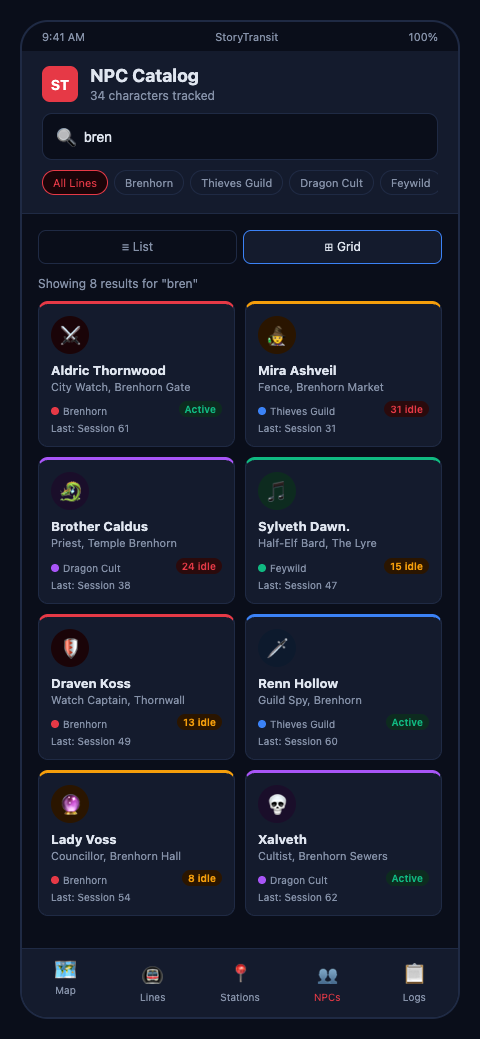
Link NPCs to plot stations. This is where StoryTransit adds infrastructure that a flat list can't provide. Each NPC exists not in isolation but in relation to your campaign's transit map — they're characters whose routes intersect with specific plot lines. When you're prepping a session that involves the merchant faction, you want to pull up all Tier 1 and Tier 2 NPCs linked to that faction's plot line, not scroll through an alphabetical list of 150 characters.
Studies using visual structured records show significantly improved recall of named entities compared to unstructured notes — which is why the catalog's structure matters, not just its existence.
For managing forgotten NPCs that have already accumulated, the recovery approach is triage-first: build complete records only for NPCs who are currently active in story threads, then add historical characters as they become relevant. Don't attempt a full retroactive audit at once.
Catalog Maintenance in Practice
A catalog only functions if it's maintained. The most common failure mode isn't building a bad system — it's building a good one and then letting it lapse after five sessions because the maintenance cost outpaces the perceived benefit.
The session close ritual. The most effective maintenance habit is a five-minute end-of-session ritual: review any NPCs who appeared this session, update their Last Seen fields, and add any new characters who were introduced. This takes five minutes when done immediately after a session and an hour when done retroactively three sessions later.
The pre-session NPC scan. Before each session, scan the catalog for any Tier 1 or Tier 2 NPCs who are likely to appear based on the session's planned events. Read their records before play begins. This creates a "warm" state for those characters in working memory, which is the most reliable way to maintain name-and-detail consistency under session pressure.
Villain roster management deserves its own catalog section for campaigns with complex antagonist hierarchies. Villain NPCs have additional fields to track: capabilities, known intelligence about the party, and advancement toward their objectives. A villain who has been offscreen for 20 sessions should have a record of what they've been doing during that time.
Decommission retired characters. When an NPC dies, departs the world permanently, or becomes irrelevant to all active threads, move them to a retired section rather than deleting them. In a long-running homebrew, yesterday's minor character becomes tomorrow's historical reference — the thieves' guild leader from five years ago might be the legendary figure a new party encounters a rumor about.
For assigning NPCs across plot lines in complex events, the same tiering logic applies — catalog the important ones comprehensively, give incidentals minimal records, and maintain the catalog as a live document rather than a static archive.
Second-brain research from IBM on how people manage personal knowledge systems finds that retrieval strategies and organizational structures directly determine whether stored information gets used — which is the entire argument for a tiered, link-structured NPC catalog over a flat list or scattered notes.
Before Session 51 Arrives
Homebrew D&D dungeon masters typically hit the NPC recall wall around Session 40-50, when the cast has grown large enough that improvisation alone can no longer maintain consistency. The time to build the catalog is before that wall, not after. StoryTransit's NPC catalog integrates directly with the campaign transit map, letting you link characters to plot stations and pull relevant records by thread rather than scrolling through an undifferentiated list.
Three practical indicators that the wall is approaching: (1) you've accidentally used two different names for the same incidental NPC in separate sessions; (2) a player asks about an NPC you mentioned six sessions ago and you can't immediately recall anything about them beyond a vague sense that they were a merchant; (3) you're consciously avoiding certain regions or factions in your session prep because following up on their associated NPCs would require more note archaeology than the session is worth. All three are signals that campaign memory is no longer keeping pace with the campaign's cast. At that point, dungeon master organization becomes a continuity prerequisite, not just a prep convenience. Build the tiered catalog before those signals appear, and maintain it with the session close ritual — five minutes per session that keeps the cast findable instead of lost.
If your campaign is approaching Session 30 and you're already losing track of names, join the waitlist for homebrew D&D DMs at StoryTransit — and get a catalog structure that scales to 200 hours of campaign history without burying you in maintenance overhead.