Why Forgotten NPCs Derail Homebrew Worlds (And How to Prevent It)
When the Wrong Name Breaks the World
A dungeon master running a three-year homebrew campaign described the moment a player pointed out a discrepancy: the inn keeper in Brenhorn Village had been referred to as "Oswin" in Session 14 and then "Aldric" in Session 61. Both names had come from the DM improvising on the fly, and neither had been written down. The players weren't angry — they were disoriented. The world felt less real, not because of a major plot contradiction, but because one minor NPC had two names.
This is the quiet way forgotten NPCs erode homebrew continuity. Research published by the Association for Psychological Science found that at least half of everyday forgetting stems from prospective memory failures — intentions formed but later lost, details registered but never stored in a way that makes them retrievable. A DM meeting dozens of session-specific NPCs every week has no reliable biological mechanism to retain all of them. The forgetting is structurally inevitable without an external system.
A 2016 DM survey from SlyFlourish found that 55% of DMs run personal campaign settings — meaning they are solely responsible for maintaining every NPC's name, motivation, faction, and relationship. With roughly 50 million total D&D players worldwide, the majority running ongoing campaigns, the scale of this problem is enormous and almost entirely unaddressed by existing tools.
The cost isn't just a duplicated name. When an NPC who was allied with the party at Session 20 shows up as a neutral stranger at Session 67 because the DM forgot the prior relationship, the players lose confidence in the world's coherence. When the blacksmith who swore a blood oath against the thieves' guild is suddenly doing business with them 40 sessions later, the campaign loses the feeling of a world with consequences. Forgotten NPCs are where homebrew worlds stop feeling alive.
The NPC Continuity Framework
The solution isn't to document everything before every session — that's the prep spiral that leads to DM burnout. The solution is a lightweight NPC continuity system that captures exactly what you need to avoid the failure modes, and nothing more.
Think of your NPCs the way a transit system manages stops. Each NPC is a station on one or more plot lines. The station has a name, a location, and a set of relationships to the surrounding network. What you need to know at any given moment isn't a biography — it's the station's current status: active, dormant, hostile, allied, or closed (deceased, departed, or otherwise removed from play). Good NPC management is the foundation that keeps a homebrew world feeling coherent — the difference between dungeon master tools that actually prevent continuity errors and ones that merely archive them.
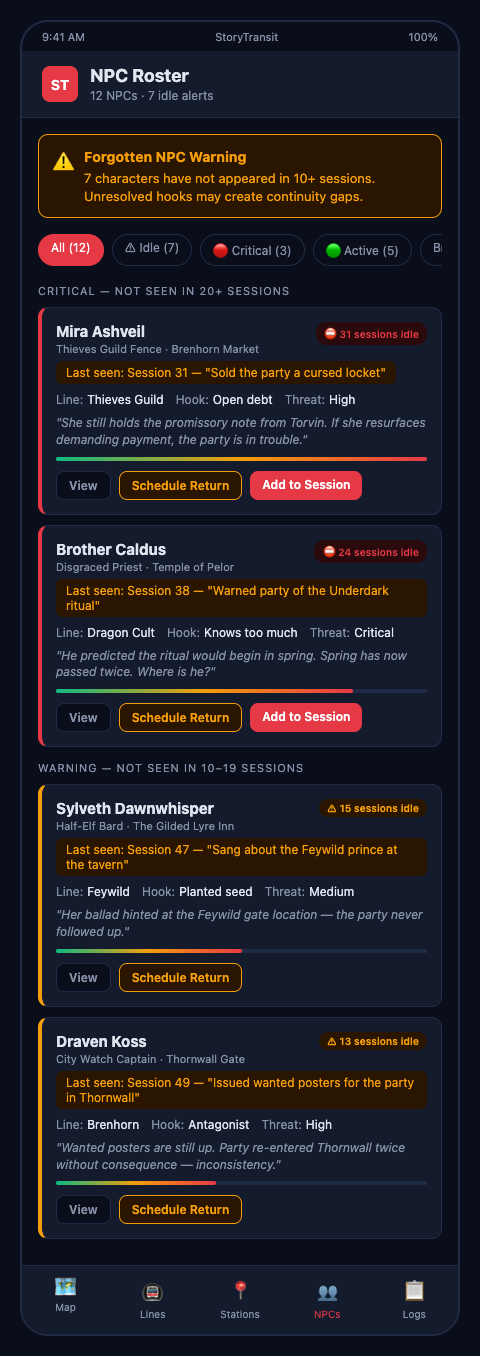
The minimum viable NPC record contains five fields: Name, Location (where the party last encountered them), Role (what function they serve in the homebrew world — merchant, faction agent, quest giver), Relationship (current standing with the party), and Last Seen (session number). That's it. A record this small takes 90 seconds to create and 10 seconds to consult before a relevant session.
Cognitive-load research confirms that working memory holds only 2–4 novel chunks of information under load. During a session, a DM is simultaneously narrating story, roleplaying NPCs, adjudicating rules, and tracking player intentions — a cognitive demand so high that recall for minor NPCs falls to near-zero without external reference. The five-field record exists to offload that recall to a system, not a stressed brain.
Once you have minimum viable records for your NPCs, the next layer is relationship mapping. Which NPCs know each other? Which factions employ which characters? Which NPCs share a history with a player character's backstory? These relationships form the connective tissue of the world. When you can see that the innkeeper is secretly a faction agent and the faction agent is connected to the villain's lieutenant, you start finding story lines that didn't exist in your prep notes.
StoryTransit structures this as NPC continuity sheets — living documents linked to plot stations on your campaign's transit map. When the half-elf bard from Brenhorn Village appears at a transfer station between two plot lines, the continuity sheet tells you immediately: last seen Session 22, allied with the party, has outstanding business with the thieves' guild. No scramble, no improvised contradiction.
To catalog NPCs before your campaign outgrows your memory, the best approach is to work backwards through your session history in batches. Don't try to document every NPC ever mentioned — start with the ones still active in the story, then add dormant ones as they become relevant. A rolling NPC index that grows organically beats a comprehensive database that never gets built.
Preventing the Failure Modes
Knowing the theory is one thing. Here are the specific failure modes that catch DMs off guard, and how a continuity system prevents them.
The duplicate name problem. Improvised NPCs get named in the moment and never logged. Two sessions later, you improvise a different name for the same character because you don't remember the first. Prevention: a running list of NPC names associated with locations. Before you name a new character in Brenhorn Village, check the list. If you've already named someone there, reuse the name or explicitly introduce a new character.
The loyalty flip. An NPC who was hostile becomes friendly, or vice versa, without any in-world event to justify the change — just DM memory failure. Prevention: log the relationship status after any session where it changes. "Aldric: hostile as of Session 34 (party burned down the mill)." Now the hostility is anchored to an event, and you can't accidentally forget it.
The faction orphan. An NPC was introduced as a member of a faction that has since been destroyed, but the NPC keeps appearing without acknowledging the faction's fall. Prevention: when a faction changes status, run a quick audit of all NPCs linked to that faction and update their records.
The retcon alternatives trap. When a DM realizes they've made a continuity error, the instinct is to retcon. But retcons erode player trust faster than the original inconsistency. A continuity record lets you find an in-world explanation for the discrepancy rather than erasing it — which is almost always a better story outcome anyway.
For DMs who have run long enough that their NPC list is already enormous, there's a useful triage principle from forum-based play environments: flag only the characters your players have asked about more than once. Repeated player questions are the clearest signal of which NPCs matter enough to document thoroughly. Let the rest stay in minimal-record status until they're needed.
Your Campaign's Characters Deserve Better Than Your Memory
For homebrew D&D dungeon masters running multi-year campaigns, forgotten NPCs are the leading cause of the slow erosion that makes a campaign feel less alive over time — not a single catastrophic break, but a hundred small inconsistencies that add up. StoryTransit's NPC continuity sheets are designed specifically for this problem: lightweight enough that you'll actually maintain them, structured enough that you'll find what you need in ten seconds during a session.
The practical starting point for most DMs isn't a full retroactive audit of every NPC they've ever introduced. It's a targeted pass through the last 20 sessions: list every named NPC who appeared, their current relationship to the party, and their last known location. That list alone catches most of the duplicate-name and loyalty-flip failures. From there, you expand the record for any NPC a player references more than once — those are the characters who matter enough to track in detail. An NPC mentioned by a single player a single time can stay at minimal status until the campaign returns to them. The five-field minimum viable record scales naturally with player investment: simple for background characters, more complete for the ones who drive active subplots.
If your campaign has passed Session 30 and you've started dreading the moment a player asks "whatever happened to..." — join the waitlist for homebrew D&D DMs at StoryTransit. The NPC continuity framework is built for campaigns with history, not just campaigns in planning.