Why Retcons Destroy Homebrew Trust and Safer Narrative Alternatives
The Trust That Dies Quietly
It's Session 56. The party is interrogating a merchant about the cult in Brenhorn Village. The half-elf bard's player says: "Didn't the blacksmith tell us in Session 23 that the merchant was actually working for the militia?" You pause. You say "No, I think he just said the merchant was suspicious." The player nods. But they know what they remember.
That moment — small, deniable, quickly recovered — is a retcon. Whether intentional or not, you changed an established fact to fit the current narrative. And your player's trust in the world's coherence took a hit they may never articulate but won't forget. The continuity warning signs that precede the retcon impulse are almost always detectable earlier — and catching them before a contradiction forces your hand is cheaper than managing the trust damage afterward.
Wikipedia's entry on retroactive continuity documents the pattern in serialized fiction: retcons erode narrative credibility when audiences have invested in established facts. The investment is the key variable. A player who has been at your table for 56 sessions has substantial emotional investment in the consistency of your world. A retcon isn't just a narrative correction — it's a message that the investment might not be safe.
The Angry GM's DM Prep Habits Survey found that DMs spend 15 to 30 minutes on NPC prep on average and that gaps in notes are the root cause of unintentional retcons. This reframes most retcons as documentation failures, not creative decisions. You didn't change what the blacksmith said because the story needed it — you changed it because you couldn't verify it.
ResearchGate research on continuity in TV drama serials shows that serialized audiences invest emotionally in continuity, and violations of established facts damage long-term engagement. D&D players are a particularly acute version of this — they remember specific details from specific sessions, and they use that memory to construct their trust in your world.
What Makes a Retcon Damaging vs. Acceptable
Not all retcons carry equal risk. StudioBinder's analysis of retcon craft distinguishes between additive retcons — which expand established lore without contradicting it — and subtractive retcons, which erase or override established facts. Additive retcons, done carefully, can feel like satisfying reveals. Subtractive retcons always carry trust damage.
The transit system analogy helps here. Your campaign is a network of stations visited in sequence. Every visit to a station creates a record — what happened there, who said what, what decisions were made. A retcon is an attempt to edit the historical record of a station that already exists in your players' mental maps.
Additive change: "Actually, the blacksmith was working for the militia AND the cult — a double agent." This expands what was established without contradicting it. The player's memory of the blacksmith's militia connection remains valid; new information was layered over it.
Subtractive change: "Actually, the blacksmith wasn't working for the militia — he was just suspicious of them." This directly contradicts the player's memory of an established fact. Even if the player says nothing, the damage is done.
The practical test: if the change requires a player to remember something differently than they currently do, it's a subtractive retcon. If it requires them to know something additional, it's an additive reveal.
Continuity failures that seem to require subtractive retcons almost always have additive alternatives. The question is whether you're willing to live with the consequences of what you established rather than erasing it.
Continuity debt audit as a periodic practice gives DMs a formal mechanism to surface and address contradictions before they become retcon-or-consequence dilemmas. Run a quarterly audit and most retcon-forcing contradictions disappear before a session surfaces them.
LARP documentation failures in live events trace the same root cause: insufficient documentation leads to inconsistency, which leads to either retcons or broken trust. The context differs, but the failure pattern is identical.
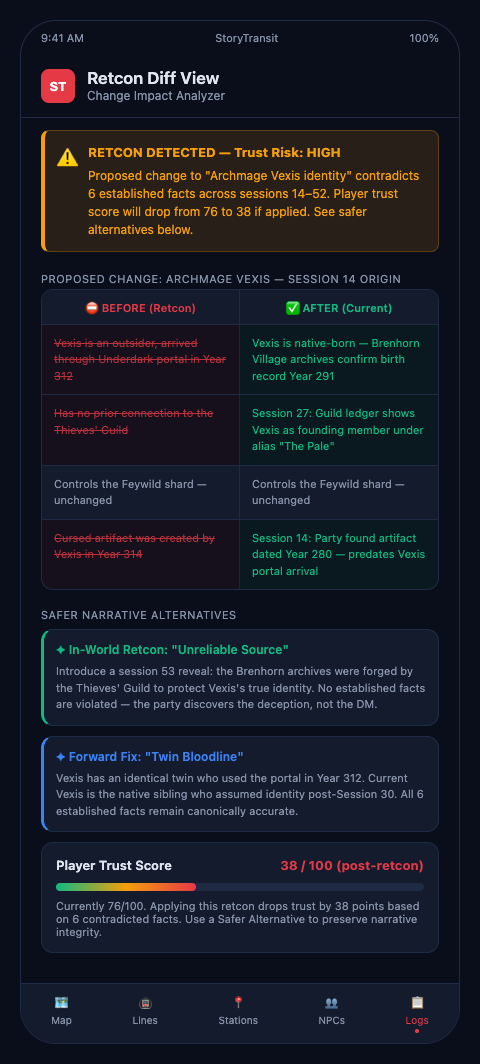
StoryTransit's NPC continuity sheets and session log archive exist specifically to provide the documentation that makes retcons unnecessary rather than just inadvisable.
Five Alternatives to the Retcon
Alternative 1: The Reveal. Instead of contradicting what was established, add new information that changes how players interpret it. The blacksmith was working for the militia. The militia, it turns out, has a splinter faction aligned with the cult. The blacksmith was unaware. His information was accurate — the world was just more complicated than anyone knew. No established fact changes; the context for it does.
Alternative 2: The Character Error. Established NPCs can have been wrong or lying without requiring the DM to retcon. If the blacksmith told the party the merchant was working for the militia and that turns out to be false, the blacksmith was either mistaken or deliberately misleading. Either creates narrative tension that a retcon would eliminate. Let NPCs be wrong. Let NPCs lie. Don't change what they said.
Alternative 3: The Consequence Embrace. Sometimes the narrative inconsistency you're trying to fix is actually an opportunity. The party was told the merchant works for the militia. Now you've decided the merchant is actually the cult's key contact. Rather than retconning the militia connection, make the merchant actually work for both — and let that double-dealing be a plot thread the party has to unravel.
Alternative 4: The Admission. For factual errors (you genuinely misremembered what you established), a brief, direct acknowledgment at the table is less damaging than a quiet retcon. "Actually, I checked my notes and I got that wrong — the blacksmith said X, not Y." Players forgive honest corrections. They remember quiet rewrites.
Alternative 5: The Campaign Bible Entry. TV showrunners use series bibles to prevent retcons across writers' rooms — the shared continuity document is the single source of truth. The homebrew equivalent is a campaign bible that captures every established fact, NPC commitment, and faction decision in a searchable record. When a potential contradiction arises, you check the bible before deciding whether one exists.
The Ethics of Retcon analysis distinguishes between retcons that expand and those that contradict: organic expansion preserves trust while forced contradiction erodes it. The five alternatives above all expand. None contradict.
The campaign bible is not a DM document only. Sharing a sanitized version — without spoilers but including all established world facts, NPC behaviors, and faction histories — with your players is a powerful trust-building move. When players can independently verify established facts rather than relying on your memory, the implicit accusation of "I think you changed that" becomes a collaborative fact-check instead. A shared continuity document puts both DM and players on the same footing, which is exactly the relationship that campaign consistency requires.
Campaign consistency as a craft skill compounds over time. The DM who maintains a campaign bible from Session 1 through Session 100 will find that the bible itself becomes a story artifact — a document that proves the world was always building toward where it arrived. StoryTransit's session log and NPC continuity sheets form the practical core of that campaign bible, structured specifically for the homebrew D&D dungeon master who wants narrative trust to be a deliberate feature of their campaign rather than a lucky byproduct.
Advanced Tactics for Maintaining Narrative Trust
The contradiction log. Before every session, review your upcoming plans against your session archive. If something you're planning contradicts an established fact, flag it before the session — not during it. Pre-session contradiction checks are far less damaging to trust than mid-session corrections.
NPC commitment tracking. Every time an NPC makes a promise, a threat, or a factual claim to the party, log it immediately. Untracked NPC commitments are the single largest source of unintentional retcons. The merchant who promised to contact the party if he heard anything about the cult either followed through or didn't — and your players will remember that he promised.
The "what did we establish" check. Build the habit of checking your session archive whenever a player asks a question you're uncertain about. Saying "let me check my notes" takes 30 seconds and prevents a retcon. It also signals to your players that you're taking the documented history seriously, which itself builds trust.
Escalation over erasure. When a narrative direction you established turns out to be less interesting than you expected, resist the urge to erase it. Instead, escalate it to something that makes the original establishment feel like it was always building toward something better. The double-agent blacksmith with militia and cult ties is more interesting than a blacksmith who was never connected to either. You had to live with the constraint — but you built something richer for it.
D&D story alternatives to retcons are always available. The constraint of honoring established facts is also a creative engine. Some of the most memorable campaign moments come from DMs who decided to live with what they established rather than quietly changing it.
Build a World Your Players Can Trust
The homebrew campaign that runs for five years isn't the one with the most creative worldbuilding — it's the one where players trust that the world remembers itself. That trust is built session by session, NPC commitment by NPC commitment, established fact by established fact. Retcons erode it. Documentation prevents the need for them. Build the campaign bible, track the commitments, and never make players wonder what you changed while they weren't looking.
The specific cost of a lost retcon trust moment is hard to quantify but easy to observe: a slight withdrawal of player investment in the world's established facts. Players who notice retcons start holding the world's history at arm's length rather than leaning into it. They stop invoking past details in their plans because they're not confident those details will hold. That defensive relationship with the campaign's history is the long-term cost of a documentation failure that looked like a small improvisation in the moment.
StoryTransit was built for homebrew D&D dungeon masters who understand that narrative trust is the foundation their world runs on. Every continuity sheet, session log, and foreshadowing receipt in the system exists to make retcons unnecessary. Join the waitlist and give your players the world they've been investing in.