7 Warning Signs Your Campaign Continuity Is About to Collapse
The Collapse You Don't See Coming
Most campaigns don't end with a dramatic implosion. They end with a session that felt slightly off, then another, then a player saying "I thought we already dealt with that" — and a DM who has nothing to say. According to Roll20 research, the average D&D campaign lasts 6 months to 2 years, with campaigns that die early most often citing DM overwhelm as the cause. EN World data suggests most campaigns never reach double-digit sessions — and early collapse is tied to management failure, not loss of player interest.
Continuity collapse is a slow process. The mechanisms behind it are well-documented in cognitive science: working memory overload degrades recall order — meaning that under the cognitive load of running a session, the DM loses access not just to information, but to the sequence of events that gives that information meaning. The consequence isn't a single wrong answer; it's an accumulation of small inconsistencies that erode the players' belief in the world.
Campaign continuity collapse rarely announces itself. It looks like normal D&D campaign play right up until the moment it doesn't. The DM still runs the sessions. Players still show up. But homebrew management without adequate structure produces a slow divergence between the world as it was established and the world as the DM is improvising it — and that divergence widens session by session until a player's question exposes the gap.
Here are seven warning signs that this process has already started in your campaign.
Seven Warning Signs
Warning Sign 1: You improvise faction allegiances you should already know.
You're mid-session and a player asks whether the Iron Veil controls the northern docks. You know you established this somewhere around Session 30. You're not sure it's still true. You improvise an answer. This is the first sign: faction status has become uncertain enough that you're guessing rather than recalling. Factions are the load-bearing architecture of homebrew worldbuilding — when you lose confidence in who controls what, the world's political logic stops functioning.
Warning Sign 2: A player corrects you on NPC names or relationships.
When a player pulls out a note from three sessions ago to tell you that the merchant's name is Sera, not Sara, you have a documentation problem. Forgotten NPCs are covered in depth elsewhere in this series, but a player catching a name discrepancy mid-session is a specific continuity warning: your NPCs have become unreliable enough that your players are doing your continuity work for you.
Warning Sign 3: You dread player questions about past events.
This is a psychological signal as much as a practical one. DM burnout research identifies continuity erosion as a key stressor — the cumulative weight of unresolved threads creates anxiety that makes DMing feel like a liability management exercise. When you start hoping players don't ask about 47 sessions ago, the campaign has entered burnout territory.
Warning Sign 4: You've retconned the same subplot twice.
A single retcon can be explained away as a refinement. Two retcons on the same thread means the thread was never properly tracked. Players absorb retcons, but they remember them — and each one marginally reduces their investment in the world's established facts. The relationship between retcon frequency and player engagement is direct.
Warning Sign 5: Session prep feels like archaeology.
If preparing for the next session requires you to dig through 60 sessions of notes to reconstruct what the current stakes are, your documentation system is no longer functional as a retrieval system. Prep should require orientation to current state, not excavation of history. When it feels like archaeology, the campaign has outgrown its organizational structure.
Warning Sign 6: Plot threads have been active for more than 20 sessions without advancing.
An active thread with no forward movement isn't a slow burn — it's a stalled subplot waiting to be forgotten. Twenty sessions is roughly the threshold where a thread moves from "deliberately paced" to "accidentally buried." If you have multiple threads in this state, you've accumulated more narrative debt than a single session's prep can service.
Warning Sign 7: You can't name the last three story beats for each major plot line.
Pick your campaign's three main plot threads. For each one, name the last three sessions where that thread had a meaningful moment of consequence. If you can't do this from memory — and more importantly, can't do it quickly from your notes — then your campaign's story consistency is already compromised. The shape of the story is invisible to you.
For DMs already seeing multiple of these signs, the first step is recognizing that this isn't a failure of creativity — it's a failure of infrastructure. Forgotten NPCs and buried subplots are symptoms of a campaign that has outgrown the organizational system running it.
What to Do When You See the Signs
The good news is that continuity collapse is reversible at almost any stage before the campaign ends. The intervention follows the same pattern regardless of which warning signs are present.
Triage first. Don't try to fix everything at once. Pick the three most active plot threads and make those your continuity priority for the next five sessions. Let dormant threads stay dormant while you stabilize the core.
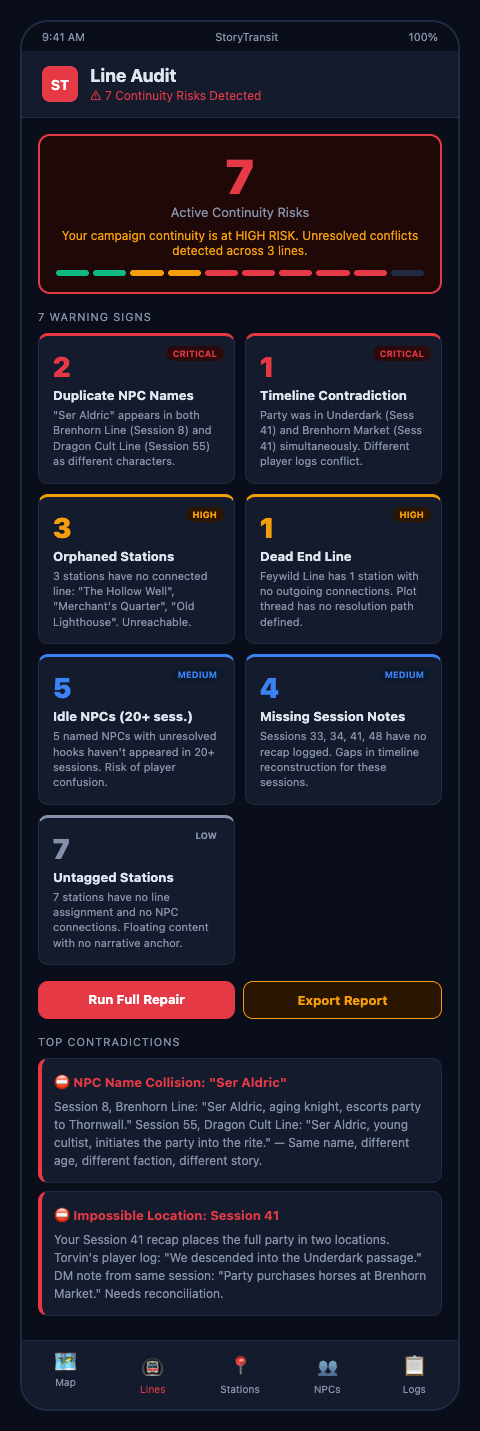
Build a transit map of current state. Identify your active lines, their most recent stations, and any dormant stops that players are likely to revisit. This doesn't need to be comprehensive — it needs to cover what's going to matter in the next ten sessions. StoryTransit is designed for exactly this triage mode: start with current state, not full history.
Document forward, not backward. The instinct when a campaign has documentation problems is to go back and fill in everything that was missed. This produces a time-consuming backfill project that rarely gets completed. Instead, document from this session forward and add historical context only as it becomes relevant. A campaign that starts documenting at Session 60 is infinitely better off at Session 80 than one that never starts.
Set a hard deadline on faction states. Before any session that involves a major faction, write down in one sentence what that faction's current position is. This takes 30 seconds and prevents the most common mid-session fumble: discovering you don't know what the Iron Veil's current agenda is because the last time they appeared was Session 34. Good homebrew management means keeping at least your primary factions current-stated, even when they're not in active play. A campaign continuity collapse caused by faction drift is preventable with this single habit — three sentences per session, one per active faction, covering status, current goal, and last known action.
Address retcon dangers proactively. When you identify a continuity error, find an in-world explanation rather than erasing the established fact. This requires a record of what the established facts are — which is the argument for the transit map itself.
Podcast-quality narrative continuity requires the same infrastructure that prevents campaign collapse — which is why actual-play producers often develop more rigorous continuity systems than tabletop DMs do.
Information overload research identifies cognitive strain as both a symptom and an accelerant: the more overwhelmed you are by unmanaged information, the worse your decisions become, which produces more inconsistency, which increases overwhelm. Breaking this cycle requires a structural intervention, not more willpower.
Seven Signs, One System
For homebrew D&D dungeon masters who recognize their campaign in two or more of these warning signs — you're not alone, and the campaign isn't lost. StoryTransit was built specifically for multi-year homebrew DMs who need a way to see their campaign's story consistency at a glance rather than discovering breakdowns mid-session.
Three of the seven warning signs are worth flagging as leading indicators — the ones that appear earliest and most clearly predict worse collapse to come. Warning Signs 1, 3, and 7 tend to cluster: when a DM starts improvising faction allegiances they should know, dreading player questions, and losing track of each plot line's recent history simultaneously, it's not because three different things went wrong. It's because the documentation system crossed a threshold where the campaign's complexity exceeded what it was designed to hold. Recognizing that crossing early — before the retcons start, before the players catch the contradictions — is what makes intervention possible rather than reactive.
The waitlist for homebrew D&D DMs is open now. If your campaign has been running long enough to accumulate the kind of history that becomes a continuity liability, StoryTransit's transit map view gives you a way to manage that history without rebuilding it from scratch.