Bridging the Gap Between Recording and Post-Production
The Handoff Gap Nobody Talks About
An actual play session ends at 11 PM. The recording gets uploaded to a shared drive. Someone sends a Slack message with a rough timestamp of "the good stuff." The editor opens the file three days later with no notes, a vague memory of what was discussed pre-session, and a runtime target. The editing gap has already opened.
This is not a niche problem. The handoff between recording and post-production is where narrative context is most commonly lost in any production pipeline. For actual play podcasts, the gap is worse because the content is improvised — there's no script to reference, no pre-planned scene list, no writer's room document. The only record of what happened and why it matters lives in the GM's head and maybe a bullet-point note doc that hasn't been touched since the session wrapped.
Actual play editors spend roughly two hours editing per one hour of raw recording, which means the cost of a broken handoff is paid in wasted editor time, rework, and missed narrative context — not just inconvenience. When the editor doesn't know that the scene at the 47-minute mark is a callback to Lord Thadderon's arc from episode nine, that scene gets cut. Or it survives when it should have been trimmed because the editor can't assess its importance.
The editing gap compounds over time. In the first five or ten episodes, the team's collective memory covers most of the context. By episode twenty, no individual on the team can reliably reconstruct the narrative significance of every scene without documentation. The handoff process that worked informally at the start becomes inadequate for the actual play workflow at scale — and shows that don't address this tend to show the strain in their audio quality and story consistency simultaneously.
Misaligned recording-to-post handoffs cause rework and timeline confusion for production teams. The rework problem is real: an editor who has to go back and re-cut a scene because its narrative context was only discovered after the edit was locked is losing time that compounds across a season of episodes.
Building the Production Bridge
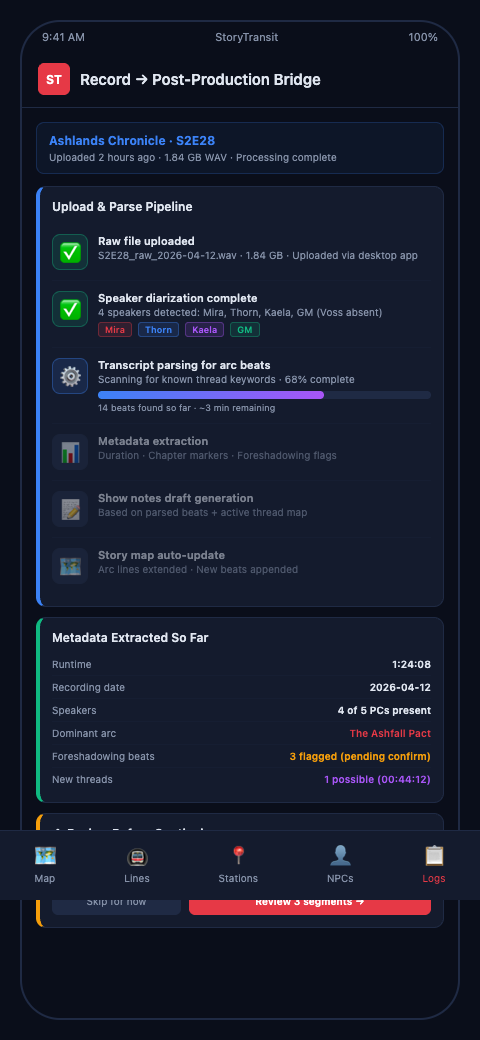
StoryTransit treats the recording-to-post-production transition as a bridge crossing between two parts of the transit network. The recording is the inbound route — raw, improvised, full of narrative cargo. Post-production is the outbound route — structured, audience-facing, purpose-edited. The bridge between them is the handoff protocol, and without it, cargo falls into the water.
The bridge has four structural components.
Component 1: The post-session debrief (15 minutes). Immediately after recording, the GM and producer spend fifteen minutes capturing context while it's fresh. This is not a full session recap — it's a targeted capture of three things: which existing threads were touched and how, which new threads were introduced, and which moments the GM considers non-negotiable for the edit. This debrief is the source material for everything downstream.
The debrief works best immediately after the session, before anyone leaves the call or chat. The GM's memory of intent — why that scene with the cursed compass was significant, what Kaelith's choice was actually about — is most precise in the first hour after play. By the next morning, the specific details of why certain moments mattered start blurring into general impressions. Capturing the debrief in the session window isn't perfectionism; it's the difference between useful documentation and retrospective guesswork.
Component 2: The handoff document. The producer converts the debrief into a structured one-page brief. Systematic production workflows prevent context loss when files move from GM recording to editor. The brief includes the episode's narrative function (what arc does it primarily serve), a list of flagged scenes with their thread context, and the runtime priority ranking. The editor receives this with the audio file — not as a suggestion, but as the frame for every cut decision.
Component 3: Story map update. Before the handoff document goes to the editor, the producer updates the StoryTransit map with the new episode's thread data. This keeps the map current and ensures the handoff document is derived from an accurate system of record rather than memory. A full pipeline from raw recording to final audio requires structured metadata handoff at each stage. If the story map is out of date, the handoff document is built on a faulty foundation — the editor receives context that reflects the show as it was three episodes ago, not as it is now.
Component 4: Post-edit reconciliation. After the edit is locked, the producer updates the story map again — noting which flagged scenes survived the cut, which were modified, and which were dropped. Any dropped scenes carrying live threads get flagged for follow-up in the next session. This closes the loop and ensures the pre-production workflow for the next episode starts from accurate arc status rather than from stale data.
Closing the Editing Gap in Practice
The handoff protocol described above eliminates the most common failure mode: the editor making cuts based on audio quality alone, without narrative context. But there are several additional tactics that actual play podcast producers use to close the gap further.
Timestamp-anchored scene notes. During the debrief, capture timestamps for key moments — not just descriptions. An editor who knows that the cursed compass callback is at 1:12:40 can protect that moment precisely rather than hunting for it. Clear pipeline stages require metadata handoff between recording and editing. Timestamps are the single most practical upgrade most actual play production workflows can make to their handoff documents without changing anything else.
Automation for routine handoff tasks. Zapier templates automate handoff tasks such as file delivery and notifications between recording and editing phases. For shows with consistent production schedules, automating the file delivery and brief distribution removes manual steps that tend to get skipped when the team is tired after a session. When the automation handles the file movement and notification, the producer can focus on the narrative context capture — the part that can't be automated.
Tiered handoff for different editors. If your show uses a primary editor for story-sensitive cuts and a secondary editor for cleanup, the handoff documents for each are different. The primary editor needs the full narrative brief. The secondary editor needs the flagged scene list and the timestamp anchors. Layering the handoff reduces noise for each role and prevents the secondary editor from being overwhelmed by narrative context that isn't relevant to their specific task.
Pre-session context refresh. For shows recording biweekly or monthly, a brief pre-session context refresh — reviewing the current arc status before play begins — helps the GM enter the session with their foreshadowing intentions intact. This pre-session document becomes the frame for the post-session debrief, giving the producer a before/after view of where each arc stood before and after the session. That comparison is what generates the most precise handoff document.
The handoff process is one component of a larger producer editing toolkit that intermediate producers build over time. Once the bridge is stable, the next challenge is the edit itself — and advanced audio editing addresses how narrative-first decisions reshape the audio editing process at the structural level. Producers looking at adjacent production systems will find parallels in how runtime logging basics operates in LARP contexts, where live-event documentation creates a similar challenge of capturing context before it evaporates.
The Handoff Is the Product
Actual play podcast production is a relay race. The GM runs the first leg, the producer runs the second, and the editor runs the third. When the baton pass between legs one and two is fumbled — when context is lost at the handoff — the editor runs the final leg blindfolded.
The production bridge framework turns the handoff from an afterthought into a designed workflow. StoryTransit sits at the center of that bridge: the GM's session context flows in, the editor's brief flows out, and the story map stays current throughout. The editorial decisions that shape each episode — what stays, what gets cut, what goes into show notes — are made from a position of complete information rather than partial memory.
The cumulative effect of a working handoff process is consistency. Listeners notice when a show's narrative quality is steady across episodes. They may not know why — they don't see the production pipeline — but they feel the difference between a show where the editor understood every scene and a show where the editor was guessing. The handoff protocol is what creates that feeling.
One dimension of the handoff that often goes unaddressed is the show notes pipeline. The handoff document that goes to the editor can also seed the show notes template: the episode's narrative function becomes the episode description, the flagged scenes with timestamps become the show notes timestamps, and the thread status from the story map becomes the arc index. A well-structured handoff document is not just an editing guide — it's the raw material for everything that reaches the subscriber in the episode feed.
For shows managing a rapid production schedule — two or more episodes per month — the handoff protocol's efficiency matters as much as its thoroughness. The fifteen-minute post-session debrief, the structured handoff document format, and the story map update together should take under an hour for a standard session. Shows that build this process into a repeatable template find that the overhead drops significantly after the first few cycles, because the format is familiar and the documentation habits are established.
Actual play podcast producers who want a structured handoff protocol built into their production workflow can join the waitlist now. Join the Waitlist for Actual Play Producers to get early access to StoryTransit's handoff templates and pipeline documentation tools.