Session Zero Worldbuilding: Planting Seeds You'll Actually Remember
The Problem with Forgotten Foundations
A dungeon master spent three hours building the Session Zero for a new homebrew campaign: player character backstory hooks, a secret flaw in the ruling council, a forgotten god stirring beneath a buried temple, three regional conflicts that would give the world political texture. It was, by any measure, excellent worldbuilding. By Session 35, the DM could recall the broad strokes but not the specific details — which council member had the secret, which direction the buried temple lay, which regional conflict had been introduced through which NPC.
The seeds were planted. The DM just couldn't find them when it was time to water them.
A 2016 DM survey found that 17% of DMs spend over an hour weekly on worldbuilding. Session Zero is typically the heaviest single worldbuilding investment — and the one most at risk of being lost, because it's completed before the documentation habits that support a running campaign have been established.
The forgetting isn't immediate. Research on spaced learning shows that knowledge encoded at a single session begins decaying within 24 hours without deliberate spaced revisiting. Session Zero worldbuilding, which is often encoded across a single afternoon, is especially vulnerable to this decay curve. By the time the campaign reaches the sessions where those seeds should be paying off, the original details have been replaced by reconstructed impressions.
D&D Beyond's guidance on Session Zero emphasizes establishing lore hooks that sustain long-running campaigns — but sustaining them requires more than planting; it requires a retrieval system that keeps them accessible across the months between planting and payoff.
How to Plant Seeds That Stay Found
The key insight is that a Session Zero story seed is not just a creative note — it's a campaign promise. It creates an obligation to the future: a moment where the payoff will arrive and the players will feel the satisfaction of a thread that was respected. That obligation needs to be documented as a first-class object, not filed in a folder with the rest of your prep notes.
Here's a protocol for Session Zero worldbuilding and dungeon master planning that produces seeds you'll actually be able to use. The goal isn't exhaustive homebrew lore documentation — it's capturing the specific details that will matter when planting story seeds pays off 30 sessions from now. D&D campaign prep at the Session Zero stage should produce a map of future obligations, not just a binder of world facts.
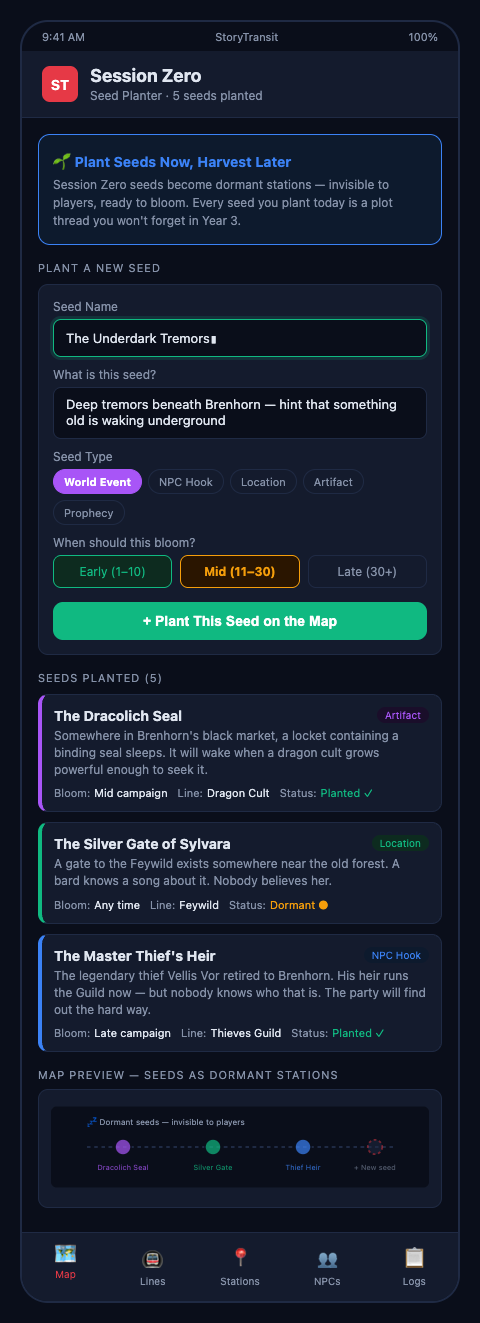
Document seeds on the transit map immediately. Every story element you introduce in Session Zero should be placed as a station on your campaign's plot line map before the first session begins. The buried temple is a station on the "Ancient God" line. The council member's secret is a station on the "Political Corruption" line. Each player character's backstory hook is a station on that character's personal arc line.
This is the entry point for each of these threads into your campaign's transit system. When you can see them on the map alongside your active lines, they don't disappear into a folder — they remain visible as dormant stops waiting for the train to arrive.
Write the payoff window, not the payoff. You don't need to know exactly how Session Zero's seeds will pay off — that would undermine the collaborative, emergent nature of D&D. But you do need a rough window: "this should become relevant between Sessions 15 and 30" or "this is a late-campaign revelation, target Sessions 50+." The window is what StoryTransit calls a foreshadowing payoff receipt — a logged commitment with a delivery range.
Capture player backstory hooks as separate line entries. The half-elf bard's mysterious patron, the fighter's missing sister, the rogue's debt to a guild — each of these is a transit line originating from Session Zero. They deserve their own entries on the map, separate from the world's political or cosmic threads, because they're the seeds most likely to produce the campaign's most emotionally resonant moments.
Handwriting Session Zero planning notes encodes world details more deeply than typed equivalents — the cognitive science of encoding suggests handwritten notes create stronger initial memory traces. But encoding strength doesn't prevent decay. The handwritten notes need to be transferred into a retrievable structure before the campaign session count climbs past 10.
Year-five survival for a homebrew campaign is largely determined by what was set up in Sessions Zero through Five — the foundational infrastructure that either holds the campaign together or fails under accumulated weight.
The Revisit Protocol
Planting and forgetting is the default outcome without an active revisit protocol. Spaced revisiting is the mechanism that turns a seed from a one-time documentation entry into a maintained campaign asset.
The 10-session check. At every tenth session, scan your Session Zero seeds that haven't yet become active on the transit map. Are any of them approaching their payoff window? Are any of them sufficiently dormant that they risk being forgotten even by the players? A 10-minute scan at session milestones keeps the foundational lore visible without consuming session prep time.
Feed seeds into active threads. The most effective way to keep Session Zero seeds alive is to connect them to threads that are already active. If the political corruption line is currently hot, look for a connection between the corrupt council member's secret and the faction your players are currently investigating. The seed doesn't need its own dedicated arc — it needs an entry point into something already in motion.
Flag seeds that players have engaged with. When a player asks a question about a Session Zero element — even indirectly, even speculatively — that's a signal that the seed is alive in their minds. Upgrade its priority. A seed that players are already curious about is much easier to pay off than one they've forgotten.
SlyFlourish's session zero guidance recommends tying story seeds directly to player characters — which creates an automatic retrieval trigger every time that character's arc becomes relevant. This is the structural version of the revisit protocol.
Foreshadowing arcs planted in Session Zero can pay off 18 months later — but only if the seed is in a system that surfaces it when the payoff window approaches, not buried in a folder with three years of prep notes.
For first pbp campaign frameworks, Session Zero seed management is even more critical than in live play — because the slow pace of asynchronous sessions means the gap between planting and payoff can span years of real time.
Seeds Become Payoffs When You Can Find Them
Homebrew D&D dungeon masters who invest in a rich Session Zero are investing in the future payoffs that make long-running campaigns feel intentional and alive. The difference between a campaign where players describe the worldbuilding as "incredible" and one where they describe it as "inconsistent" is usually whether the DM could find the seeds when it was time to deliver them. StoryTransit's session zero seed tracker integrates with the full campaign transit map, so every foundation you build before Session One stays visible until it's ready to pay off.
The waitlist for homebrew D&D DMs is open. If you're prepping a new campaign now, or if your current campaign's Session Zero seeds are buried in a folder you haven't opened since Year One, StoryTransit is the retrieval system your worldbuilding has been waiting for.