The Anatomy of a Homebrew Campaign That Survives Year Five
What Year Five Actually Requires
EN World data suggests that most campaigns fail before reaching ten sessions. The subset that reaches Year Five represents the top percentile of campaign longevity — and the structural differences between short-lived and long-lived campaigns are rarely about creativity or player engagement. They're about infrastructure.
DM burnout is the primary killer of long-running campaigns, according to DM fatigue research that identifies continuity management as a leading stressor. The DM who reaches Year Five has, intentionally or not, built systems that prevent the specific burnout triggers: unmanageable plot backlogs, NPC recall failures, and the growing anxiety of knowing your world's internal consistency is eroding.
A campaign at Session 87, with 200 hours of history, is a different organizational object than a campaign at Session 10. The same prep habits that worked at Session 10 will fail at Session 87 — not because the DM has gotten worse, but because the complexity has grown past what those habits were designed to handle. Campaigns 2–3 years in are achievable but require deliberate structural planning from the start. Year Five requires even more deliberate structure.
The six systems described below are the campaign anatomy of D&D longevity — the recurring structural features that enable year five survival for long-running homebrew campaign DMs, regardless of genre, setting, or play style. Worldbuilding endurance comes from this architecture, not from talent or enthusiasm alone. StoryTransit was designed specifically around this anatomy: each system maps to a tool layer, so the infrastructure can be built incrementally rather than all at once.
The growing TTRPG market is producing more DMs who aspire to long-running homebrew worlds than ever — and more who hit the structural wall at Year 2 or 3 without the infrastructure to push through.
The Anatomy: Six Systems That Sustain a Long Campaign
System 1: The Transit Map (Plot Architecture)
A Year-Five campaign has accumulated 30-60 distinct plot threads, some resolved, some active, many dormant. Without a structural representation of this network, the DM can't see which lines are currently running, which transfer stations are overloaded with converging arcs, or which dormant stops have been sitting without a train for 40 sessions.
The transit map of interconnected plot stations is the load-bearing architecture of campaign longevity. It's not a session-by-session log — it's a topological view of the story's structure. Which threads are running? Which ones intersect? Which dormant subplot is closest to a natural re-entry point? These questions require a map to answer quickly. Without one, they require archaeology — session-by-session reconstruction that burns prep time and DM energy.
System 2: The NPC Catalog (Character Infrastructure)
A campaign at Year Five has introduced several hundred named characters. The fraction that are still relevant to active plot lines might be 30-50. The fraction the DM can reliably recall under session pressure without external reference is far smaller. The NPC catalog keeps the relevant characters findable, not memorable — these are different requirements with different solutions.
NPC continuity sheets that link characters to their associated plot stations are more useful than a flat alphabetical list. When you're prepping the session that involves the harbor faction, you want every harbor-faction NPC surfaced automatically, with their current status, last seen session, and outstanding story obligations visible in one view.
System 3: The Foreshadowing Payoff Registry
Every story seed ever planted in the campaign — in Session Zero, in improvised NPC asides, in strange environmental details — is a promise. The foreshadowing payoff receipt system tracks those promises, attaches a delivery window to each one, and surfaces them when the window approaches. Without this system, story seeds either get accidentally paid off in a way that contradicts the original plant, or they get forgotten entirely.
System 4: The Session Recap Infrastructure
Long-running campaigns need session recaps that serve a structural purpose beyond player memory aids. A recap that captures new dormant stops introduced, NPC status changes, and plot station advances is a maintenance event as much as a narrative one. The recap updates the transit map after each session, keeping it current without requiring a dedicated maintenance session.
System 5: Cross-Campaign Lore Documentation
For DMs running multiple campaigns in the same homebrew world — which is common by Year Five for active worldbuilders — cross-campaign lore is the documentation that prevents the second campaign from contradicting the first. Events from Campaign 1's Session 47 are now world history in Campaign 2. Without documentation, that history exists only in the DM's memory, which has the same forgetting curve problem as everything else.
System 6: The Burnout Circuit Breaker
The sixth system is psychological rather than organizational: a protocol for when the campaign's complexity starts to feel like a burden rather than a creative asset. This usually manifests as dreading prep, avoiding player questions about past events, or feeling like the world has gotten too big to manage.
The circuit breaker is a planned pause and audit: a session or two of lower-intensity play while the DM audits the transit map, closes out threads that have naturally resolved, retires dormant stops that no one will miss, and identifies the three most compelling active threads to focus on for the next 10 sessions. This resets the cognitive load without ending the campaign.
For the continuity warning signs that signal System 6 is needed, the earlier post in this series covers them in detail.
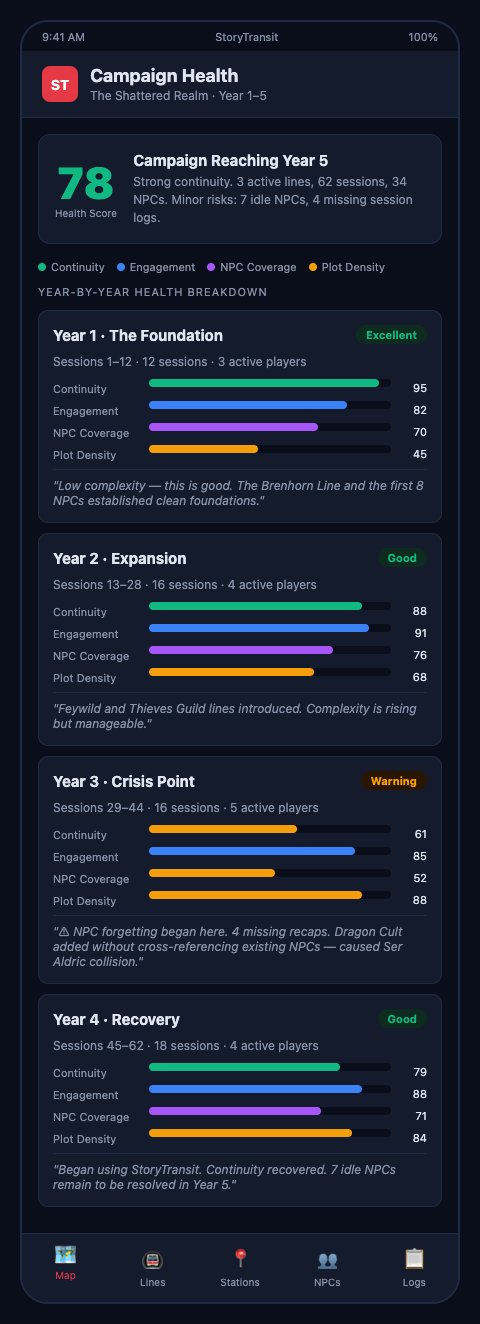
What Year Five DMs Do Differently
The specific habits that separate Year-Five DMs from the ones who burned out at Year Two:
They document forward, not backward. When they miss documenting a session, they don't go back and fill in the gap retroactively. They accept the gap and document from the current session forward. A campaign documented from Session 40 onward has 60+ sessions of clean records by Session 100.
They cull actively. At every 20-session milestone, they formally retire plot threads that have naturally concluded, demote NPCs who haven't appeared in 30 sessions, and close dormant stops that no player has referenced in over a year. This keeps the active map from growing without bound.
They use collaborative worldbuilding. Research on narrative collaboration confirms that distributing the cognitive load of continuity maintenance across the group reduces per-person burnout. Year-Five DMs often delegate session recaps to a player scribe, ask players to maintain their own character arc notes, and use session zero consensus to establish world facts that don't require the DM to single-handedly authorize.
They treat the transit map as a prep tool, not an archive. The map isn't a record of everything that happened — it's a working document that shows what matters now. History that no longer has bearing on active threads gets archived, not deleted, but it comes off the active map.
The west marches threads problem — managing dozens of simultaneously active threads in a player-driven campaign format — is the extreme version of Year-Five complexity, and the same systems apply.
For actual play podcast production, the Year-Five anatomy maps directly onto the editorial challenge of maintaining listener engagement across hundreds of hours of serialized content — the same six systems, applied at production scale.
The Architecture of Endurance
Homebrew D&D dungeon masters who want to reach Year Five don't need more creativity — they need better infrastructure. StoryTransit was designed specifically around the anatomy described above: a transit map for plot architecture, NPC continuity sheets, foreshadowing payoff receipts, and a session recap system that keeps everything current with minimal overhead.
Most DMs who encounter the Year-Two or Year-Three structural wall do so because they built System 1 (some version of a story map, often as a list or a folder of session notes) and stopped there. The subsequent five systems don't require the same upfront effort — Systems 3 and 4 together take roughly ten minutes per session to maintain once the templates exist, and System 6 is invoked only when specific warning signs appear.
The practical build order for a DM in the middle of a campaign is: audit the active plot threads first (System 1), then create minimum viable NPC records for the ten most referenced characters (System 2), then build the foreshadowing payoff receipt for any seed you planted in the last 30 sessions that hasn't paid off yet (System 3). Those three steps, in a single two-hour prep session, represent the difference between a campaign that stalls at Year Three and one that reaches Year Five with its continuity intact.
The waitlist for homebrew D&D DMs is open. If you're in Year Two or Three and feel the weight of accumulated complexity, this is the structural intervention that prevents the burnout spiral — built specifically for DMs with 100+ hours of campaign history who are playing the long game.