Recovering a LARP Plot When Key Players Drop Out Mid-Weekend
When One Exit Breaks Five Storylines
Player dropout at live-action events is not rare. Illness, personal emergencies, and simple exhaustion pull participants out mid-weekend at almost every large event. The problem isn't the dropout itself—it's the structural damage it causes to plot threads that were built around that player's character.
Leaving Mundania's documentation of LARP dropout scenarios puts the challenge plainly: plot reconciliation must account for unplayed character arcs when key players exit before the event closes. A faction leader who goes home Saturday morning takes with them every pending story beat assigned to their character—unless the plot system was built to surface and reassign those beats immediately.
Most plot bibles aren't designed with dropout contingencies. Story beats that require Character X to deliver information, make a decision, or appear at a plot station become stranded when Character X is gone. Those beats don't quietly disappear—they leave gaps that other players will notice, especially when those beats were visible precursors to larger narrative payoffs. The ranger who was supposed to reveal the traitor in the council is just absent. The players waiting for that revelation spend the rest of the weekend wondering if they missed something.
Standard event contingency frameworks recommend earmarking 10-15% of budget and planning resources for unexpected disruptions. Eventcombo's risk management guidance applies this directly to live-event disruptions including participant loss. Applied to LARP, this means proactively designing your plot structure to absorb a 10-15% loss of key player participation without visible damage to the main narrative. A 200-player event should plan for twenty to thirty characters becoming unavailable mid-weekend—not because you expect it, but because you'll experience some version of it.
Eventbrite's contingency planning guidance frames dropout preparation as part of standard event risk management: preparing actionable solutions for participant loss and staffing shortages before they occur. For LARP organizers, this means the contingency structures are designed during plot pre-production, not improvised on Saturday morning when the actual dropout happens.
The Transit System Approach to Dropout Recovery
The most effective LARP plot recovery framework treats every player character as a transit route, not an irreplaceable vehicle. When a route goes offline—the player drops out—the transit system needs to reroute other vehicles to cover the essential stops on that route without disrupting the lines it intersected with.
In StoryTransit's framework, a player dropout triggers an immediate dormant stop audit. Every story beat assigned to the departing character's arc is flagged on the plot dashboard. The plot runner assigned to that line receives an alert. The radio dispatcher at the GOD tent has a list of costumed volunteers available for reassignment. Within fifteen minutes of a dropout confirmation, the plot team has a complete picture of which stranded beats need coverage, which can be absorbed into adjacent lines, and which can be intentionally held for a future event.
This speed matters because the window for effective recovery narrows quickly. A story beat stranded at 9am Saturday can be absorbed by a bridge NPC before noon. The same beat stranded at 4pm Saturday is effectively lost for this event—players in the relevant faction will have concluded their storyline by evening session, and injecting a new NPC into it feels disruptive rather than seamless.
The hot wash vs. after-action report comparison from Scope Safety makes exactly this point: immediate hot wash capture—responding to disruptions within the first hour—is the mechanism for taking corrective action that's still meaningful. Dropout-triggered plot gaps follow the same time pressure.
Alliance LARP's shift NPC structure uses part-time and shift NPCs specifically as the contingency buffer when player character participation drops below expected levels. The costumed volunteers already on-site, rostered for the pool, become the recovery mechanism—but only if there's a coordination layer that can identify the gap and direct the deployment quickly.
Contingency Plot Planning: The Pre-Built Recovery Protocols
The difference between events that absorb dropouts cleanly and ones that visibly stall comes down to pre-built contingency structures. Expert organizers design these before the event starts, during plot pre-production, when there's time to think through the recovery logic rather than improvising it under pressure.
The NPC bridge protocol. For every player character who controls a critical story beat—a faction decision, a key revelation, a narrative unlock that other parallel plotlines depend on—pre-assign an NPC who can deliver an equivalent beat if the player drops out. This NPC doesn't need to be in active play during normal runtime. They're a dormant stop that activates only when the corresponding player character becomes unavailable. Write the bridge beat in full—the NPC's role, the information delivered, the trigger condition—during pre-production. When the dropout occurs, the plot runner hands the bridge NPC their brief and deploys them within the current session block.
The stranded arc triage matrix. Before the event, build a simple two-column matrix: each parallel plotline in one column, the player characters who are load-bearing for that line in the second column—characters whose participation is required for at least one story beat to fire. When a dropout occurs, the organizer looks up the departing character in the second column and immediately sees which plotlines need triage. This matrix converts a chaotic mid-event scramble into a thirty-second lookup. The triage matrix is worth building even if you never need it.
The collapsed beat protocol. Not every stranded beat can be covered by a bridge NPC. Some beats need to be collapsed—their essential narrative information folded into an adjacent active beat so players still receive the content through a different delivery mechanism. Write collapse scripts in advance for your three to five most critical beats. When those beats go stranded, plot runners deliver the collapsed version through whichever NPC is already active in the relevant zone. Players experience a slightly different version of the story; they don't experience a gap.
The dropout communication cascade. Establish a clear protocol for how dropout information travels through the staff structure. The player tells a volunteer. The volunteer tells the GOD tent coordinator. The coordinator alerts the relevant line conductor and the radio dispatcher simultaneously. The line conductor activates the bridge protocol. The dispatcher updates the dashboard and adjusts pool NPC availability. This cascade should take less than five minutes from confirmation to active response.
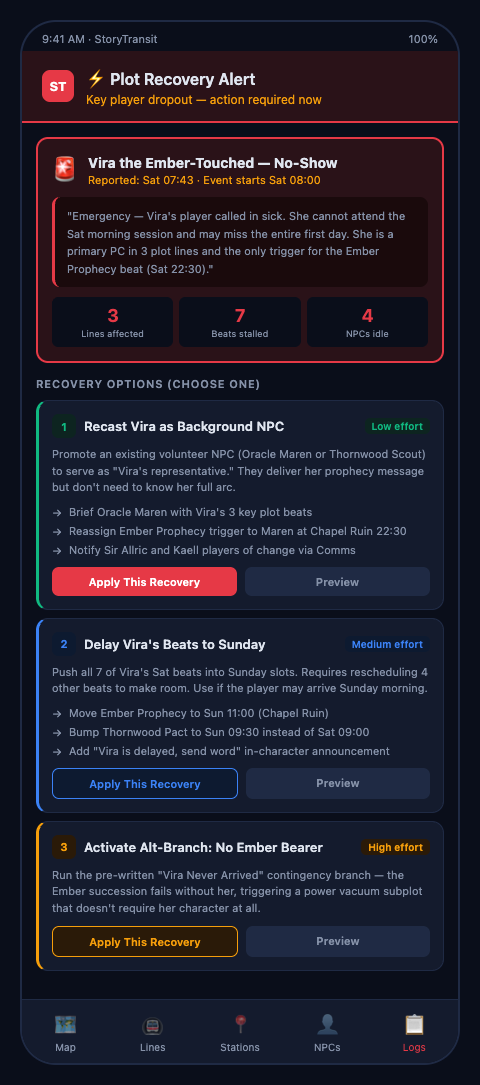
What to Do When the Dropout Is Structural
The protocols above address dropouts where the player leaves but their character's role can be transferred or bridged. Some dropouts are more structurally damaging—the player was the sole source of a faction's decision-making authority, or their character was the only one who knew a piece of information that the entire Saturday evening climax depended on.
For structural dropouts, the response is triage rather than recovery: what is the minimum viable version of the affected plotline that can still run without this character? Identify the three or four story beats from that line that are most essential to other players' experience, and focus all recovery resources on ensuring those beats reach their intended players. Let the secondary beats in that line become held content for a future event.
MarketingProfs contingency planning research on protecting event delivery under high-impact, high-probability disruptions applies directly: prioritize high-impact story beats for recovery first, accept that lower-impact beats may be deferred.
LARP advice on the NPC's role as contingency buffer confirms what experienced organizers know: costumed volunteers are the primary live mechanism when player-character plot threads become stranded. Well-briefed NPCs who understand their role in the contingency structure are the most valuable resource in a dropout recovery situation.
Tracking Dropout Impact After the Event
The effects of a mid-event dropout often extend beyond the beats that were immediately stranded. When a key character exits mid-weekend, other players who were interacting with them adjust their storylines in ways that may not be apparent until the post-event debrief. The faction that lost its leader improvised a new political structure. The character who was supposed to betray the departing player's character never got the scene. The climactic confrontation that the entire weekend was building toward had to be restructured on the fly.
These secondary effects are worth tracking explicitly in the post-event reconciliation. In the line audit, mark not just the beats that were directly stranded by the dropout, but any beats that were modified, accelerated, or eliminated in response. This secondary map reveals how structurally load-bearing the departed character was—useful information for designing future events with better distributed narrative responsibilities. Player dropout recovery and dropout mitigation are not the same discipline: mitigation is the pre-event work that limits mid-event player loss damage before it happens; recovery is the runtime response once it has. The post-event audit informs both—revealing which elements of your mitigation plan worked and which recovery protocols need revision before the next event.
Distributed narrative responsibility means designing your parallel plotlines so that no single player character controls an irreplaceable number of story beats. When player A holds three critical beats and player B holds one, a Saturday morning exit by player A is structurally catastrophic and an exit by player B is manageable. The triage matrix tells you the current distribution. The goal of each event's design revision is to move toward a more distributed model—flatter risk, more resilient plot structure.
For guidance on how the plot system handles unexpected player choices that drive pivots before any dropout occurs, the post on player-driven pivots covers the real-time adjustment protocols that share a lot of operational DNA with dropout recovery. When a dropped character was central to a setting imported from another format, the tabletop-to-LARP transition post covers specific structural vulnerabilities that format conversions introduce. For cross-format perspective on recovering dormant narrative threads in a serialized format, the post on how to revive dormant storyline covers similar recovery strategies in the actual play podcast context.
StoryTransit makes dropout recovery operational rather than improvisational. When a key player leaves mid-weekend, the plot dashboard surfaces their stranded beats immediately, flags which parallel plotlines are affected, and shows available costumed volunteers for reassignment. Join the Waitlist for LARP Organizers and build dropout resilience into your next event's plot infrastructure from the start.