How LARP Runners Handle Unexpected Player-Driven Story Pivots
The Domino Problem in Live-Action Events
It starts with one decision. A player chooses to expose the assassin publicly instead of using the information as leverage. That choice collapses the assassination subplot, shifts the political faction dynamics, and suddenly three separate plot lines that depended on the assassin being an active unknown have lost their forward momentum. Your radio dispatcher is fielding calls from four runners simultaneously. Your plot bible has nothing written for this branch.
This is what researchers studying large-scale LARP production call the domino effect: a single player-driven action cascades through multiple plot threads, requiring parallel runner response across the venue. The Larp Domino Effect The challenge is not that it happens — it will always happen, and it is often the most memorable story beat of the weekend. The challenge is that most LARP runner response systems are not designed to absorb cascades.
Game masters significantly change story paths based on player actions and do so using a waypoint approach: the destination stays constant even when the route changes. Modeling Game Master-based Story Facilitation in Multi-player Role-Playing Games For LARP runners managing twenty-three parallel plotlines across a sixty-acre venue, this approach needs to be systematized rather than intuited.
Larp events are "unpredictable but non-random" — emergent pivots always operate within design parameters rather than entirely outside the story's logic. Emergence, Iteration, and Reincorporation in Larp This means that even the most unexpected player-driven pivot is likely to interact with story structures you have already designed — it just activates them in an unplanned order or through an unplanned mechanism. A reactive plot management system that makes your existing structure visible gives runners the ability to see what they have to work with, rather than treating every pivot as a blank page problem.
The immersive live-event market reached $110 billion in 2024, with pivot-heavy narrative formats driving premium pricing and audience return rates. Immersive Live Event Market 2030 (Grand View Research) The events that command those prices are the ones where unexpected player actions produce memorable story beats rather than production failures. The difference is not improv talent — it is infrastructure.
Building a Reactive Plot Management System
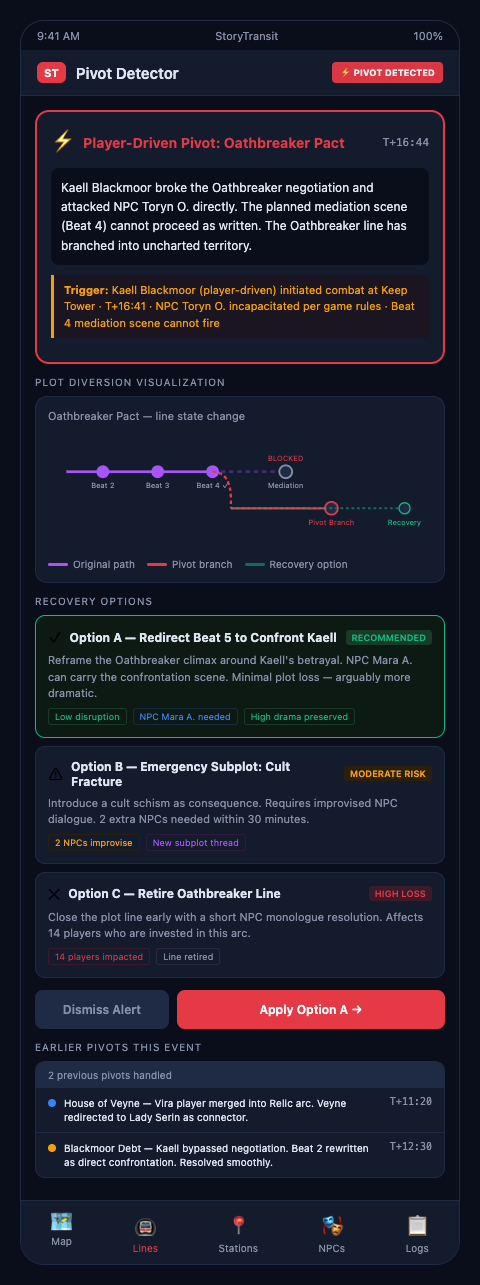
StoryTransit models plot structure as a transit network. Player-driven pivots are rerouting events — a line that was running north now needs to run east, and the passengers (both players and costumed volunteers) need to be redirected without stopping service.
The system works because the transit map shows you what already exists. When a pivot hits, you are not building from scratch — you are looking at a map of active lines, dormant stops, and available volunteer capacity, then making an operational decision about which existing infrastructure absorbs the new story direction.
Here is the runner response protocol for unexpected story turns:
Step 1 — Identify the cascade scope immediately. When a player-driven pivot occurs, the first question is not "what do we do?" It is "which lines does this affect?" Open StoryTransit and look at the station map. Which beats depended on the current state of the situation that just changed? Mark those stations as pending — not cancelled, not live, but pending review. This prevents other runners from activating affected beats before the cascade assessment is complete.
Step 2 — Locate usable dormant stops. Every well-prepared transit map has dormant stops — beats designed to activate conditionally based on story state rather than on schedule. A player-driven pivot often creates exactly the condition a dormant stop was waiting for. The conspiracy subplot that had no activation trigger now has one. Mark it live. Radio the assigned costumed volunteer with the activation call. Emergence, Iteration, and Reincorporation in Larp
Step 3 — Redirect affected lines to the nearest viable station. For plot lines whose current trajectory is now invalidated, identify the next station that still makes sense given the new story state. You are not rewriting the destination — you are finding a new route to an existing stop. The assassination subplot failed, but the underlying political tension still exists. Find the nearest station on the Political Tension line and redirect the line there.
Step 4 — Broadcast the pivot to all relevant runners. Player-driven pivots require fast, clear communication across the runner team. Use the dedicated plot-pivot radio channel — not general dispatch — and broadcast a brief structured update: which station was affected, what the player action was, which dormant stops are now active, and which stations are pending review. Slack for Event Staff Coordination Teams using structured communication channels for runtime alerts can broadcast pivot updates to all relevant staff within seconds.
Step 5 — Update the plot dashboard before moving on. The pivot is not handled until it is logged. Timestamp the change in StoryTransit, record the player action that triggered it, and note which stations were affected. This takes sixty seconds and prevents the pivot from becoming undocumented institutional knowledge that the night shift inherits without context.
The five-step protocol matters most under pressure, which is exactly when it is hardest to follow. Practice the protocol on a small scale before large-scale events — run it through a tabletop walkthrough with your runner team before the event starts, using a hypothetical player-driven pivot as the scenario. Runners who have executed the protocol once in a low-stakes context will execute it faster and more completely when a real pivot hits at 9 p.m. on Saturday night with six other things happening simultaneously.
This reactive plot management discipline connects directly to mid-event adjustments — the upstream skill of making plot changes without breaking immersion. Player-driven pivots are the most pressure-tested version of that challenge. Building the adjustment protocol before you need it is what makes the difference between live pivot handling and live crisis management.
Advanced Tactics for Live Pivot Handling
Once the basic cascade protocol is functional, more sophisticated approaches become available.
Pre-label pivot archetypes. Not every unexpected story turn is truly unprecedented. Most player-driven pivots fall into recognizable categories: early reveal, faction betrayal, NPC death, alliance formation, goal abandonment. Before the event, write a one-paragraph response framework for each archetype: which line types are most affected, which dormant stop categories are likely to activate, which radio protocol to use. When a specific pivot hits, the runner identifies the archetype and executes the framework rather than inventing a response from scratch.
Treat pivots as story assets, not story failures. Improvisational theater treats unexpected inputs as additions to the fiction rather than disruptions of it. Improvisational Theater as Complex Adaptive System The player who exposes the assassin has not destroyed Plot D — they have created a new story beat that your dormant stop infrastructure can serve. The runner who sees this clearly makes better live decisions than the runner who is trying to recover a plot that no longer exists.
Map player agency against narrative tension as a routine practice. Strong player agency and authored narrative tension exist in genuine structural tension — the core challenge of live story management. Agency Play: Dimensions of Agency for Interactive Narrative Design Build this into your pre-event design process: for each major story beat, ask explicitly what player-driven pivot would most likely invalidate it, and design one dormant alternative that activates if that pivot happens.
When a key participant drops out of an event and their absence forces plot restructuring, the same cascade principles apply. Good LARP dropout recovery depends on having named fallback routes in the same way that pivot handling does. The play-by-post context offers a slower-motion version of the same problem: pbp player dropouts require narrative restructuring over days rather than minutes, but the underlying rerouting logic is identical.
Design for the Pivot You Know Is Coming
Every weekend-long LARP contains at least one player-driven pivot that invalidates a major plot thread. Experienced LARP runners do not treat this as a risk to mitigate — they treat it as a design constraint to engineer around. The transit map does not prevent unexpected story turns. It gives you a system that shows you where to go when they happen.
The difference between a pivot that produces a memorable story beat and a pivot that produces a production crisis is not the quality of the improvisation. It is whether the runner team had a shared map before the pivot hit. Runners who have spent the event managing from StoryTransit already know the dormant stops, the contingency branches, and the cross-line dependencies. When the pivot comes, they are not inventing — they are selecting from pre-built options and executing.
This is also the argument for investing in reactive plot management infrastructure before you have needed it. Organizers who build the system after a crisis are always one event behind. The weekend where the big pivot happened without a recovery system is the weekend where players remember the production falling apart rather than the unexpected story it produced. Build the map before the detour.
StoryTransit builds reactive plot management into the dashboard so runners can identify cascade scope, activate dormant stops, and broadcast pivot updates without leaving their operational workflow. If you are running live-action events where the story is the product, join the waitlist for LARP organizers and get early access before your next weekend event.