Turning Archived Forum Threads Into Searchable Story Histories
The Archive Is Unnavigable by Design
You're writing today's IC post and need to check what the herbalist said to Kael three months ago. The exchange happened in the Merchant Quarter subforum — you remember that much. But the Merchant Quarter subforum now has four threads, the relevant one is on page seven, and forum search is returning results from the wrong thread entirely because "herbalist" appears in six posts across three different contexts.
This is not a failure of memory. It's a failure of archive structure. Forum platforms are optimized for new posts, not retrospective navigation. A play-by-post archive that has accumulated eighty in-character posts across six threads over three months is, from a navigation standpoint, nearly unusable without an external index.
Pew Research: When Online Content Disappears documents that 38% of links from 2013 no longer work — forum content is especially vulnerable because platforms prune inactive threads and restructure subforums without notification. Columbia Journalism Review: Ephemerality of the Web and Hyperlinks found that 72% of links from 1998 are now dead, and content drift means that archived pages often differ from their original state when they do survive.
Your forum archive is a story history that's actively deteriorating. The question is not whether to build a searchable index — it's whether to build one now, while the content still exists, or after the pruning schedule has already removed the threads you needed.
What "Searchable Story History" Actually Requires
A searchable story history for a pbp archive has three distinct layers, each serving a different retrieval need.
The thread index answers the question "where is this thread?" It's a flat list: thread name, subforum, current page count, last IC post date, and a one-line description of the narrative scope covered. A well-maintained thread index means you can identify the right thread in fifteen seconds rather than navigating subforum hierarchies.
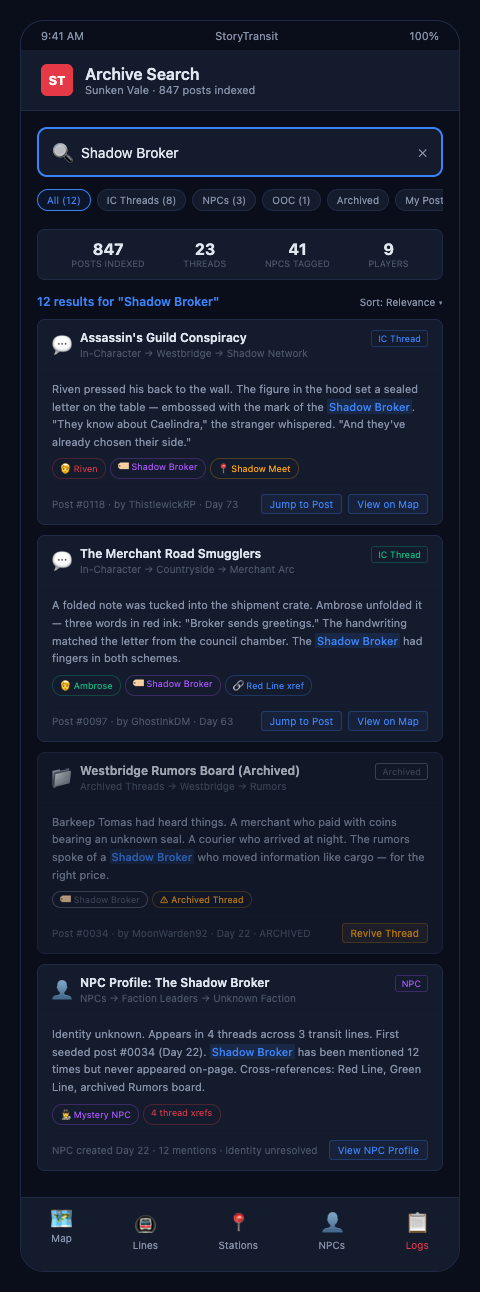
The station log answers the question "what happened in this thread?" StoryTransit's station log structure is the operational core of the searchable story history: for each active transit line in your campaign — each plot thread — the station log records every meaningful story beat with its thread reference, page number, post number, and date. When you need to know what the herbalist said to Kael three months ago, the station log gives you "Red Line / Station 4 / Merchant Quarter Thread #2 / Page 3 / Post 67 / 2026-01-12." You go directly to that post.
The NPC state index answers the question "where does this character stand right now?" Not a biography — a current-state entry: last appearance (thread, page, post), current narrative status (active, dormant, resolved), and a one-sentence summary of where they are in the story. Searchable by name.
Together these three layers transform a forum archive from a reverse-chronological pile into a navigable reference system. Web Archiving – Wikipedia describes the structural challenge of web content preservation: it requires active strategy, not passive accumulation. The same applies to your campaign archive.
World Anvil Worldbuilding Tools — one of the most widely used campaign management platforms — converts session logs into searchable, interlinked wiki databases. The indexing logic it applies to campaign content is functionally identical to what a transit-model story history does for pbp archives: instead of reading through posts to find information, you navigate a structured index.
Building the Index Layer by Layer
The index doesn't have to be built all at once. For a campaign already in progress, the pragmatic approach to thread indexing is forward: start tracking from today and backfill only the archived forum threads you actually need for play-by-post archive navigation.
Start with the thread index. Open your forum and make a list of every active thread: name, subforum, current page, last post date, one-line scope description. This takes about twenty minutes for a three-month campaign. Pin this list in your OOC thread or maintain it in a separate document. Update it whenever a thread changes page count or a new thread opens.
Add station logs for active lines only. For each transit line that is currently active, log the last three stations: thread reference, page number, post number, date, one-sentence beat. This is not a comprehensive backfill — it's the minimum viable current state. Going forward, you add a new station entry every time an IC post meaningfully advances that line.
Backfill dormant stops on demand. The forum archive subplots that are buried in pagination are the ones most at risk from pruning. For each dormant subplot you care about, do a targeted backfill: find the thread, identify the last meaningful station, log it. You don't need to excavate the full history — you need to know where the thread stands so you can revive it.
Digital Preservation & Web Archiving – CUNY Library Guides describes institutional frameworks for preserving digital content before it disappears. The same logic applied to pbp archives: the preservation workflow is simple, but it has to happen before the content is gone.
The Retrieval Workflow
Once the index is in place, retrieval changes completely. Instead of "search the forum for 'herbalist' and scroll through results," your workflow is:
Check the station log for the Red Line. Find Station 4. Read the thread reference. Navigate directly to Merchant Quarter Thread #2, Page 3, Post 67. Read the exact exchange. Return to writing. Elapsed time: ninety seconds.
The NPC state index handles a different retrieval need: when you're introducing an NPC who appeared briefly three months ago and needs to have consistent details, you look them up by name rather than trying to reconstruct them from memory or re-reading archive pages. The Ultimate Guide to TTRPG Campaign Managers – PhD20 evaluates tools like Kanka and Obsidian Portal specifically on their ability to convert flat forum archives into indexed, searchable campaign records — the same capability that a transit-model story history builds manually.
For the bump stale subplots workflow, the station log is the essential prerequisite: you cannot effectively revive a dormant thread if you can't quickly determine where it stands. The station log gives you the last station on any dormant line in seconds, which means revival decisions are based on current information rather than half-remembered history.
The back catalog audit that actual play podcast producers use to find overlooked threads in their episode history is structurally identical to the pbp archive retrieval problem — both require an index that makes old content searchable without requiring full re-read.
Making the Index Player-Accessible
A story history built only for the GM is valuable. A story history that players can also navigate multiplies that value.
The thread index and lore reference thread — the two layers most accessible to players — should be shared in the OOC thread with explicit update announcements. When the thread index adds a new entry, a brief OOC note: "Thread index updated — new Merchant Quarter subforum thread added." When the lore reference thread updates NPC status, a note: "The herbalist's current status has been updated in the lore reference thread." These announcements make the index a living document players trust rather than a static reference they check once and forget.
The station log and NPC state index are typically GM-only tools — they contain narrative information players shouldn't have in advance. But their existence changes how the GM responds to player questions. Instead of "I'll have to check the archives," the answer becomes "one moment, let me check the log." That response time difference — thirty seconds versus five minutes — communicates campaign organization to players who are evaluating whether the forum campaign is worth their sustained engagement.
Exporting the index before platform transitions. Forum platforms close, restructure, or prune without warning. Web Archiving – Wikipedia describes web archiving as requiring active strategy, not passive accumulation — the same applies at the campaign level. If your campaign is hosted on a platform with uncertain longevity, export your thread index and station log to an off-platform document monthly. The IC posts themselves may be unrecoverable if the platform goes down, but your story history survives in the index.
Platform transitions happen to long-running campaigns: a hosting forum closes, the community migrates to a new platform, and suddenly eighty in-character posts across six threads exist on a domain that may not be accessible in a year. The GM who built a searchable story history before the migration can restart on the new platform with continuity intact. The GM who relied on the forum archive alone starts over from whatever anyone can remember.
Preservation Before Pruning
Usenet – Wikipedia documents how decades of online community history have disappeared simply because nobody built a preservation workflow in time. Your pbp forum archive is on the same trajectory. The threads that exist today on page fourteen of an archived Merchant Quarter subforum will not exist in their current form indefinitely.
The story history you build now is not a convenience — it's a copy of your campaign that lives outside the forum's pruning schedule. When the host auto-prunes threads older than a year, your station log still has every story beat. Your thread index still shows the thread name and scope. Your NPC state index still has the herbalist's current status.
StoryTransit is built for play-by-post forum GMs who need their story history to survive the forum archive. Join the Waitlist for Play-by-Post GMs to access the indexing tools that turn your accumulated threads into a searchable, navigable campaign record — before the next pruning cycle runs.