Beginner's Walk-Through for Parish Chasuble Color Work
What Parishes Actually Hand You
The phone call came from the sacristan of a mid-sized urban parish: the Easter green chasuble, made in 1952 by a Midwest vestment studio, had faded so severely that the parish council debated replacing it entirely. The sacristan had found the original invoice — weld-yellow and indigo blue mixed to produce the liturgical green — but had no colorimetric data, no preservation records, and no surviving fabric sample. The chasuble was the only evidence.
This is the standard entry condition for parish textile work. Parishes rarely maintain conservation-grade documentation. The canonical 50-lux limit for sensitive textiles on display is almost universally exceeded in working sanctuaries — a nave with adequate lighting for reading runs well above that threshold, and liturgical textiles are exposed for hours at a time during services (Caring for Textiles and Costumes — Preventive Conservation Guidelines, Canada.ca). The 1952 green chasuble had received fifty-plus years of this exposure, plus intermittent dry cleaning that shifted the weld component faster than the indigo.
The specific chemistry of this failure mode is worth understanding. Weld (Reseda luteola) produces luteolin and apigenin flavonoid chromophores that are moderately photostable under UV but significantly more vulnerable than indigo to the thermal component of dry-cleaning solvents. A 1952 weld-and-indigo green chasuble that received annual dry cleaning from the 1960s through the 1990s would show a weld loss rate approximately two to three times faster than its indigo loss rate, producing the characteristic shift from a warm, slightly yellow-green toward a cool, blue-green before the indigo itself begins to fade visibly. The Fadeboard wash-cycle fader models this differential by applying separate degradation rates to each constituent chromophore — which is why the channel output for a weld-indigo compound is more accurate than any estimate based on a single-dye fading model.
The conservator's first task is not to match the color — it is to characterize what remains and build a degradation timeline. Only then can you determine whether the existing silk can be revived through consolidation and light washing, or whether new panel silk needs to be dyed and inserted.
The Beginner's Fadeboard Session, Step by Step
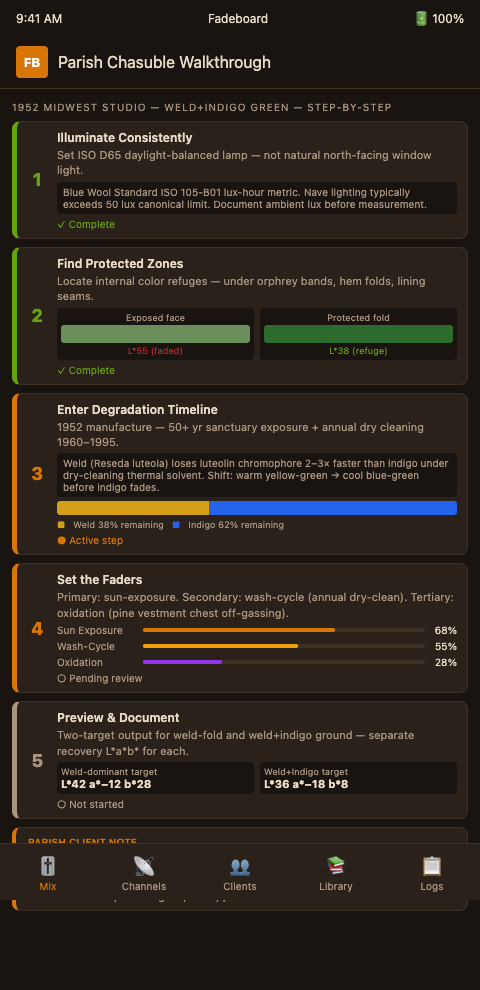
Fadeboard's parish chasuble workflow is designed to be completed in a single afternoon session with the garment present. You do not need HPLC data, spectrometric analysis, or institutional-grade equipment for a first session — the foundational colorimetric measurements can be taken with a calibrated spectrophotometer and good lighting discipline.
Step 1: Illuminate consistently. Photograph and measure under ISO D65 illumination. Natural light through north-facing windows is not ISO D65. A dedicated daylight-balanced examination lamp costs under two hundred dollars and eliminates the single largest source of inconsistency in parish-level color work. The Blue Wool Standard ISO 105-B01 lux-hour metric for cumulative fading means your lighting environment affects both the measurement and the deterioration projection — calibrate it (TSG Chapter III: Environmental Concerns for Textiles — Light, AIC Conservation Wiki).
Step 2: Find the protected zones. Every chasuble has internal color refuges — areas where the silk was folded against the lining, covered by orphrey bands, or otherwise shielded from cumulative exposure. These zones read closer to the original color than the exposed face. Measure them separately and flag them as internal reference points.
Step 3: Enter the degradation timeline. Open Fadeboard and enter the chasuble's documented history: estimated date of manufacture, typical liturgical use (weekly, seasonal, high-feast only), storage conditions, and any known cleaning treatments. The soundboard uses this timeline to weight the channel settings. UV damage to silk fibers is distinct from thermal degradation and occurs faster than most parishes expect — photodegradation causes silk fibroin chain scission at rates that can halve tensile strength in less than a century of combined UV and visible-light exposure (Study on Photodegradation Behaviors of Thermal-Aged Silk, npj Heritage Science).
Step 4: Set the faders. The sun-exposure fader is the primary mover for a mid-20th-century parish chasuble. Set it to reflect the sanctuary's estimated lux level and the number of liturgical seasons the garment has been in active use. The wash-cycle fader addresses dry-cleaning and wet-cleaning history — for a silk chasuble that has been dry-cleaned annually, this channel carries more weight than for an untouched museum piece. The oxidation channel handles storage-related degradation from the pine vestment chest.
Step 5: Preview and document. Fadeboard generates a restoration target expressed as colorimetric coordinates. At this stage you have a record that can be attached to the treatment proposal — not a subjective description of the color, but measured values that your diocesan conservation reviewer can evaluate against comparable treatments. AIC-standard examination and treatment records require photographic documentation before and after treatment, plus a written treatment report (Conservation and Restoration of Textiles, Wikipedia). For the 1952 green chasuble, the restoration target was expressed as an Lab* coordinate pair — one for the weld-dominant folds, one for the weld-plus-indigo ground — rather than a single "Ordinary Time green" designation, because the two-component dye system required two independent recovery targets to restore the correct hue balance between fold and face.
Advanced Tactics for First-Time Parish Clients
Parish clients often have two specific concerns that experienced conservators navigate instinctively but first-time clients find confusing: budget and liturgical correctness. Fadeboard's output addresses both.
On budget: the colorimetric target lets you separate what requires new silk (areas where the fiber has degraded past the point of dye-bath revival) from what can be stabilized in place. A parish with limited funds benefits from a channel-by-channel assessment that identifies the minimum intervention required — not because minimum intervention is always correct, but because a documented minimal treatment that preserves liturgical color is better than no treatment at all. Conservation services for parish chasuble work typically cover a range of treatment scopes and documentation requirements (Textiles Conservation, Midwest Art Conservation Center).
On liturgical correctness: the output from Fadeboard is not a creative recommendation — it is a reverse-engineered reading of what the chasuble's original dye formula produced. If your channel settings are properly calibrated, the restoration target is the original liturgical color, not an approximation. This is the answer to the parish council member who asks whether the restored green will be "the right green."
The full National Park Service textile handling and storage protocol provides a reference framework for what parishes should implement after the conservation work is complete, to prevent the same degradation from recurring over the next fifty years (Appendix K: Curatorial Care of Textile Objects, NPS).
When the treatment is complete and you are preparing the documentation package for diocesan review, liturgical hue documentation for vestment records covers what the formal record should include and how to present the Fadeboard output in a format conservation reviewers recognize. For sanctuary settings where candlelight is the primary illumination, candlelit sanctuary soundboard calibration addresses the specific adjustments needed to validate color under candlelight rather than studio conditions. Conservators who have worked on theatrical costume archives will find a closely parallel first-session workflow in archive first soundboard session for costumes.
Starting Your Parish's First Conservation Record
The parish chasuble sitting in your sacristy has been waiting for a conservation record since it was made. Fadeboard gives you the tools to create that record in a single working session, producing documentation your diocese can use for insurance appraisal, liturgical authenticity review, and long-term preservation planning. If the 1952 green chasuble — or its equivalent in your parish — is still wearable, there is enough color information remaining to recover the original.
A useful first step before your Fadeboard intake session is to photograph all vestments under the same light source on the same afternoon, building a visual baseline that captures relative condition across the full set. A Lenten violet that reads slightly different from the Ordinary Time green is normal and expected; a set where the violet and the green have converged toward a similar grayish mid-tone indicates that differential fade rates have eroded the seasonal distinction and the soundboard needs to address both simultaneously. Parishes that complete this pre-session photo documentation arrive with evidence that makes the channel calibration faster and the output more reliable.
Join the Fadeboard waitlist and contact the team to schedule a parish textile intake session — begin the conservation record that vestment has never had before the next Easter Vigil or Ordinary Time season places further photodegradation stress on silk that can still be saved.