Integrating Soundboard Mixing With Silk Dye Application
When a Single Visual Match Fails the Whole Cope
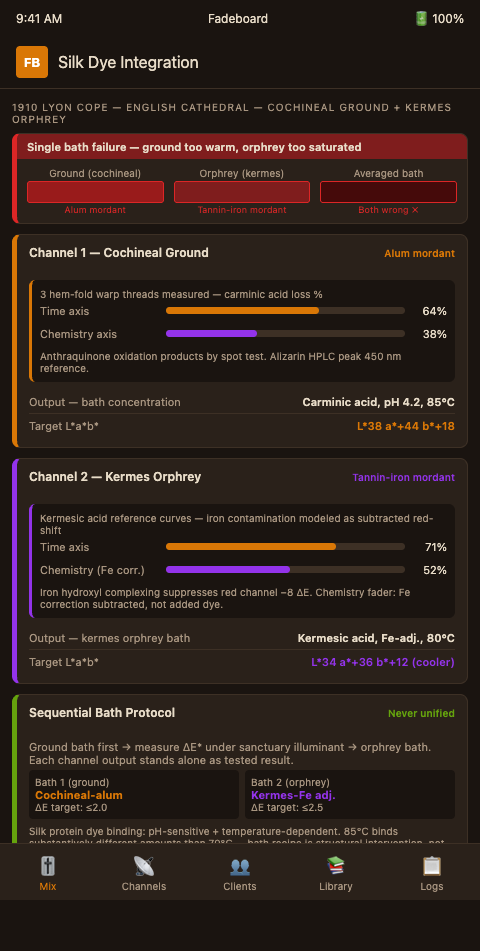
A conservator working on a 1910 Lyon silk cope for an English cathedral parish found that the vermillion-red ground and the gold-thread-adjacent deep crimson orphrey banding had faded at entirely different rates. The ground used cochineal with alum mordant; the orphrey crimson, based on fragment testing, had relied on kermes with a tannin-iron combination that gave it a cooler, browner character. Both areas read as a muddied red under studio light. Attempting a single unified dye bath to restore the cope produced a match for neither: the ground came out too warm, the orphrey too saturated.
Natural Dyes in Embroideries of Byzantine Tradition (MDPI Heritage) confirms that liturgical silks from this period routinely carry multiple dye species coexisting in adjacent zones. Each species has its own degradation rate, mordant dependency, and spectral signature. A workflow that ignores these distinctions and averages them into a single target invites exactly the problem that chapel parish faced: an aesthetically unified surface that is chemically wrong in every zone.
The root issue is structural: the mixing decision — how much of each dye component, at what mordant concentration — must be made before bath preparation, not inferred after. That is the role Fadeboard fills in a liturgical silk dyeing workflow.
Channel-by-Channel Mixing Control for Ecclesiastical Silk
Silk fiber binds dye molecules at the protein's free amine and carboxyl groups. Silk Dyeing Guide: How Color Binds to Protein Fibers (SELVANE) explains that dye-fibroin bonding is pH-sensitive and temperature-dependent: a bath run at 85°C binds substantively different amounts than one at 70°C, and the difference compounds when mordant concentration changes. This means the bath recipe is not merely a color decision — it is a structural intervention in the fiber's bonding capacity.
Fadeboard treats each dye component as an independent channel, analogous to an audio mixer fader. For the Lyon cope, the conservator opens three channels: the cochineal-ground channel, the kermes-orphrey channel, and a supplementary mordant-correction channel for the tannin-iron residue that is altering base hue in the orphrey zone.
Each fader has two axes: the time axis (how much of the original dye has been lost to photodegradation and hydrolytic decay) and the chemistry axis (which degradation products remain and what spectral contribution they make to the current appearance). Thermal degradation of natural dyes and their analysis using HPLC-DAD-MS (Fashion and Textiles, Springer) provides the degradation curves for alizarin, purpurin, and indigotin on silk — the kind of quantitative reference that allows a Fadeboard time-fader position to correspond to a measurable percentage of chromophore loss rather than a subjective judgment.
Setting the cochineal-ground fader: measure reflectance on three unsoiled warp threads from the hem fold. Plot against reference cochineal-alum silk curves. Determine what percentage of carminic acid remains. Set the time fader at that loss percentage and the chemistry fader to account for anthraquinone oxidation products detected by spot test. Fadeboard outputs a target bath concentration — carminic acid w.o.f. at the appropriate pH for this fiber condition.
Setting the kermes-orphrey fader: the same process, but with kermesic acid reference curves. The chemistry fader here must also account for the iron contamination from the tannin-iron mordant residue, which suppresses the red channel slightly. Bio-mordants: a review (PMC/NIH) covers how iron-based mordanting alters the final hue by complexing with the dye's hydroxyl groups — exactly the variable the chemistry fader models.
With both faders set, the conservator can preview the mixed result on-screen before preparing a single gram of dye. The two target spectral curves are displayed side by side, and the conservator can compare them against the reference photograph taken at the sanctuary under ISO D65. If the orphrey target needs a slight shift toward a cooler red to read correctly next to the gold thread, the kermes fader chemistry axis is adjusted until the two curves diverge by the correct amount. The damask in-dyeing best practices post extends this logic specifically to damask weave structures.
Advanced Tactics for Silk Dye Integration
Pre-Bath Mordant Alignment
Before setting bath concentrations, verify that both zones have been pre-mordanted to the same baseline. How to Mordant Protein Fibers — Silk and Wool (Kristin Arzt) describes a standard alum bath at 12–15% w.o.f. and 85°C for silk. If the cope's orphrey zone has residual tannin-iron from original preparation, a pre-mordant with aluminum sulfate will compete with the existing metallic complex. Log this in the Fadeboard chemistry channel before adjusting the fader — the iron correction needs to be modeled as a subtracted red-shift, not added dye.
Sequential Bath Protocol
Never attempt to restore both zones in the same bath unless spectral targets are identical. Even when two areas appear to need the same final color, different mordant histories mean different uptake rates. Restore the cope ground first, measure ΔE* under the sanctuary's measured illuminant, then proceed to the orphrey. This lets each Fadeboard channel output stand alone as a tested result rather than a theoretical average.
Silk Weft Stability Monitoring
Silk weft stability in restoration dye applications is worth reviewing before committing to a high-concentration bath on aged fibers. If tensile strength testing on extracted threads shows brittle fracture below 0.8 N/tex, reduce bath temperature to 70°C and extend immersion time rather than increasing dye concentration. Note that this adjustment changes the equilibrium uptake and must be re-modeled in the Fadeboard time fader.
Gauche inpainting as a complement
For areas where the silk ground is too fragile for bath immersion — broken warp threads, surface fiber loss — the gouache inpainting workflow post covers surface application techniques that can be calibrated against the same Fadeboard spectral target. The conservator exports the target RGB values from the Fadeboard session and uses them as the inpainting reference, ensuring visual continuity between bath-restored and surface-restored areas.
Session Documentation for Diocesan Review
Export the full Fadeboard mixing session as a PDF report before the first bath preparation. The report should include: channel fader positions with measured spectral baselines, target output curves for each zone, the maximum bath concentration applied, and the measured ΔE* result after treatment. Diocesan fabric committees increasingly require this level of documentation for pieces with heritage significance, and having it prepared before treatment begins — not reconstructed from memory afterward — is the professional standard.
Final Note for Silk Dye Conservators
A liturgical silk cope is not an abstract color problem; it is a garment that will be worn by a bishop or priest at specific feast days for decades after restoration. The mixing decisions made in Fadeboard's channels are decisions about how that vestment will read under candlelight at Easter Vigil, under a coloured window at a Marian feast, and in the flat light of a sacristy inspection. Channel-level precision in the soundboard session is what makes the difference between a cope that serves its liturgical function and one that must return for correction inside a year.
Ecclesiastical silk dye integration starts at the channel level, not the dye pot. Open a Fadeboard session with a separate fader for each dye component present in your vestment, document your spectral baselines before the first bath, and produce a provenance-quality mixing record that will satisfy both the sacristan and the diocesan commission.