Vestment Color Recovery: An Introduction to Soundboards
When the Fragment Is the Only Record
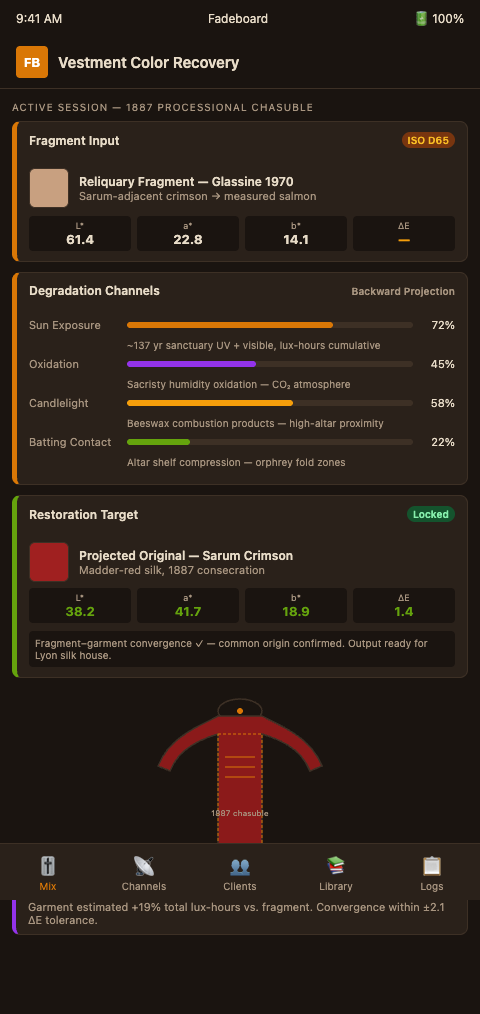
The 1887 processional chasuble arrived at the diocesan textile conservation lab with a treatment request that read simply: "restore original liturgical red." The conservator opened the case to find a garment whose silk ground had blanched from deep Sarum-adjacent crimson to a washed-out rose, its orphrey bands still slightly darker where they had been folded against the altar shelf for decades. A single fragment — cut for an earlier HPLC analysis — sat in a glassine envelope. That fragment was the entire evidentiary record.
This situation is not unusual. A multi-analytical study of papal vestments, including a silk chasuble, stole, and maniple attributed to Pope Pius VII, documented precisely this kind of differential fading: UVL and NIR imaging revealed pigment loss invisible to the naked eye, while XRF confirmed that pastel-reading areas had once carried far higher dye concentrations (Chemical Characterization of Pope Pius VII Ecclesiastical Vestment, MDPI). The fragment tells the truth the full garment can no longer tell.
The challenge for church textile conservators is that liturgical color is not merely aesthetic. Sarum red carried penitential and festal meaning depending on its exact chromatic position. Marian indigo and Lenten purple occupy canonically separate positions in the liturgical year. When a chasuble fades, it loses not just color but meaning — and matching that meaning requires recovering pigment values with fragment-exact fidelity, not approximating them by eye.
The Soundboard Framework for Vestment Color
Audio engineers working on archival tape restoration face an analogous problem: a recording that once had a particular frequency balance has drifted over time, and the engineer must reverse-engineer the degradation pathway — oxide shed, print-through, tape hiss accumulation — to recover the original signal. Fadeboard applies the same logic to pigment.
The core metaphor is an audio mixing soundboard with independent faders, each representing a distinct degradation channel. For ecclesiastical silk, the relevant channels are:
- Sun exposure — cumulative photooxidation from UV and visible light, which destroys the chromophore structure of madder, cochineal, and weld at different rates
- Oxidation — atmospheric oxygen reacting with dye molecules, particularly in silks stored in sacristies with variable humidity
- Candlelight and gaslight — localized thermal and combustion-product exposure that affects altar-frontal areas and orphrey bands disproportionately
- Batting contact — where vestments are folded against interlining, compression affects dye penetration unevenly
- Kiln aging — relevant for ceramics but also for historically fired-mordant processes in historic brocade
Textile fading from light is photooxidation driven by both UV and visible wavelengths, and critically, the damage is cumulative and irreversible — every lux-hour that strikes a dyed silk fiber removes pigment that cannot be put back (TSG Chapter III: Environmental Concerns for Textiles — Light, AIC Conservation Wiki). This is why a vestment that has hung in a sanctuary for forty years of Easter Vigils, Advent services, and ordinary Sundays may have lost more than half its original saturation while appearing merely "aged."
Fadeboard's faders let you dial each channel independently. You begin with the fragment's measured colorimetric values — taken under ISO D65 standardized illumination — and work backward. The sun-exposure fader models how much photooxidation the full garment would have accumulated over its documented liturgical life. The candlelight fader adjusts for altar proximity, since silk six inches from a beeswax taper ages differently than silk on a bishop's mitre in a sealed case.
Historic silk degrades through amino acid chain scission: as the fiber itself weakens, the dye's physical bond to the substrate changes, and early-warning markers can be detected before visible fading reaches its final state (Analytical Markers for Silk Degradation, PMC/Springer). This means the soundboard is not just a color tool — it is a degradation chronometer, letting you project backward from current state to original manufacture condition.
Once each channel is set, the output is a restoration target: the specific pigment values your Lyon silk house or Florentine brocade supplier needs to match. The target is expressed as measured colorimetric coordinates rather than a visual description, which means it survives the translation from your studio to the dyer's bath.
Advanced Tactics for Fragment-Based Recovery
The soundboard framework becomes most powerful when the fragment's exposure history differs from the main garment's. A fragment cut for analysis in 1970 and stored in a dark archival envelope has accumulated fifty fewer years of light exposure than the chasuble hanging in the sanctuary. Fadeboard lets you apply differential sun-exposure values to fragment and garment separately, arriving at a common origin point.
For vestments with multiple dye layers — a gold-ground Byzantine brocade, for example, where silk weft threads carry one colorant and the linen-core warp carries another — independent faders for each fiber type are essential. The conservation recommendation of ≤50 lux for sensitive textiles on exhibition exists precisely because each fiber type and dye class has a different threshold for visible damage onset (Light Exposure for Artifacts on Exhibition, CCAHA).
LED light sources cause measurably less degradation than UV-heavy incandescent or halogen sources, but "less" is not "none" — quantified comparisons show UV causes greatest strength loss and LED causes least, but cumulative lux-hours still accumulate (Study on Aging Mechanism of Textile Relics in Museum Environment, Taylor & Francis). A vestment that survived gaslight-era sanctuaries may have accumulated a different degradation profile than one in a post-1980 nave with fluorescent tubes.
For parish conservators beginning this work, the first session should focus on characterizing the fragment under consistent illumination before touching the main garment. Measure the fragment's current colorimetric values, document the garment's estimated exposure history from parish records, and set the soundboard channels conservatively. You can always add degradation; you cannot subtract it once you have committed to a dye bath.
Common Pitfall: Treating the Fragment as a Color Target
A widespread error in fragment-based vestment restoration is using the fragment's current, degraded color as the restoration target rather than as the input for a backward-projection. The fragment is a degraded reading, not an original one. If the fragment has been stored in a glassine envelope in a diocesan archive since 1970, it has still accumulated fifty-plus years of acid off-gassing from archival paper and whatever light exposure occurred before it was filed. A conservator who simply matches the fragment's current Lab* values is matching a degraded reading, not the original Sarum red or Marian indigo the chasuble carried at consecration.
Fadeboard's channel framework enforces the correct logic: the fragment's current colorimetric state is the starting point of a backward-projection through its own estimated degradation pathway, which is then compared against the garment's projected original. The two projections should meet at a common origin. If they do not, one of the channel settings needs review — either the fragment's estimated storage exposure is wrong, or the garment's liturgical use history has been underestimated.
For chasubles with multiple dye layers — a gold-ground Byzantine-influenced cope, for example, where the linen warp and the silk weft carry different colorants — the backward-projection must be run separately for each fiber type. The convergence point for a compound weave is not a single original color but a pair of coordinated original colors calibrated to read together under the sanctuary's specific illuminant.
When you are ready to extend this documentation into a formal treatment record for diocesan review, liturgical hue documentation for vestment records provides the framework for capturing what Fadeboard's output means in a conservation report. For those preparing to take a first full chasuble through the process, parish chasuble color work for beginners walks through each stage with annotation. Conservators in adjacent preservation fields will recognize the exposure-channel logic from costume archive soundboard basics.
Getting Started With Your First Fragment
If your parish has a chasuble or stole that has lost its liturgical color identity, Fadeboard gives you the tools to recover it systematically rather than by approximation. The fragment-to-garment workflow takes under an afternoon for a single vestment, and the output integrates directly into AIC-standard treatment documentation. Diocesan commissions reviewing conservation proposals respond to colorimetric precision in ways that subjective color descriptions do not satisfy.
Before scheduling your first session, gather what documentation survives: the vestment's estimated manufacture date, any parish inventory entries, photographs from historical events where it appears, and the fragment's own storage history. Even a partial record narrows the channel settings considerably and reduces the conservator's reliance on estimation at the most uncertain parts of the degradation pathway. A 14th-century Corpus Christi chasuble with no archival record requires wider channel uncertainty bounds than a 19th-century Gothic-revival piece with a documented manufacture invoice and a known sacristy storage history.
The first session should produce not just a restoration target but a documented uncertainty range for that target — the conservator's confidence interval around the channel outputs. This uncertainty range belongs in the treatment proposal submitted to the diocesan commission, because it is honest about what the fragment data can and cannot support. Commissions that receive only a point estimate rather than a defensible range sometimes reject proposals that omit this context, treating the absence of uncertainty documentation as a sign of insufficient rigor.
Sign up for the Fadeboard waitlist to begin your studio's fragment-based vestment recovery workflow. Conservators who join before the next Pentecost season can schedule their first intake session in time to produce a commission-ready treatment proposal for any Easter-cycle or Ordinary Time vestment in their care.