A Pigment Soundboard Primer for Quilt Restorers
Why a Single Recipe Fails the Whole Quilt
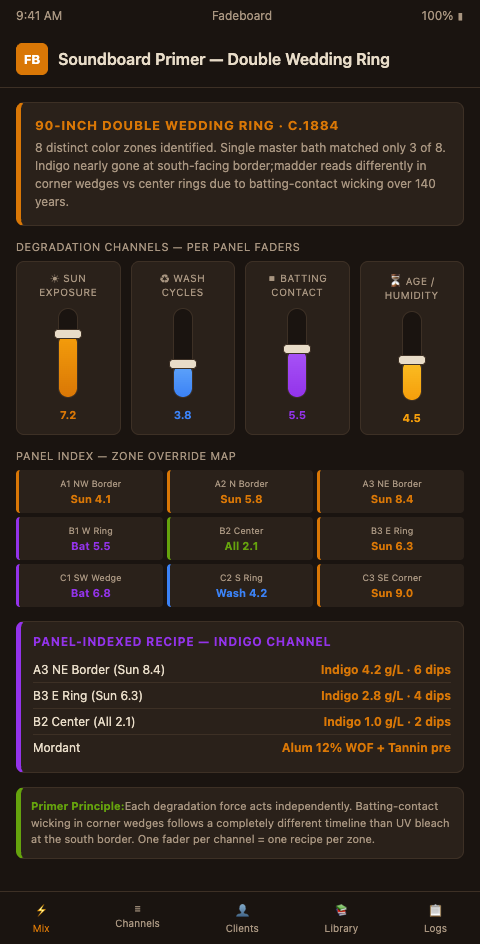
A 90-inch Double Wedding Ring arrived at a restoration workshop with eight distinct color zones. The indigo blue was nearly gone at the top border where a south-facing window had done its work. The madder red read differently in the center rings than in the corner wedges — not because the original dyer used different batches, but because the batting contact beneath those wedges had wicked moisture repeatedly over the quilt's 140-year life. The workshop specialist mixed one reference bath, tested it on a calico swatch, and ended up with a color that matched roughly three of the eight zones.
This is the core failure mode of quilt restoration when approached without panel-indexed thinking. The Metropolitan Museum's materials overview of 19th-century American quilts documents the palette clearly: turkey red, indigo, madder, weld yellow, logwood black, and cochineal were the dominant colorants, each with different photochemical and mechanical degradation profiles. You cannot treat them as a uniform faded mass and expect a coherent result.
Craft Industry Alliance's 2024 quilting survey estimates 9–11 million active quilters in the US and Canada, and the demand for specialist restoration of antique and heirloom work has grown steadily within that community. Workshop specialists restoring multi-yard pieces are facing increasingly complex fade problems — and increasingly demanding clients who want panel-level accuracy, not a globally averaged approximation.
The Soundboard Framework: One Fader Per Degradation Channel
The conceptual breakthrough comes from treating a quilt the way a sound engineer treats a multi-track recording. In an audio mixing soundboard, each instrument sits on its own channel with its own fader. You can push the vocals up without affecting the drums. You can add reverb to the bass without touching the guitar. The relationships between channels are independent, even though the final output is a single, coherent mix.
Fadeboard applies the same logic to quilt restoration. Each degradation force — sun exposure, wash cycles, batting contact, humidity cycling, gaslight exposure in 19th-century interiors — becomes its own fader. The sun-exposure fader tracks photochemical bleaching from UV radiation. The wash-cycle fader models the progressive loss of surface dye from repeated laundering. The batting-contact fader captures the localized dye migration that happens when cotton wadding presses against the top fabric layer through thousands of hours of use.
Every square yard of a multi-yard quilt becomes its own channel strip. A north-facing interior block that was never exposed to direct light and sat tightly quilted against dense cotton batting has a completely different fade fingerprint than a corner piece that spent decades in a south-facing window, was washed six hot washes in the early 20th century, and sits over a thin batting zone that allowed more UV penetration to the backing. When you index each panel separately, you can build a panel-indexed recipe that specifies dye concentration, mordant ratio, and bath temperature for that specific square yard — not for the quilt as an undifferentiated whole.
Research on natural dye decomposition rates confirms that anthraquinone dyes like madder and cochineal are chemically more stable under light exposure than flavonoid-based yellows such as weld. That means a sampler quilt with both weld yellow borders and madder red center blocks will show a strongly asymmetric fade pattern even under identical light conditions. The soundboard framework makes that asymmetry explicit and actionable: the weld channel gets a higher sun-exposure fader position than the madder channel, reflecting the real chemistry rather than averaging it away.
The Met's conservators use HPLC analysis to distinguish cochineal, madder, and indigo on historical textiles — confirming that the colorants behave as separate chemical systems that must be treated independently. Fadeboard makes that same principle accessible to workshop practitioners who may not have laboratory instrumentation, by building the differential degradation logic into the channel structure itself.
Applying the Framework: First Steps for Workshop Practitioners
Start by laying the quilt flat under even, diffuse light and photographing it in sections — not as a single wide shot. Each section becomes a working zone. Note the original colorants present in each zone: is the red a true turkey red (a cotton-specific mordant dye known for its orange-red cast and relative colorfastness), or is it a later synthetic alizarin red? Is the blue a deep indigo vat dye or a lighter logwood black that has shifted toward purple-gray?
Antique Quilt History's color documentation work records that turkey red and indigo were specifically prized by 19th-century quilters for their comparative colorfastness — meaning that when you encounter severe fade in one of these colorants, the degradation force was unusually strong. A faded turkey red signals something significant: either extraordinary sun exposure, acidic washing conditions, or contact-based dye loss. The soundboard faders help you identify which force was dominant by cross-referencing the spatial distribution of the fade with the quilt's known history.
Once zones are mapped, assign each panel a position on the relevant faders. A corner panel with documented south-facing window exposure gets a high sun-exposure fader reading. A center medallion with intact batting and minimal washing history gets a low wash-cycle fader reading and a moderate batting-contact fader. The resulting panel-indexed recipe for each zone specifies not just a target color, but the degradation state that produced it — which tells you how to recreate it consistently.
For quilt fade documentation before any treatment begins, this initial mapping step is the professional standard. The soundboard framework gives that documentation a structured output rather than a set of written notes that different workshop members may interpret differently.
Apprentice Handoffs and Multi-Shift Work
One underappreciated benefit of the panel-indexed recipe system is what it does for apprentice handoffs. A restoration of a large Baltimore Album or multi-yard sampler quilt rarely happens in a single session. When a senior specialist hands off to an apprentice at the end of a workshop day, a verbal description of "the red should be a little more orange in the top-left panels" is not a reliable transfer of knowledge. Shade drift between shift changes is one of the most common sources of inconsistency in workshop environments.
Fadeboard's channel-indexed records give the apprentice a precise starting point for each panel: fader positions, dye bath concentrations, mordant ratios, and the target color for that specific zone. The apprentice is not guessing at what the senior specialist intended — they are reading from a reproducible document. This is how professional 19th-century quilt fade mapping workflows scale from solo practice to team-based restoration.
The Rate of Fading of Natural Dyes research quantifies the relative fading rates for madder, indigo, cochineal, and yellow plant dyes under controlled conditions — data that feeds directly into the fader calibration logic. Knowing that a weld-yellow block fades approximately twice as fast as a madder-red block under equivalent light exposure means you can set the sun-exposure fader for the weld channel to a higher position without needing laboratory instrumentation on-site.
For vestment conservators working with similar natural dye palettes on liturgical textiles, the same channel-based approach applies — the soundboard primer for vestment color recovery covers the parallel framework for silk-ground and linen ecclesiastical work.
Getting Started in Your Workshop
If you restore multi-yard heirloom quilts and have been applying a single reference bath to the whole piece, Fadeboard's panel-indexed channel system is the structural change that will reduce your re-dye rate and your shade-drift incidents. Start with a single quilt — one with at least three visibly distinct fade zones — and map each zone to independent sun-exposure, wash-cycle, and batting-contact fader positions before mixing your first bath. Document the fader settings alongside your dye concentrations, and compare the result against the previous whole-quilt approach. The difference in zone-level color accuracy will be apparent in the first panel. Workshop participants who bring a dated quilt with a known placement history (attic storage, south bedroom, handed-down via a single family) will get the clearest demonstration of what panel-indexed recipes change in practice.