What Funeral Homes Get Wrong About Immigrant Community Memorials
The Documented Gap Between What Funeral Homes Offer and What Immigrant Families Need
A Baylor University study on Latino bereavement practices found that funeral industry observers openly admit "the industry doesn't know how" to serve the Latino community properly. The study's bluntness is unusual but the finding is well-documented. Homesteaders Life analysis of Hispanic service delivery reports that the industry lacks familiarity with multi-day visitations, novena traditions, and bilingual service requirements that Latino families expect.
The gap extends far beyond one community. PubMed research on hospice cultural competence found only 26% of hospice board members complete cultural competence training. PMC research on end-of-life care for immigrants documents systematic cultural barriers immigrant patients face throughout the bereavement journey.
The scale is significant. Pew Research reports the United States is home to 50.2 million immigrants, representing 14.8% of the population. Many of these families also face cross-border logistics: Diaspora Insurance research found that dying abroad costs African diaspora families 5 to 10 times what they expect, a pattern that repeats across immigrant communities. The Travel.State.gov guidance on return of remains describes the consular paperwork involved, but the cultural and emotional dimensions of repatriation rarely receive the same structured support.
Immigrant family tribute gaps are not mysteries. They are predictable, documented, and correctable.
A Tapestry Framework for Serving Underserved Diaspora Memorial Needs
The tapestry metaphor clarifies what immigrant families actually want. They do not want a "standard" memorial with a few ethnic-flavored additions. They want a memorial that assumes multiple heritages, multiple languages, multiple observance timelines, and multiple contributor geographies from the start.
StoryTapestry addresses five specific funeral homes immigrant community memorial mistakes with platform-level solutions. First, the name-and-title mistake. Many immigrant families have a given name in their heritage language, an Anglicized working name, and sometimes a ceremonial or spiritual name. A Vietnamese-American woman might be Nguyễn Thị Lan to her family, Linda Nguyen to her employer, and Pháp Lan to her Buddhist congregation. All three names deserve presence in the memorial, not just the easiest one for English-speaking staff to pronounce.
Second, the calendar mistake. Immigrant families often observe multi-day rituals (Latino velorios, Irish wakes, Hindu antyesti sequences, Orthodox 40-day commemorations) that American funeral homes treat as "optional extras." StoryTapestry treats the observance calendar as primary, with the service date being one milestone among many rather than the entire memorial event.
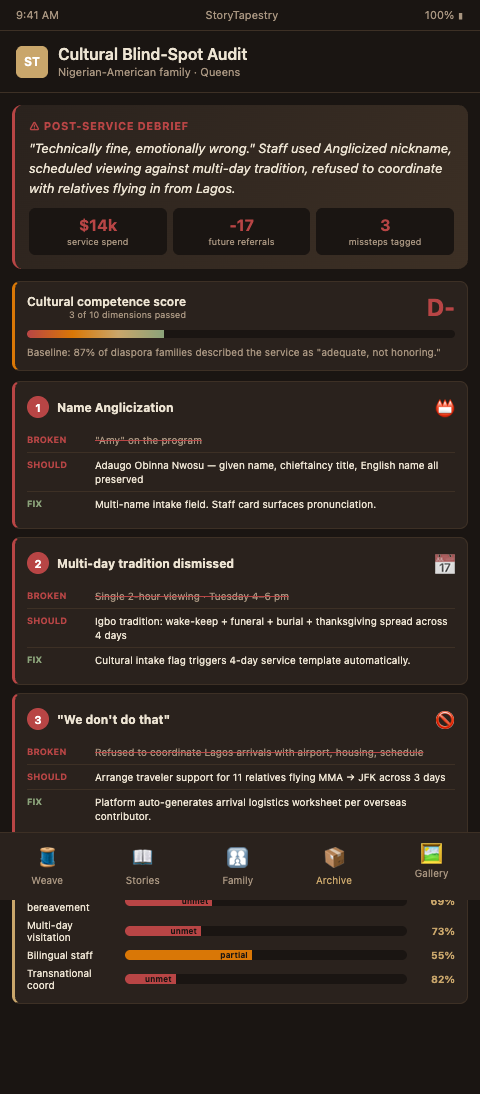
Third, the contributor-geography mistake. A Nigerian-American memorial should assume that relatives in Lagos, London, Houston, and Atlanta all need to contribute. Default platforms assume everyone is local and treat overseas contributors as edge cases. Drawing on culturally adaptive platforms principles, StoryTapestry assumes transnational contribution as the default.
Fourth, the language mistake. Bilingual or multilingual families get treated as translation problems rather than linguistic realities. Platform defaults should accommodate bilingual presentation, original-script preservation, and multi-language search from the very first intake meeting.
Fifth, the repatriation mistake. When remains or ashes return to the home country, the memorial often fractures into an "American service" and a "home country service" that never communicate. StoryTapestry supports a unified memorial that hosts both services within one tapestry, with geographic coordination for family members in each country. Partnering with diaspora contributor networks extends your funeral home's reach to communities you could not otherwise serve at distance.
Correcting these five mistakes moves funeral homes from "technically served" to "genuinely honored" for immigrant families. Word of mouth in immigrant communities is intense, and families who feel respected become the source of the next 15 referrals.
Beyond the five core mistakes, funeral homes serving immigrant communities must also confront a quieter but persistent problem: the assumption that second and third-generation family members have fully assimilated and therefore want mainstream service defaults. In practice, many second-generation clients show up wanting the opposite. They may be fluent English speakers with no accent and American cultural preferences for most of their own lives, but when a parent dies they often want to reconnect with the cultural practices their parents preserved. A Vietnamese-American son who has not spoken Vietnamese in 20 years may suddenly want Buddhist chants, incense, and 49-day observances because his father would have wanted them. Funeral homes that assume assimilation and default to generic service are surprised when these families feel underserved despite seeming culturally integrated.
Platform-level support for cultural heritage activation, not just current practice, is what separates homes that serve both generations well from those that serve only the visibly traditional.
Advanced Tactics for Closing Cultural Blind Spots in Funeral Services
Experienced funeral directors working toward immigrant community competence layer several practices on top of platform capabilities. First, map your service area demographics against your staff's cultural fluency. If 30% of deaths in your county involve immigrant families but your staff's training is 90% generic, the mismatch shows in every intake meeting. Investing in targeted cultural training for the top three immigrant communities you serve pays off within one quarter through referrals.
Second, build cultural consultant relationships before you need them. Identify clergy, community elders, and cultural association leaders for each community. When a family calls at 11 p.m. with an unexpected death, you want to text the Vietnamese Buddhist monk you already know, not scramble to find one.
Third, audit your standard intake forms for cultural blind spots. Do they ask about heritage language preferences? Multi-day observance traditions? Contributor geography? Repatriation plans? Religious dietary requirements for reception meals? If the form assumes a white, English-speaking, Christian-or-secular, local-relatives-only family, every non-matching family is already being underserved before they meet a staff member.
Fourth, partner with memory care and hospice providers in immigrant community hubs. Building funeral home partnerships with facilities that serve immigrant elders creates continuity of care from late-life through memorial. Families notice when their loved one's care team and memorial team coordinate rather than start from zero.
Fifth, price transparently for transnational services. Repatriation can run $8,000 to $25,000 depending on destination and documentation. Families who receive clear itemized estimates in advance (even as "typical ranges" rather than quotes) feel respected rather than ambushed. Hidden costs are one of the top complaints from diaspora communities about funeral services.
Sixth, follow up at culturally appropriate anniversaries, not generic 30-day email blasts. A Jewish family receives a shloshim follow-up at 30 days and a yahrzeit at 1 year. A Chinese family receives a 49-day outreach and a Qingming outreach at the appropriate time. These anniversary touches convert one-time clients into lifetime community relationships, because immigrant families remember who honored their traditions and who treated them as a generic transaction.
Seventh, publish plain-language service descriptions in the languages your community speaks. A funeral home website with Spanish, Vietnamese, Tagalog, or Arabic service descriptions signals competence before the first phone call. Translation quality matters: machine-translated content reads as dismissive, while professionally translated content signals investment.
Eighth, prepare explicit guidance for cross-border case complications. When remains must travel from the US to Haiti, from Canada to India, or from the UK to Pakistan, the paperwork, timing, and coordination differ in meaningful ways. Funeral homes that have documented checklists for the 15 to 25 destination countries that account for most of their repatriation caseload save families weeks of stress. The checklist covers consular requirements, documentation translations, airline transport rules, destination country arrival procedures, and local burial or cremation requirements. StoryTapestry maintains these checklists at platform level and surfaces the correct one automatically once the family confirms the destination.
Ninth, establish clergy and spiritual leader relationships before you need them. A Catholic priest for Latin American families, a Sunni imam for Pakistani families, a Theravada monk for Cambodian families, a Coptic priest for Egyptian families, a Pentecostal pastor for Nigerian families, a Mahayana monk for Vietnamese families, a rabbi for Russian Jewish families: these relationships take months to build and should be in place before a middle-of-the-night phone call requires them. Funeral directors who cultivate these relationships proactively, often by attending community events unrelated to funerals, find themselves dramatically better positioned when an immigrant family needs rapid cultural and religious support.
Close the Gap Your Immigrant Community Already Notices
Immigrant families in your service area are already discussing which funeral homes "get it" and which do not. StoryTapestry helps your home become the one they recommend, through platform architecture that assumes multicultural, multilingual, transnational memorials from the first intake conversation. Contact our diaspora services team for a no-obligation cultural audit of your current intake workflow and platform stack. We will identify the three highest-leverage gaps for your specific client demographics and show you exactly what a corrected service would look like. The audit covers your current intake forms, staff cultural training, language capabilities, physical facility accommodations, pricing transparency for transnational cases, follow-up communication cadence, and partnership relationships with cultural associations and clergy. We provide findings as a concrete remediation roadmap with estimated effort and expected impact for each change.
Funeral homes that implement even the top three recommendations typically see measurable referral growth from immigrant communities within two quarters. The competitive difference in serving immigrant families is rarely about advertising budget; it is about whether your home has built the operational foundation that these families evaluate you against. The gap between your current state and genuine cultural competence is usually smaller than you expect, and closing it is usually cheaper than the revenue you are currently losing to homes that already have.