Future of Real-Time Multilingual Memorial Collaboration Tools
Why Live Multilingual Memorial Work Is Not Ready Yet
A family in four time zones wants to edit a memorial tribute together, speaking four languages, over a 90-minute video call. The consumer translation stack keeps up with simple speech in scripted business contexts. It breaks on grief — on idioms, crying voices, overlapping speakers, and the culturally grounded phrases that carry memorial meaning. The family hangs up frustrated, finishes the tribute asynchronously over three weeks, and wonders why the technology promised more than it delivered.
Real-time speech translation services have improved substantially but remain limited for emotional, culturally specific speech. KUDO's platform delivers continuous real-time speech translation using AI plus human interpreters. Wordly offers AI-only real-time translation as SaaS. Interprefy runs enterprise-scale remote simultaneous interpretation. These tools work well for conferences and multilingual meetings, as documented in ResearchGate analysis of real-time MT in multilingual meetings. The gap between conference translation and grief translation, however, is documented in Middlebury's analysis of AI and the future of translation. Science Publishing Group's analysis of the future of translation argues for integrating AI with human expertise for this exact class of work. And arXiv research on collaborative document editing with AI agents shows CSCW research still maturing on shared AI agents in real-time collaborative workflows.
A Staged Roadmap for Real-Time Multilingual Memorial Collaboration
The tapestry metaphor stays instructive in live collaboration: several weavers working at a single loom in real time need both shared materials and individual judgment space. StoryTapestry ships this capability in four staged tiers, so families get the benefits at current technology reliability while we keep advancing the frontier.
Tier 1: Asynchronous multilingual editing (shipped). Contributors edit memorial sections in their preferred language. Translations propagate within minutes, not seconds, through the machine translation nuance workflow. This is not real-time, but it is multilingual collaboration that works today for 95% of transnational memorial cases. Most families do not actually need real-time speed; they need reliable translation and visible progress.
Tier 2: Near-real-time text collaboration with translation delay (shipped). Two or more contributors edit the same section simultaneously with 10-30 second translation delay on each other's changes. This works well for text editing in family review sessions. Contributors see each other's cursors, see their edits being translated, and can comment across languages. The delay is acknowledged in the UI rather than hidden; transparency beats false real-time claims.
Tier 3: Live video memorial gatherings with human-interpreter fallback (shipping 2026). For memorial gatherings on video, real-time machine translation handles routine speech and falls back to a human interpreter when the AI confidence score drops below threshold. The human interpreter is a paid role, scheduled in advance for gatherings larger than six participants or when emotionally high-stakes moments are expected. This hybrid model follows the KUDO architecture but adds the domain-specific confidence scoring trained on memorial contexts.
Tier 4: Real-time collaborative audio-video editing across languages (research track). Contributors record voice notes or short video clips and edit each other's transcripts in real time with live translation. This is the 24-month horizon, not the next quarter. Technology is not yet reliable enough for production memorial work — audio-video editing across languages is research track because the failure modes are unacceptable for grief content.
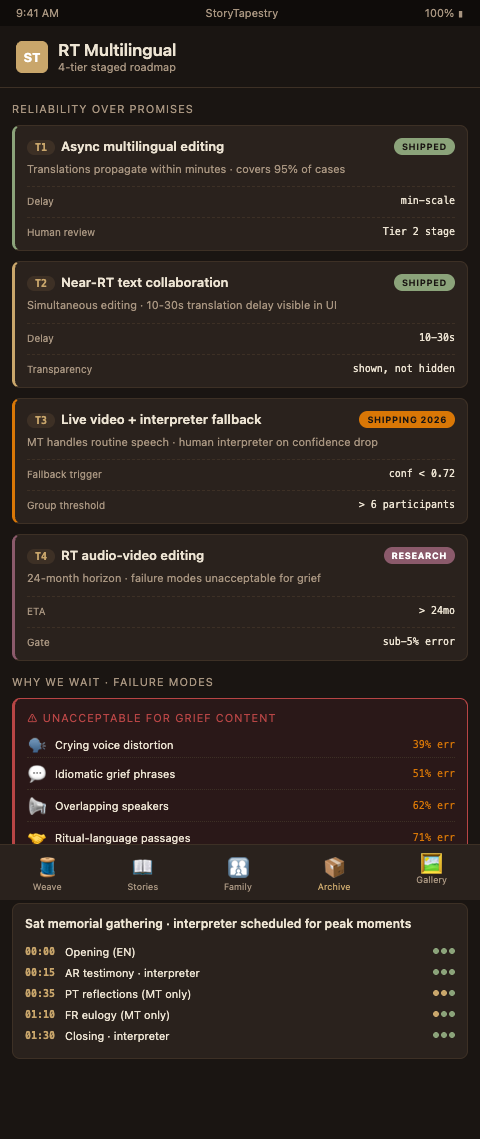
The tapestry stays woven in tiers because premature automation drops threads. A memorial is not a conference; the cost of a translation error is higher because the grieving family cannot rewind. We ship tiers as they become reliable for this specific context, not as they become technically possible for generic contexts. This staged approach benefits from geolocation metadata enrichment running alongside — each tier gets richer as metadata accumulates. For comparable high-stakes content preservation in other memorial niches, see how perinatal programs handle audio waveform preservation — a different content type but the same principle of not shipping automation faster than reliability supports.
The staged roadmap also respects a broader truth about emerging technology in grief contexts: the failure modes are the product. A consumer translation tool that botches a conference talk produces inconvenience; a memorial translation tool that botches a eulogy produces lasting harm the family will never forget. StoryTapestry's roadmap commits to shipping each tier only when the failure rate is low enough that the remaining failures can be caught by human review. This conservatism frustrates sales cycles where competitors promise more sophisticated automation sooner, but funeral directors who have tested premature automation on actual family cases typically come back wanting the reliable tier rather than the promised one. Your families cannot afford to be beta testers for memorial technology, and a roadmap that prioritizes reliability over marketing claims is the only ethical posture for this category of product.
Advanced Tactics for Live Multilingual Memorial Work Today
Four tactics help funeral services get value from current-generation tools without overpromising:
Schedule human interpreters for high-stakes moments, not full sessions. A three-hour family memorial planning call does not need a full human interpreter. The first 15 minutes and the final 20 minutes — where emotional content concentrates — benefit most. Schedule interpreters for those windows; machine translation handles the middle. This cuts cost 60-70% while maintaining quality where it matters.
Use written real-time over spoken real-time when possible. A shared document with multilingual editing, where each contributor sees translations of the others' text within seconds, produces better memorial outcomes than a video call with spoken translation. Written real-time lets contributors reread and refine; spoken real-time forces one-chance comprehension.
Record and re-translate. Live translation during a gathering is for immediate comprehension. Record the session and re-translate offline for the published tapestry. The published record should never rely on live translation quality alone; it should incorporate the careful re-translation pass.
Prepare cultural advisors before live gatherings. A 30-minute cultural advisor briefing with the interpreter before a memorial gathering — covering family background, expected ritual moments, and sensitive terminology — improves live translation quality substantially. Treat the briefing as billable; it is a service deliverable.
Publish the translation tier in your scope of work. When a funeral service offers a transnational package, state explicitly which tier the family is getting. "Tier 3 with human interpreter for the memorial gathering, Tier 2 for family planning sessions, Tier 1 for story submissions." This sets expectations and differentiates higher-priced packages.
Invest in interpreter relationships specific to your caseload's language pairs. The pool of interpreters skilled in high-emotional-content live work is small in most language pairs. Funeral homes that cultivate ongoing relationships with two or three interpreters per primary language pair have dramatically better outcomes than those who hire ad-hoc through generic agencies. The interpreters who specialize in funeral and memorial work develop distinct competencies around emotional registers, ritual-specific vocabulary, and cultural sensitivity that generic conference interpreters do not carry. Pay these specialists competitively and prioritize relationship continuity over marginal cost savings.
Prepare contingency plans for interpreter no-shows. Live memorial gatherings cannot simply be rescheduled when an interpreter falls ill or has an emergency. Maintain a secondary interpreter for each primary language pair, brief them ahead of time about the case, and compensate them for availability even when they are not needed. A 40 to 60 percent availability retainer is less expensive than a botched live gathering, and the few cases per year when the backup activates fully justify the ongoing cost.
Reserve synchronous video time for genuinely synchronous needs. Most multilingual memorial work does not require live video at all. Pre-recorded eulogies with prepared translation, asynchronous family discussions with translation delay, and written collaborative editing across languages cover the majority of communication needs. Live video adds complexity that fails more often than it succeeds in current technology, so reserve it for the specific moments that genuinely need real-time presence, and handle everything else with better-reliability asynchronous tools.
Take the Next Step
StoryTapestry's real-time multilingual roadmap is on a deliberate schedule — we ship when the technology is reliable for grief contexts, not when it is reliable for generic conference contexts. If you are evaluating memorial platforms and the competition promises real-time translation for everything, ask them which tier and which failure-mode research. Our team publishes the roadmap openly. Request a briefing with our platform lead and we will walk you through the exact capabilities available this quarter and planned for the next four. The briefing covers the current state of Tier 1 and Tier 2 capabilities in detail, the Tier 3 timeline for human-interpreter fallback infrastructure, and the research track on Tier 4 audio-video editing across languages. We share specific failure-mode research, confidence-scoring methodology, and the training data sources we use for memorial-specific prompting.
Funeral directors who understand the staged roadmap typically position their transnational packages more clearly to families, setting accurate expectations about what current technology delivers reliably and what remains a live-interpreter human role. This clarity avoids the common failure pattern where competitors promise full-session real-time translation that then degrades at emotional moments, leaving families frustrated. Your transnational families deserve accuracy about what today's tools can and cannot do, and the funeral home that speaks honestly about capabilities earns trust that vague claims cannot produce.