Future of AI-Assisted Comrade Matching for Veteran Memorial Projects
The Diminishing Comrade Window for Aging Veterans
The coordinator for a 2025 memorial for a 98-year-old WWII bomber pilot spent three weeks searching for surviving members of his B-17 crew. The crew had been photographed together in 1944. None of the eight men in the photo were labeled except the veteran himself. Traditional search methods—reunion mailing lists, VFW post queries, Air Force association databases—turned up nothing. The other seven crew members were presumed deceased or untraceable. The memorial launched with the photo captioned only with the veteran's name.
This scenario will repeat thousands of times as the WWII, Korean, and early Vietnam-era cohorts age into memorial density. The Military.com report on AI cracking an 84-year WWII mystery documents that AI facial recognition has successfully identified specific servicemembers in previously unidentified historical photos. Times of Israel coverage of the Google engineer identifying anonymous WWII faces shows the technology moving from research into practical application.
The foundational research comes from Virginia Tech's Civil War Photo Sleuth, which combines AI facial recognition with crowdsourced metadata to identify soldiers in 19th-century photographs at 85% accuracy. The peer-reviewed Photo Sleuth paper documents the hybrid AI+crowdsource framework that scales across historical military photo archives.
Adjacent domains confirm the technology's maturity. Eightfold AI matches veterans to jobs at 90%+ accuracy using service-record cross-referencing. FamilySearch AI developments in genealogy apply machine learning to cross-document person matching at scale. The capability to apply this stack to veteran memorial comrade matching exists; what has not existed is a memorial-grade workflow that deploys it responsibly.
AI-Assisted Comrade Matching in the Tapestry Workflow
StoryTapestry's AI comrade-matching framework weaves three technologies into the memorial production pipeline: facial recognition against historical military photo databases, service-record graph matching against veteran directories, and relationship inference from deployment and assignment overlaps. Each technology produces candidate matches that a human coordinator reviews before any contributor outreach begins.
Facial recognition against photo archives. When a family uploads a unit photo, StoryTapestry runs facial recognition against opt-in veteran photo databases and publicly available military photo archives. The 2.5 million-veteran Together We Served directory represents one of the largest opt-in photo corpora relevant to memorial workflows. A returned candidate match surfaces with a confidence score and the candidate's current contact preferences (if opted in for memorial outreach).
The coordinator reviews candidates and approves outreach to high-confidence matches. No auto-contact occurs without human review—this is a critical ethical guardrail. The system operates as a research assistant, not an autonomous agent. False-positive matches are filtered before any comrade receives an invitation they shouldn't receive.
Service-record graph matching. The system constructs a graph of service-record overlaps. If the veteran served with 552nd Fighter Squadron from 1968-1970, the system identifies other veterans in its opt-in network who served in 552nd FS during overlapping windows. This is pure metadata matching—unit + date range + branch—and produces high-confidence candidates even when facial recognition lacks photo material. The FamilySearch genealogy AI patterns inform the data-matching architecture.
Relationship inference from deployment overlap. Beyond unit-level matching, the system infers likely comrade relationships from deployment location and time overlap. A Navy corpsman who deployed to Iraq with Marine infantry units in 2004 has comrades distributed across multiple unit rosters that unit-only matching would miss. Inferring across this cross-unit overlap requires graph traversal from deployment location and time window. The resulting candidates carry lower confidence but unlock comrade cohorts that purely unit-bounded matching cannot reach. This technique pairs naturally with geospatial deployment mapping because both depend on precise location/time data.
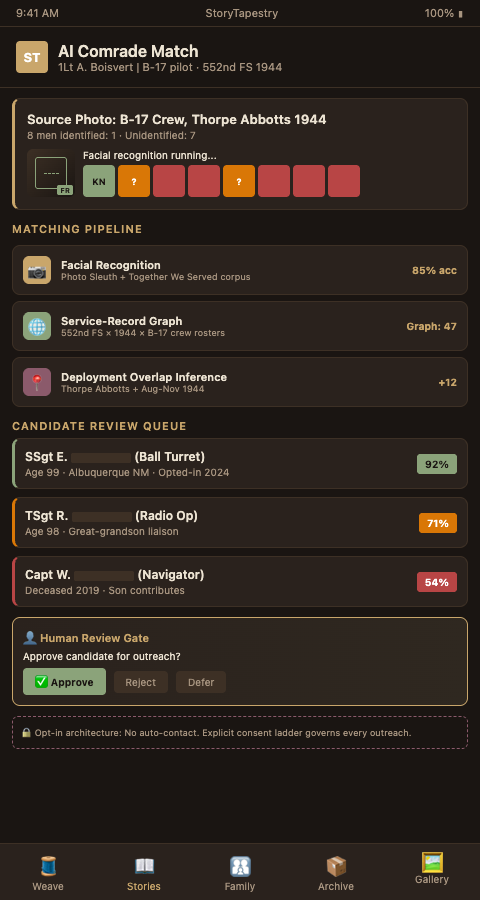
Consent and opt-in architecture. Veterans who opt into the comrade-matching network explicitly consent to being surfaced as candidates for memorial contribution. The opt-in flow covers which branches, units, and date ranges they want to be surfaced for, plus contact preferences (email only, phone acceptable, no contact for specific unit affiliations). This consent architecture addresses the ethical concerns that would otherwise block AI deployment in a sensitive context. Without structured consent, AI comrade matching becomes a surveillance tool; with it, the same capability becomes a community connection service.
Integration with oral history adaptation. AI matching produces candidate lists that flow into the oral history adaptation interview workflow. Candidates are not just names—they are contributor prospects with known unit overlap, date overlap, and relationship inference context. Interviewers arrive at contributor conversations with substantially better priming than manual lookup would support.
Parallel to biometric capture technology. The technology stack parallels patterns seen in biometric capture technology in adjacent memorial domains, where sensor data creates memorial-grade evidence that manual methods cannot produce. The ethical and consent architecture translates similarly—both require explicit opt-in, human review, and contributor-protective defaults.
Advanced AI Matching Tactics
Confidence thresholding calibrates the outreach volume to coordinator capacity. For a memorial with coordinator bandwidth for 40 contributor outreaches, the system surfaces the top 40 candidates by confidence score. Coordinators at larger scale can adjust thresholds to surface more candidates. The system learns from coordinator accept/reject decisions to improve future matching quality—a feedback loop that compounds accuracy over time.
Historical photo enhancement extends matching to low-resolution archival images. Many WWII and Korean War-era photos are scans of prints with degraded detail. StoryTapestry's photo pipeline runs lightweight enhancement (not generative reconstruction, which would introduce false features) to improve facial recognition accuracy on historical source material. The distinction between enhancement and fabrication is critical—memorial-grade matching cannot rely on AI-invented facial features.
Multi-generational matching supports family research. When the great-granddaughter of a WWI doughboy approaches a funeral home to plan her veteran father's memorial, AI matching can surface connections across generations of the family's military heritage. This isn't direct comrade matching for the father's memorial but supports broader family military-history context that enriches the tapestry narrative.
Cohort-specific outreach language adapts to matched candidate characteristics. A candidate matched through WWII bomber crew facial recognition is typically 95+ years old if living; outreach language, timing, and channel differ substantially from outreach to a post-9/11 candidate in their 40s. StoryTapestry's outreach templates adjust based on candidate cohort metadata.
Ethical review boards become a governance layer as AI matching scales. Funeral home networks running AI-matched memorials at volume benefit from a cross-organization ethical review board that reviews matching outcomes, audits consent compliance, and surfaces emerging ethical issues. This governance parallels institutional review board structures in clinical research and is appropriate for AI systems operating in bereavement contexts.
Finally, transparency to families is a cornerstone. Families learn which contributors were found through AI matching versus traditional methods. This disclosure respects family agency, allows families to flag matches they'd prefer not to pursue, and maintains the authenticity of the memorial production process.
Pilot AI Comrade Matching on Your Next Veteran Memorial
Veteran Memorial Programs handling memorials for aging veteran cohorts cannot rely on manual search alone as the comrade window narrows. StoryTapestry's AI comrade-matching framework brings facial recognition, service-record graph matching, and deployment overlap inference into your production workflow with human review gates and explicit consent architecture. Request pilot access with a StoryTapestry product specialist to run AI matching on a current-caseload memorial. The B-17 pilot's other seven crew members may still be findable; some of them may even still be living. The pilot access engagement runs 45 minutes to scope a current-caseload memorial and cover the facial recognition workflow, the service-record graph matching methodology, the deployment overlap inference logic, the human review gate architecture, and the explicit consent ladder that governs every matched contact attempt.
Pilot deployments include AI-matching onboarding for your two lead coordinators, a supervised first-run on one current-caseload memorial with a named implementation specialist, and a 60-day audit of match quality, consent acceptance rates, and comrade contribution outcomes against manual-search baseline. Most programs begin running AI matching on active memorials within 10 business days of the walkthrough. Bring your lead coordinator, one family-services director, and a veteran-community liaison with trust in the surviving cohort — the pilot call produces a consent-ladder runbook the three of them can execute before the first AI-matched outreach goes out.