Oral History Techniques Adapted for Combat Veteran Memorial Interviews
Why Combat Veteran Interviews Break Standard Oral History Protocols
A program coordinator at a funeral home in Norfolk scheduled a 90-minute interview with the squad members of a KIA Marine sergeant for a memorial video. She used the Library of Congress Veterans History Project sample questions—the federal gold standard for veteran oral history. Three of four participants gave strong interviews. The fourth, a combat corpsman who had been with the sergeant when he died, answered every prompt in two clipped sentences and asked to end early.
The coordinator had done nothing wrong by standard oral history practice. She had done everything wrong for combat veteran interviews. The LOC Veterans History Project collection documentation itself acknowledges that combat-era interviews require methodological adaptations beyond the baseline protocol.
Peer-reviewed research on moral injury in UK Armed Forces documents that combat veterans carry specific psychological terrain—moral injury, survivor guilt, classified-memory boundaries—that standard interview structures do not accommodate. Asking a combat corpsman "What happened the day the sergeant died?" in minute 15 of a memorial interview is not just poor pacing; it's a protocol violation that collapses the narrative capacity of the interviewee for the remaining 75 minutes.
The consequence for memorial programs is severe. Without adapted protocols, coordinators either produce thin interviews that don't capture the comrade's actual knowledge, or they produce interviews that re-traumatize the contributor and damage the relationship. Neither outcome serves the memorial or the veteran community.
Trauma-Informed Oral History for Memorial Tapestries
The VA's Trauma-Informed Care framework identifies six principles: safety, trustworthiness, peer support, collaboration, empowerment, and cultural humility. Voice of Witness trauma-informed storytelling practices translate these principles into interview methodology. StoryTapestry's combat-veteran interview framework weaves these principles into an adapted protocol specifically calibrated for memorial tapestry contributions.
Pre-interview chapter framing. The interviewer walks the contributor through the memorial tapestry before recording begins, showing which chapters already have contributions and which are placeholder slots waiting for this contributor's thread. This establishes control: the contributor sees what they're being asked to contribute to, and sees that they are not the sole source. If they decline to address a given chapter, other threads still fill the tapestry.
Concentric question structure. Rather than building toward the traumatic event, the adapted protocol starts at the outer ring (unit culture, daily life, inside jokes) and moves inward only if the contributor signals readiness. Every question comes with an explicit skip option. The concentric pattern is adapted from NPS oral history guidance on interviewing about difficult topics, which is a federal framework originally designed for civilian witnesses to traumatic events and applies strongly to combat contexts.
Chapter-bounded prompts. Instead of "Tell me about your deployment," which opens an undifferentiated flood, the prompt becomes "Tell me about the first week you and Sergeant Martinez worked together—before the unit deployed." The bounded scope gives the contributor a manageable narrative unit and signals that the interviewer respects the specificity of memorial contribution rather than demanding a full combat narrative.
Co-regulation cues. The interviewer watches for physical signals of dysregulation—shallow breathing, averted gaze, jaw clench—and proactively offers breaks. The Smithsonian oral history guide covers general interview pacing, but combat-adapted interviews require more active monitoring. StoryTapestry's interviewer training explicitly covers dysregulation signals and offers scripted language for pausing ("Let's take a minute before we move on") that doesn't frame the pause as a failure.
Classified-aware questioning. Combat veterans often carry memories bound by classification or operational security. The adapted protocol includes explicit framing language: "We're only recording stories you're comfortable sharing publicly. Anything still classified or need-to-know stays with you." This framing aligns with the PTSD-sensitive collection approach and reduces the cognitive load of the contributor monitoring their own disclosures mid-narrative.
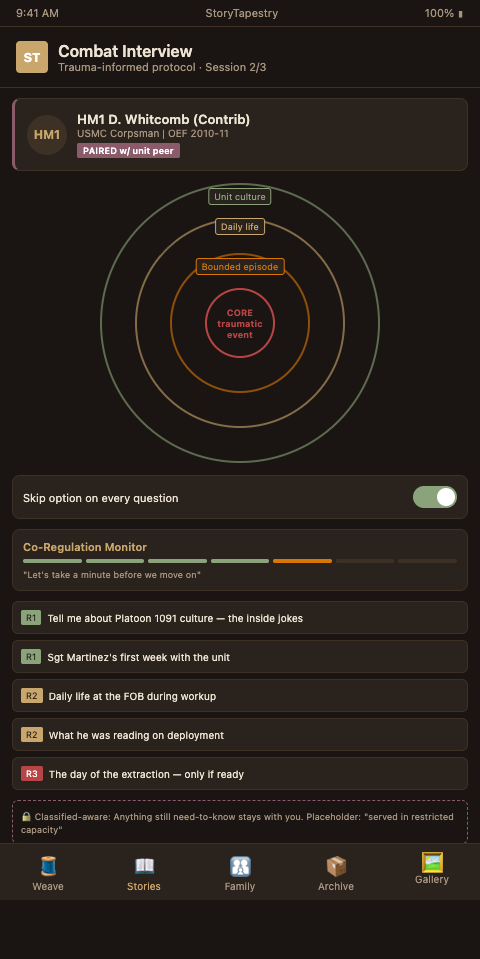
Tapestry-weaving close. The final five minutes of the interview transition from extraction to integration. The interviewer shows which specific chapters the contributor's testimony will weave into and invites the contributor to suggest other contributors who should be approached for adjacent chapters. This close respects the contributor's authorship, reinforces that their fragment is part of a larger tapestry, and often surfaces additional contacts that formal rosters miss. This mirrors the broader pattern of building authentic veteran stories through community-validated contributions rather than single-source extraction.
The therapeutic dimension is real. Research on therapeutic memorial outcomes in adjacent trauma-loss domains demonstrates that structured memorial contribution, when properly trauma-informed, can support grief processing rather than exacerbate it. The combat-adapted protocol is designed to leave contributors feeling that their contribution mattered, not that they were mined for content.
Interviewer calibration for combat-specific content matters as much as protocol discipline. An interviewer who served in combat themselves reads physiological cues and recognizes narrative patterns that civilian interviewers miss. A civilian interviewer trained in the adapted protocol can execute the structure, but the pacing decisions that actually protect the contributor during sensitive moments require fluency the training alone cannot fully provide. StoryTapestry's certification program includes case-study review with veteran interviewers who can coach civilian staff through the judgment calls specific to combat testimony, raising the quality floor for funeral homes that do not have veteran staff on the interview team.
Advanced Interview Tactics for Memorial Coordinators
Pre-interview coordination calls reduce interview-day stress. A 15-minute call 48 hours before recording lets the contributor understand the scope, ask logistical questions, and express any topics they'd prefer to avoid. The interviewer can adjust the chapter prompt list based on this input. Contributors arrive to the recording with calibrated expectations, which dramatically reduces the cold-start tension that produces clipped responses.
Pair interviews outperform solo interviews for certain contributor types. When a contributor has been out of contact with the unit for decades and has never debriefed the events publicly, pairing them with a trusted unit peer during the interview can unlock narrative that solo interviewing cannot. The Voice of Witness practices reference group testimony as a validated pattern, and memorial coordinators have reported that pair interviews produce richer material for combat-era contributors.
Asynchronous contribution options serve veterans who cannot tolerate real-time interviews. Some combat veterans can write in depth what they cannot speak in the moment. StoryTapestry supports structured written contributions with the same chapter-bounded prompt approach, so contributors who opt out of recording can still weave substantial threads into the memorial. Audio-only (no video) is another option for contributors uncomfortable with being filmed.
Post-interview contributor wellness follow-up is not optional. Within 72 hours of the interview, the coordinator sends a check-in message acknowledging the weight of what was shared and confirming next steps. Memorial-grade combat interviews should not end with the last recorded word; the contributor's wellbeing extends past the recording session.
Interview chunking across multiple sessions accommodates contributors whose capacity varies. Rather than forcing a 90-minute single session, the protocol can span three 30-minute sessions across two weeks. Each session addresses one or two chapter prompts with space between for the contributor to process. Chunking produces higher-quality testimony and lower contributor dropout rates.
Handle classified or need-to-know content with explicit protocol. When a contributor volunteers that a specific story cannot be shared publicly but they want to mention that a classified chapter existed, the tapestry can include a placeholder panel that acknowledges the classified period without exposing operational detail. Phrasing such as "served in a restricted capacity during this period; details remain with the contributor and the family" respects both operational security and memorial integrity. This approach comes up frequently with Special Operations Forces veterans, intelligence community veterans, and certain aviation specialties whose mission sets include classified components. Families appreciate the acknowledgment that their veteran carried work they could not discuss, and the memorial honors the service without crossing security lines.
Support contributors who become emotionally activated mid-interview without shutting the session down. The protocol includes explicit scripted language for acknowledging the emotional weight of a moment, offering a pause, and asking whether the contributor wants to continue, reschedule, or skip the specific chapter prompt. Some contributors push through after a brief pause and produce the deepest testimony of their session; others need to end and reschedule for a later date. The protocol respects both paths. Interviewers should never push a contributor past their capacity, but they should also not assume activation means the interview must end. The contributor's agency is the governing principle.
Rehearse the protocol with staff before the first real combat interview. Mock interviews with a veteran colleague or a trained coach help staff internalize the concentric question structure, the co-regulation cues, and the scripted pause language so the protocol feels natural rather than recited when the real interview happens. Firms that skip the rehearsal step typically produce thinner first interviews; firms that invest two or three mock sessions per interviewer build team capacity that compounds across every subsequent combat interview.
Train Your Team on Combat-Adapted Memorial Interviews
Veteran Memorial Programs handling combat veteran contributor interviews need interviewers trained beyond generic oral history baselines. StoryTapestry's combat-adapted interview certification covers the concentric question structure, co-regulation cues, chapter-bounded prompts, and post-interview wellness protocols your coordinators need to responsibly produce memorial-grade combat testimony. Request the interviewer training curriculum with your StoryTapestry account manager to certify your memorial team. The corpsman who sat across from your coordinator last month will give a richer interview the next time around.
The certification runs across a structured eight-hour curriculum delivered over two weeks, with live case studies drawn from actual combat veteran memorial interviews, mock interview practice with coached feedback, and final certification assessment that validates readiness for live combat interview work. Funeral homes serving communities with high combat-veteran density—communities near Fort Bragg, Fort Campbell, Fort Stewart, Camp Lejeune, Camp Pendleton, Joint Base Lewis-McChord, and the many other active-duty installations—handle combat interviews as standard memorial work and benefit from certifying multiple staff members across the team. Firms serving smaller combat-veteran populations benefit equally because the few combat interviews they handle annually deserve the same protocol discipline as higher-volume firms. Your account manager schedules the certification at intervals that match your caseload pacing, and staff can reference the protocol library between certification cycles to maintain fluency.
Book the certification before your next combat veteran memorial and give the contributors the adapted interview experience their service earned rather than the generic oral history protocol that breaks down on them.