When to Redesign vs Re-Route: Flow Thresholds for Museum Retrofits
The Decision That Costs the Most When It's Wrong
At 10:20 AM, 34 third-graders from P.S. 142 are in the atrium of a children's science museum. The exhibit design director is watching the live floor camera and seeing, for the fourteenth consecutive school-visit Tuesday, the same thing: the group splits at the central junction and 26 of the 34 students take the right-side corridor, bypassing the Water Cycle puzzle and the Earthquake Simulator in the left-side approach. The museum board has been asking for a plan since September.
The director has two proposals on her desk. The first is a re-routing plan: move the rope partition, shift docent positioning, coordinate with the booking system to adjust the entry stagger for Tuesday morning groups, and update the floor map distributed to school teachers before visits. Estimated cost: $3,000 to $8,000 in staff time and materials. Estimated timeline: three to four weeks to implement and evaluate.
The second is a redesign plan: physically relocate the Water Cycle puzzle to a position with a direct sight line from the main atrium entry, which requires moving two adjacent stations and reconfiguring the left-side corridor's partition wall. Estimated cost: $85,000 to $140,000. Estimated timeline: six to eight months including fabrication and closure days.
The decision between those two proposals is a flow threshold question, and answering it without data produces a 50/50 guess with enormous cost consequences.
The common failure mode is choosing re-routing for structural bypass problems because re-routing is cheaper and faster. The museum implements the partition change and docent repositioning, sees bypass drop from 83% to 64% in the first two weeks, declares success, and closes the issue. Six weeks later bypass is back at 78% because the structural cause—the branch geometry that consistently routes wave pressure away from the Water Cycle approach corridor—hasn't changed. The museum has spent $5,000 to confirm that the problem is structural and is now six weeks further from the redesign it needed. On a scaling 40-exhibit floor, this failure mode can repeat across multiple stations simultaneously, with each misclassified bypass problem consuming re-routing budget that should have been directed toward the floor-wide flow infrastructure addressing the structural causes.
Spatial Layout and Visitor Paths (MDPI) documents six exhibition layout typologies and their effect on visitor routing. The typology of the bypass problem determines whether it's structurally solvable through re-routing or requires physical reconfiguration: a bypass caused by low visibility from the approach corridor is a routing problem; a bypass caused by the approach corridor itself being a low-traffic branch of the floor's network is a design problem.
Managing Crowded Museums (ScienceDirect) identifies congestion thresholds at greater than 5 persons per square meter as the industry comfort ceiling for high-density visitor environments. For museum bypass analysis, the inverse threshold matters: stations with approach corridor density consistently below 0.8 persons per square meter during school-wave peaks are receiving insufficient wave pressure to generate bypass—they're being skipped entirely because the wave never reaches their branch.
PressurePath's Threshold Framework
PressurePath defines the re-route vs. redesign decision through three quantitative thresholds derived from wave-pressure analysis. The framework treats the bypass problem as a pipe-pressure diagnosis: before recommending valve replacement (redesign), you check whether the valve is closed for structural reasons (insufficient pressure in the branch) or operational reasons (the valve is positioned correctly but isn't opening under normal wave pressure).
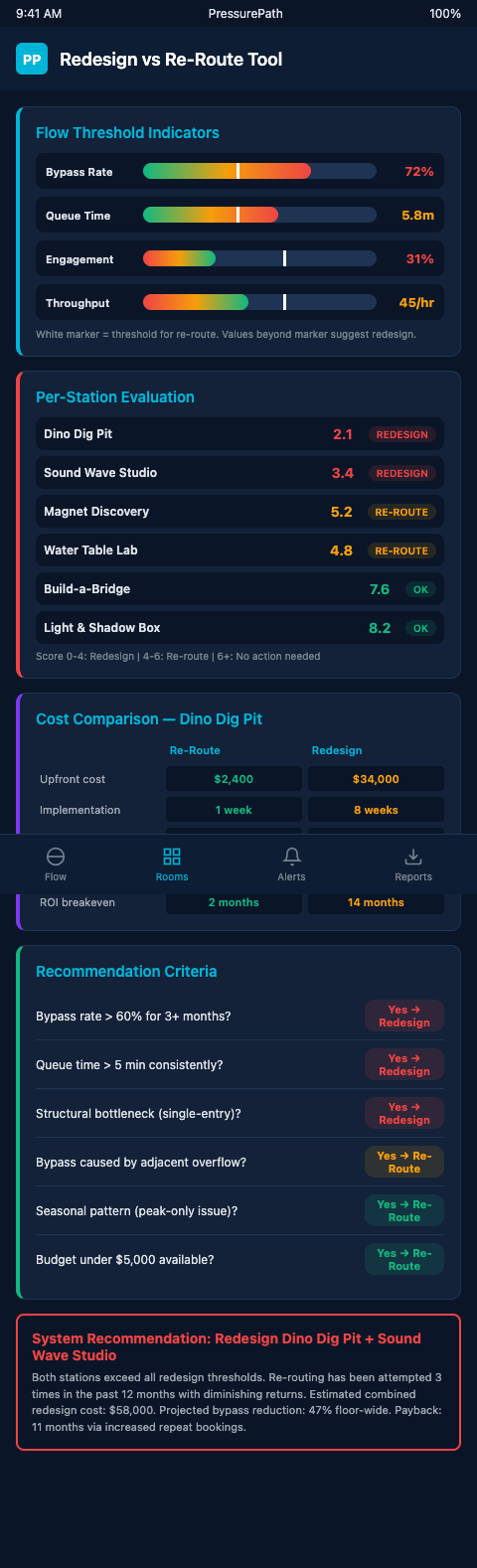
Threshold 1: Branch pressure ratio. Compare the wave pressure arriving at the bypassed station's approach corridor against the floor's average branch pressure during school-wave peaks. If the bypassed station's branch receives less than 40% of average branch pressure, the problem is structural—the floor's pipe network is routing wave pressure away from that branch regardless of what's at the end of it. A re-route can increase branch pressure through partition changes, but if the branch geometry is fundamentally low-visibility from the main entry, only physical repositioning of the approach corridor will sustainably fix it. Redesign threshold.
If the branch receives 60% or more of average pressure but the station still shows high bypass, the problem is at the station's capture point—the valve itself—not the pipe. That's a re-routing candidate: docent positioning, partition adjustments, or exhibit face-changes that improve the station's attracting power at the moment of approach.
The 40%-to-60% zone is the ambiguous territory where PressurePath's simulation layer adds the most value: it runs the proposed re-route in silico and predicts whether the intervention will produce durable bypass reduction or short-term masking. If the simulation's wave-pressure model shows that even with the re-route active, the branch pressure ratio stays below 45% on high-density school-wave days, the re-route will produce temporary improvement but won't hold under peak conditions. That prediction—available before any physical work begins—is the basis for an honest recommendation to the board about which category the problem falls into.
Threshold 2: Bypass consistency across group types. If bypass at the station is consistent across grade levels, group sizes, and seasonal visit patterns—same 72% bypass rate whether the group is second-graders or fifth-graders, October or March—the bypass cause is structural. Physical approach geometry that produces identical bypass behavior across heterogeneous visitor populations isn't responding to visitor-level variables; it's responding to a fixed spatial constraint. Redesign threshold.
If bypass rates vary substantially by grade level, time of day, or docent presence, the cause is operational. The same physical space produces different bypass rates depending on who's in it and how the visit is managed. Re-route interventions address the operational variables.
Seven Ways to Modernize Museums (CambridgeSeven) recommends flexible gallery systems as a re-routing solution before full redesign. The "flexible gallery system" recommendation is precisely targeted at the 60%-plus branch pressure cases where the station has adequate approach traffic but the capture mechanism is failing.
Threshold 3: Intervention decay rate. If previous re-route attempts at the station produced bypass reduction in weeks one and two but bypass rates returned to baseline by week six, the structural cause was temporarily masked but not addressed. Intervention decay—documented through PressurePath's session-over-session bypass tracking—is the strongest indicator that redesign is required. A structural bypass route doesn't stay closed under operational pressure alone.
Visitor Flow in Cultural Spaces (Quinn Evans) documents case studies showing exactly this pattern: flow analysis identifying when routing changes produced durable improvement versus when structural reconfiguration was required for lasting impact.
Museum Cost Estimates (DOI) provides federal museum cost benchmarks that separate re-route budget territory from redesign budget territory. The decision framework becomes financially concrete when you know that re-route interventions typically operate in a $2K to $15K range and redesigns in an $80K to $300K range—and that the threshold analysis can reliably distinguish which category the specific bypass problem falls into.
From Threshold to Recommendation
The practical output from PressurePath's retrofit threshold analysis is a prioritized recommendation that directors can take to their boards: specific stations with specific flow diagnostics, specific intervention categories (re-route vs. redesign), and specific cost implications. That structure replaces the anecdotal bypass report with a data-grounded capital recommendation.
Insights on Museum Expansions (Advisory Board for the Arts) documents the conditions that trigger redesign vs. reconfiguration in major museum renovation reviews—the institutional decision criteria that boards and capital committees use. PressurePath's threshold framework maps those institutional criteria to measurable flow metrics, giving exhibit designers the quantitative language to engage capital committees.
Natural Movement: Pathway Configuration (ScienceDirect) confirms that agent simulation can pre-test re-routing changes before any physical work begins. For the re-route category, this means PressurePath can simulate the proposed partition repositioning, docent placement change, or entry-sequence adjustment and predict the expected bypass reduction—giving the exhibit designer a forecast to present alongside the cost estimate.
The future exhibit design implication is structural: museums that build pacing-aware design practices now will face fewer costly redesign decisions in the future, because the bypass causes will be caught at the brief and layout stages rather than after fabrication. The retrofit threshold framework is the retroactive application of what pacing-aware design prevents prospectively.
Floor-wide flow data provides the context for retrofit prioritization: when you have branch pressure ratios and bypass consistency scores for all stations, you can stack-rank retrofit candidates by threshold confidence and cost-impact ratio rather than responding to whichever bypass complaint reached the director's desk most recently.
The when add new room decision in escape room franchise management is structurally parallel: the question of whether to re-route traffic within an existing room configuration or add physical capacity maps directly to the redesign vs. re-route framework. The threshold logic—structural vs. operational bypass causes, intervention decay rate, branch pressure ratio—applies across both contexts.
Know Before You Spend
If your board is about to approve a $120K station relocation that flow data suggests is a re-routing problem, PressurePath can save you that capital. If your operations team has been re-routing a bypass problem for three years and the same stations keep underperforming, PressurePath can confirm that you're facing a design threshold, not an operations failure. Join the waitlist to run a retrofit threshold analysis on your museum's chronic bypass stations—built specifically for children's museum exhibit designers who need a data-grounded answer before the next capital decision.
The cost of getting the redesign vs. re-route decision wrong compounds over time. A re-route that masks a structural problem for two years delays the necessary redesign by that same window, and the bypass accumulates engagement losses during the masking period. A redesign that addresses what was actually a re-routing problem spends capital that could have funded three or four other operational improvements at the same engagement impact. Neither error is recoverable after the fact; the capital is spent and the operational window has closed. The threshold analysis is the decision-quality investment that prevents both error modes.
The framework also changes how exhibit designers present these decisions to boards and capital committees. Rather than arguing for a redesign based on anecdotal bypass observations, the designer brings a quantified threshold analysis: branch pressure ratio, bypass consistency score, intervention decay rate. Those metrics translate directly into the financial language that capital committees use — risk-adjusted ROI, capital efficiency ratio, expected return on intervention — and the redesign recommendation becomes defensible in terms the board already understands rather than requiring them to accept an expert judgment call on faith.