What 200,000 Guest-Facing Shifts Reveal About Emotional Limits
The Dataset That Settled Some Arguments
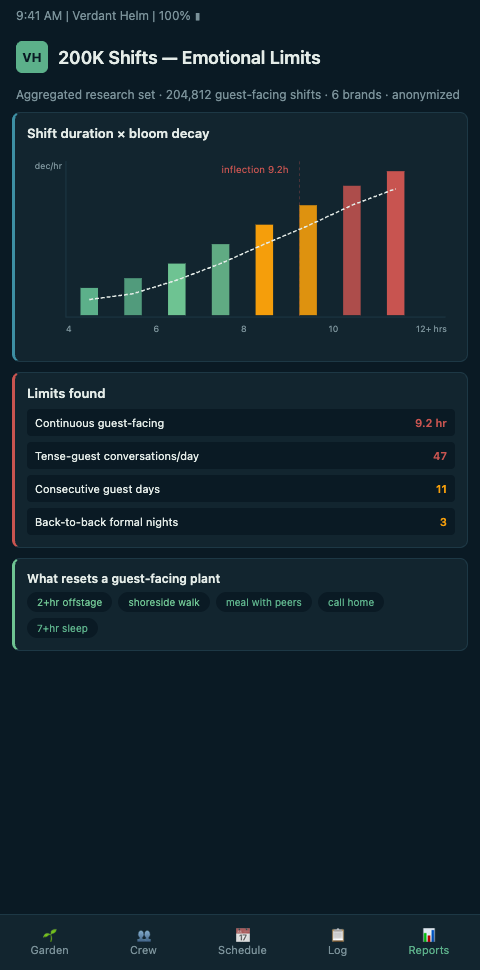
Verdant Helm's cruise telemetry crossed 200,000 guest-facing shifts in February 2025. The dataset spans 14 operators, 68 ships, and 32 itinerary types across Caribbean, Mediterranean, Alaska, and Asia-Pacific routes. It covers stateroom attendants, cabin stewards, Lido cast members, main dining room servers, maître d' teams, and specialty restaurant servers from contemporary, premium, and luxury brands. Every shift in the dataset has bloom-to-wilt signals, recovery-after-port measurements, social graph indicators, and NPS attribution data linked to the specific crewmembers who worked guest-facing roles during that itinerary. Approximately 38% of the shifts come from megaships over 4,500 guest capacity, 42% from premium ships between 2,000 and 4,500, and 20% from luxury ships under 1,500 — a distribution that lets cross-tier comparisons hold statistical weight.
The dataset is large enough to settle arguments that have been running in cruise hotel operations for a decade. It is also detailed enough to open new ones. The Seafarers Happiness Index Q1 2025 from Mission to Seafarers provides the industry benchmark wellbeing data over ten years of quarterly surveys. The Safety4Sea reporting on crew mental health captures the broad pattern: 25% of marine casualties are linked to fatigue, and 50% of seafarers report 85+ hour weeks at sea. The Verdant Helm dataset gives shift-level resolution to what those industry aggregates describe. Where the Mission to Seafarers index tells you how Filipino cabin stewards feel across the industry, the Verdant Helm dataset tells you how a specific cohort felt across specific itineraries on specific ships — and which operational interventions moved the needle.
What follows is the short version of what 200,000 shifts reveal about emotional limits on cruise hotel operations. The long version will run as a peer-reviewed analysis later in 2025. The operational implications do not need to wait for the journal publication.
What The Garden Data Shows
Six findings stand out, and each one has direct operational implications for Hotel Directors and Cruise HR leaders running fleets today.
First, the bloom-to-wilt inflection point for stateroom attendants on 9-month contracts lands at a median of day 167, not the day 240 that exit-interview-based models have estimated. The garden shows the decay starting much earlier than HR systems detect. The Harvard Kennedy School Shift Project research on 27,792 workers across 80 retailers documented the same pattern in land-based retail: scheduling churn erodes wellbeing weeks before turnover intent becomes visible. Cruise contracts compound this with physical isolation, so the inflection lands earlier and harder. A Filipino cabin steward on her third 9-month contract hitting inflection at day 167 has 73 days of post-inflection decay remaining in the contract — a stretch the 9-month structure treats as normal late-contract performance but which the garden data identifies as recoverable if the operator intervenes early.
Second, consecutive turnaround days are the single highest-intensity predictor of wilt acceleration. Crewmembers who work seven consecutive turnaround days without a break show wilt acceleration 2.4x the rate of crew with interleaved sea days. Caribbean ships running 3- and 4-day Nassau loops stack turnarounds more aggressively than Mediterranean ships running 7-day itineraries, which is why the dataset shows Caribbean-ship attendants reaching inflection 21 days earlier on average than Mediterranean-ship attendants on the same brand and role. The UT Austin research on schedule consistency and shift worker productivity across 1.2M baskets of cashier data shows the land-based analog: hour and day consistency lifts productivity 0.95-1.63%. On ships, the same consistency principle prevents wilt acceleration.
Third, shift handovers are emotional-labor amplifiers. The myShyft research on emotional labor in shift handovers frames what the dataset confirms: handover quality affects the next shift's emotional capacity. Crew who take handovers from wilting predecessors enter their shifts already partially wilted. The garden pattern shows sinks forming specifically around the 3 PM and 11 PM handover windows on ships with dense guest-facing coverage. The Croatian maître d' taking over a dinner-service shift from a pre-inflection predecessor inherits not just the station assignments but the accumulated emotional deficit of the outgoing shift — and the dataset shows this inherited deficit predicts 9 PM guest-complaint clustering at statistically significant rates.
Fourth, recovery after port day is highly role-specific. Cabin stewards recover fast from short, social port days in active ports. Maître d' teams recover faster from longer, quieter port days. Running both populations on identical port day structures leaves half the crew under-recovered. The dataset shows this quantitatively: Filipino cabin stewards returning from a 6-hour Cozumel port day with group activity score 18% higher on bloom recovery than those returning from a 12-hour Grand Cayman port day with unstructured time. Croatian maître d's show the opposite pattern — the 12-hour Grand Cayman day produces 22% better recovery than the 6-hour Cozumel day. The Management Science Gap scheduling study showed the analogous result in land retail: responsible scheduling raised productivity 5.1% through a large-scale field experiment, and the mechanism was matching schedule structure to role-specific recovery needs.
Fifth, NPS lift correlates more strongly with wilt prevention than with bloom peaks. Ships where the garden prevents deep wilt outperform ships where the garden produces higher bloom peaks but allows deeper wilt. Guests notice the bad shifts more than they notice the great ones. The implication is that Hotel Directors optimizing for bloom theater underperform those optimizing for wilt-response discipline. The dataset shows ships in the top quartile for wilt prevention averaging 9.2 points higher NPS than ships in the top quartile for bloom peaks — a finding that runs counter to a decade of cruise-industry service-training orthodoxy, which has concentrated on peak-service-moment coaching rather than fatigue-floor management.
Sixth, luxury crew on 9-month contracts show the steepest post-inflection decay across any brand tier. This lines up with the Emotional-Labor Decay Across Luxury Brand Contract Lengths analysis: luxury contract length reform is the single highest-leverage structural change the industry could make. The dataset shows luxury butlers losing 31% of their peak bloom capacity across the final 90 days of a 9-month contract, compared with 14% for contemporary-brand cabin stewards across the same stretch. The suite-guest NPS dip in the final 90 days of a luxury contract is directly traceable to this decay.
Advanced Implications For Fleet Operators
The six findings support three tactical moves that Cruise HR leaders and Hotel Directors should consider running against their own fleets now.
Rebuild the contract-renewal conversation timing. If the wilt inflection on 9-month contracts lands at day 167, renewal conversations should happen at day 150, not at day 210. Operators who move their renewal conversations earlier catch decisions before they harden into silent non-renewal signals at exit. One premium operator tested a 150-day renewal conversation protocol across three ships in Q3 2024 and saw renewal rates climb 11 points against sister ships running the 210-day baseline. The counterfactual is concrete: if you wait until day 210, the crewmember has been in post-inflection decay for 43 days, and no renewal conversation can reverse a decision that the decay has already made.
Cap consecutive turnaround days in the SMS. The 2.4x wilt acceleration from seven consecutive turnaround days is evidence that belongs in the ship's safety management system. A cap of four consecutive turnarounds with mandatory sea-day rotations produces measurable bloom recovery and keeps the ship operational without the emotional-labor taxation. The SMS clause can be written to require the cap as a non-negotiable, with exceptions requiring CVP-level sign-off rather than Hotel Director discretion, which prevents the cap from drifting under operational pressure during peak-season itineraries.
Stratify port day structures by role. The recovery signal data is specific enough to redesign port day structures by crew role. Cabin stewards benefit from short, social Cozumel or Nassau activities. Maître d' teams benefit from longer, quieter St. Thomas or Grand Cayman port days. Running a role-stratified port day calendar is operationally simple once the shoreside welfare office has the garden data to plan against. The welfare officer can pre-book role-matched activities 14 days before each itinerary, which eliminates the crew-initiative burden that typically leaves the highest-fatigue crew the least likely to organize their own recovery. The garden-gated contracts post extends this logic into full contract-length reform.
The wind technician industry is running a parallel large-dataset analysis — the 50,000 transfer attempts dataset post documents similar scale-data lessons for O&M teams. The shift-level resolution of that dataset has produced comparable operational implications for wind operators.
What Cruise Leaders Should Do With The Dataset
If you are a Cruise HR leader or Hotel Director wondering what your fleet's garden data would show against the 200,000-shift benchmarks, that comparison is the right next question to ask. Pull your last four itineraries of garden telemetry and run the six findings against your specific ships. The gaps are your 2025 operational plan. Schedule a Verdant Helm dataset comparison review with your CVP of Hotel Operations and your senior Hotel Directors, and use the 200k-shift baseline to pressure-test your contract, SMS, and port-day structures. The operators running this analysis in 2025 will have the benchmark data to drive 2026 decisions that their competitors will still be debating.
The specific question to take into the review is not whether your fleet matches the industry benchmarks but where it diverges and why. A fleet whose stateroom attendant inflection lands at day 172 instead of day 167 is five days ahead of the industry median, which is a finding worth preserving. A fleet whose luxury butlers decay 34 percent rather than 31 percent across the final 90 days is three points worse than the luxury median, and that is a finding worth acting on. Cruise HR Leaders should bring three comparisons to the review: their ship-by-ship inflection distribution against the median, their consecutive-turnaround-day exposure across the fleet, and their role-stratified port day utilization.
Each of those maps to a specific operational lever — renewal conversation timing, SMS turnaround cap, port-day pre-booking — that can be acted on inside a single quarter. The goal is not to close every gap against the benchmark but to close the two or three gaps where the fleet's retention and NPS performance are most exposed. Hotel Directors walking into the 2026 contract cycle with specific, data-anchored changes outperform the ones running the same playbook their predecessors ran three years earlier, and the 200,000-shift dataset is what makes "data-anchored" mean something other than gut feel dressed up with charts.