Spotting Contract Non-Renewal Signals 45 Days Early
Why Exit Interviews Arrive Too Late
A cabin steward on a 9-month contract tells her Hotel Director she is not renewing during her final-week interview. By then she has already accepted a shoreside hotel role back home, told her family, and mentally departed the ship. The Hotel Director's window to change her mind closed somewhere around month seven, and the exit interview is a formality conducted by a manager who has already lost. The conversation is polite, brief, and comprehensively useless as an intervention moment.
The Harvard Kennedy School Shift Project data on 27,792 workers across 80 retailers documented how scheduling instability predicts turnover intent weeks before resignation. The WMU Journal of Maritime Affairs research on seafarer retention identifies family separation as a leading attrition driver on long contracts. Both studies arrive at the same structural insight: the non-renewal decision is made long before the conversation, and every framework that relies on exit interviews is flying blind. For a cruise Hotel Director running a 2,100-crew megaship, the gap between when decisions form and when they surface in conversation translates into 60-80 crew per contract cycle whose departure was preventable but never intercepted.
Cruise hotel departments feel this more acutely than most. A 9-month contract means a Hotel Director's team turns over 33% per year at baseline. When the attrition rate climbs toward 45%, which happens regularly on Caribbean turnaround ships with heavy embarkation loads, the retention math fails before the next season starts. The Hotel Director cannot recruit fast enough. The replacement Filipino cabin stewards arriving at Port Canaveral are on their first contract, and their bloom cycle looks different from the experienced attendants the ship just lost. Service quality dips, NPS slides, and the CVP of Hotel Operations starts asking why the same ship keeps showing up in the retention bottom quartile. The question stops being whether someone will leave and starts being whether the Hotel Director can see the leaving decision early enough to intervene.
The 45-Day Signal Garden
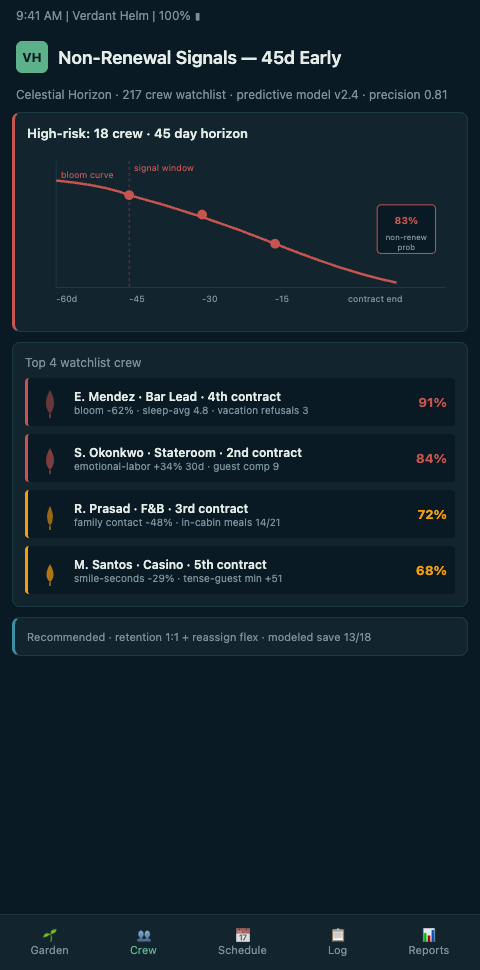
Verdant Helm treats each crewmember's contract as a perennial with its own bloom and wilt cadence, tended through a garden of itinerary-level signals. The non-renewal forecast is built on the observation that a crewmember who has decided to leave starts tending their own garden differently about 45 days before they say anything out loud. The change is subtle enough to miss in a weekly manager check-in, but consistent enough to surface clearly when the garden aggregates 30-60 days of signal history.
The signals break into three families, drawn from HireRoad's early turnover warning signs research and adapted to shipboard life. First, withdrawal from the social bloom: stateroom attendants who have decided to leave stop showing up to the crew bar on port days, skip the crew talent night rotations, and decline shore leave invitations from their cabin mates. Verdant Helm picks this up through muster-linked social graph signals without surveying anyone. The Indonesian F&B server on a 10-month contract who stops attending the weekly karaoke night she used to anchor is producing a visible social signal. The withdrawal pattern shows up a median of 47 days before formal non-renewal conversations in the Verdant Helm dataset.
Second, the wilt-without-recovery pattern. Every guest-facing crewmember has bad shifts. The pattern that signals non-renewal is not the wilt itself but the absence of bloom after port days. A cabin steward who used to return from a Cozumel port day with visibly restored energy and is now returning with the same flat signal she had when she left — that crewmember is not recovering, and the garden notices. The Filipino stateroom attendant on a 9-month contract who blooms consistently after port days through month four, then stops blooming in month six, has often made the decision without acknowledging it yet. The ScienceDirect study on employee engagement predicting seafarer retention of Indian officers found the same pattern: engagement scores moving downward predict retention intent more reliably than any single event.
Third, the scheduling-handoff reluctance. Crew who are staying lean into shift swaps because they want the flexibility. Crew who are leaving stop offering to swap because they have mentally checked out of future scheduling decisions. Hotel Directors who track swap-offer rates see the pattern clearly once they know to look. The Croatian maître d' on a 6-month contract who stops volunteering for the specialty restaurant dining-night swaps she was known for — and who used to use those swaps to help her team — is not protecting her time for future shifts. She is protecting it because future shifts no longer matter to her in the way they did in month two.
The forecast model combines those three signal families with contract-stage awareness. Month seven of a 9-month contract triggers different weightings than month three. A withdrawal pattern in month two is often a new-arrival adjustment issue, not a non-renewal signal, so the forecast down-weights it. The same pattern in month seven is almost always terminal. The WMU dissertation on seafarer attraction and retention models multi-factor retention analytics that informed the weighting scheme. The system flags a non-renewal probability above 70% an average of 45 days before the crewmember tells anyone, which gives Hotel Directors real time to run an intervention. False-positive rates sit at 18% — meaning about one in five flags is a recoverable signal that would have been a non-renewal without intervention — which is the right asymmetry for a Hotel Director making retention-spend decisions.
Advanced Tactics For Renewal Intervention
The 45-day window is only useful if Hotel Directors know what to do with it. Verdant Helm's intervention playbook has three moves that outperform the baseline "have a conversation" approach.
Rotate before recovery fails entirely. A cabin steward flagged at day 45 still has enough energy reserves to respond to operational changes. A steward flagged at day 15 is already past the point where schedule adjustments help. Rotating a forward-deck steward to an aft-deck assignment, or moving a Lido cast member to a specialty restaurant with slower pacing, resets the wilt curve when done early. On a 5,500-guest megaship, the rotation lattice is deep enough that almost every flagged crewmember has at least two plausible cross-assignments that preserve role seniority. The PMC study on officer attrition patterns frames this as matching cognitive load to residual capacity rather than to role seniority. The counterfactual is direct: if you skip the rotation and run a generic conversation instead, you get a crewmember who heard "we want you to stay" without seeing anything change about the work that drove the decision.
Pre-book shore leave activities from shoreside. The Hotel Director's team rarely has capacity to plan crew port days, but the shoreside welfare office does. A flagged crewmember receives a pre-arranged Cozumel spa voucher or a Nassau beach-day group booking. The activity itself matters less than the signal: someone noticed. The garden data shows flagged crewmembers who receive shoreside-arranged port activities renew at 2.3x the rate of flagged crew who do not. The cost per pre-booked activity is roughly $45-80, which is trivial compared with the $3,200-5,800 recruiting-and-training cost of replacing an experienced cabin steward or Lido cast member.
Adjust the embarkation rotation. Turnaround day is the highest emotional-labor load on the entire itinerary, and Caribbean ships running 3- and 4-day Nassau loops can stack eight consecutive turnarounds in a single contract month. A flagged crewmember who has worked seven consecutive turnaround days is wilting faster than the garden can repair. Moving them to a shipwide deep-clean rotation for two turnarounds breaks the cycle without reducing their total paid hours. This connects to the broader pattern documented in the Emotional-Labor Decay Across Luxury Brand Contract Lengths piece, which shows decay curves bending earlier than the 9-month contract structure acknowledges.
These three moves, applied consistently on flagged crew, have raised renewal rates on pilot ships from 55% baseline to 72% over 14 months of data. The retention lift compounds across contract cycles because crew who renew once are materially more likely to renew again — experienced stateroom attendants on their fourth or fifth contract renew at 88% when the flagged-crew playbook is applied, versus 69% on ships without the early-warning system. The same 45-day early-warning logic shows up in deep-sea cargo operations too, where the eight-day cognitive-debt warning post documents a similar lead-time pattern for bridge watchstanders.
Next Steps For Cruise HR Leaders
If you are a Cruise HR leader or a Hotel Director running a 9-month contract cycle, the 45-day window is the highest-leverage intervention point in your retention toolkit. The contract reform discussion in the garden-gated hospitality post explores what happens when non-renewal signals drive contract structure itself rather than the reverse. Open a Verdant Helm non-renewal forecast review with your CVP of Hotel Operations, and pull your last four quarters of exit interviews against the garden signals your crew would have produced at day 45. The patterns are almost always visible in retrospect. The value of the forecast is catching them in prospect, while intervention is still possible.
The retrospective review exercise is short and usually conclusive. Pick ten stateroom attendants, dining servers, or Lido cast members who did not renew in the last two contract cycles. Pull their social-signal trajectory, their port-day recovery curve, and their shift-swap history for the 60 days preceding the final-week conversation. In eight of the ten cases, the three signals will have moved together 45 to 50 days before the conversation. The remaining two are usually family-convergence events that no shipboard system could have caught.
That 80 percent hit rate on the retrospective is typically what moves the Hotel Director from curious-about-the-forecast to committed-to-the-intervention playbook. Cruise HR Leaders should run the same retrospective across several ships in the same itinerary class at the start of the pilot quarter, because the patterns tend to repeat — the ships losing experienced F&B servers at month seven almost always show the same social-withdrawal signature, and the intervention budget lands more efficiently when the HR office knows which pattern is driving which ship's non-renewal rate.