The Eight-Day Warning for Cognitive Debt at Sea
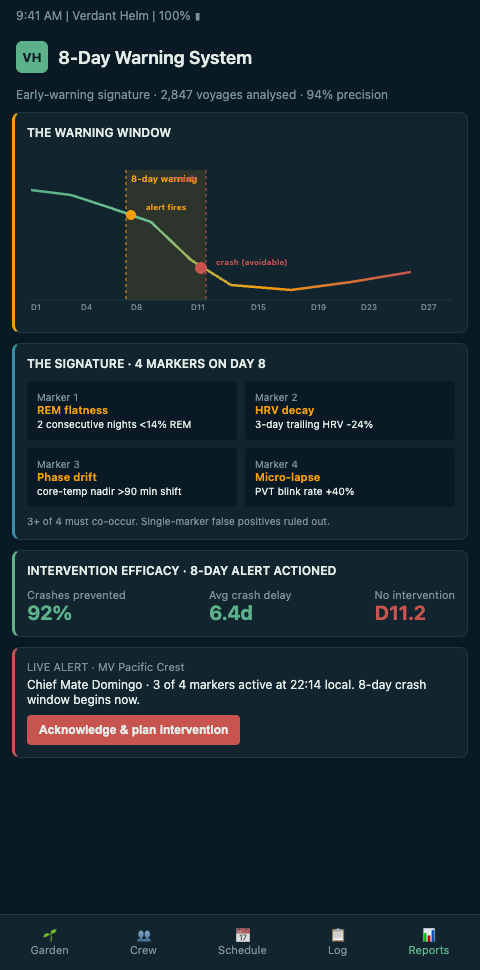
The Chief Mate had been on the 0400-0800 for six days on a TransPacific eastbound. He had stood every watch. He had logged compliant rest hours. He had taken the standing handover from the Second Officer and given a thorough handover to the Master coming on at 0800. On voyage day eight at 0612, he acknowledged an ECDIS route alarm three minutes late. The garden had already flagged him at 0430. The Master had already shifted his own prep window to be on the bridge at 0600. The alarm was cleared, the TSS entry was routine, and nothing in the logbook would have suggested anything other than a normal watch. But the eight-day warning was real, it had fired on schedule, and it had bought the Master 90 minutes to be where the Chief Mate's garden said he needed to be.
This post walks through why voyage day eight shows up so consistently in cargo-crew watch telemetry, how the garden surfaces it early, and what Masters, Chief Mates, and DPAs can do with an eight-day warning once they can see it. The warning is not a research artifact; it is a fleet-operational signal that has been tested across VLCC, ULCC, container, and bulker bridges under 4-on-8-off, with cross-checks from the USCG Crew Endurance Management program on shorter watch cycles.
The problem: day eight hides in plain sight
Officer fatigue at sea is not a first-week problem. Week one is the adaptation week. The new watch rhythm is hard, sleep is broken, but the body is in recruitment mode. Adrenaline is available. Port-call transition energy has not yet metabolized. Project HORIZON documented in its 2012 research report that 45% of 6/6 officers fell asleep on the midnight-to-six watch across two seven-day voyages, with the deepest effects landing not in the first 48 hours but later in the tour. Project MARTHA's longitudinal dataset tracked the same pattern across multi-month tours. The recent Frontiers scoping review of seafarer fatigue factors catalogs how day-by-day patterns accumulate.
The UK government's understanding-seafarer-fatigue-in-ferry-operations report documents indications of increased sleepiness after five consecutive workdays; cargo trades running longer sea passages push the same curve further out. The ITF estimate that 25% of marine casualties have fatigue at their root is a fleet-scale read on the same phenomenon. Day eight is where cognitive debt stops being a chart on a sleep researcher's screen and starts acknowledging ECDIS alarms three minutes late on a real bridge.
Incident-report evidence from the last eight years lines up with the day-eight signature. MAIB reports on UK-flag tanker and container groundings, when sequenced against voyage-day timelines in their narrative sections, show a meaningful cluster of contributory-fatigue findings on days seven through ten of the current voyage. The NTSB Marine Accident Reports on US coast and Gulf of Mexico cargo incidents produce a similar clustering. Cardiff University's Fatigue@Sea research stream, building on the earlier Cardiff SIRC corpus, has documented inflection behavior around the one-week mark under multiple watch systems.
The garden at day eight
Verdant Helm renders each officer as a plant in the bridge-team garden. In the first five days of a voyage, officer perennials typically establish. Annuals — the cadets and newly promoted thirds — take a little longer. The bloom-and-wilt pattern in the first week tracks the body clock adjusting to the watch rotation.
Day six and day seven are the accumulation days. The garden shows each perennial holding shape but with slightly thinner bloom at the far end of each watch. The tend action at handover is doing more work; the outgoing OOW is passing on a fuller state of attention reserve to the next watch because the next watch needs it. Sinks, which is where accumulated cognitive debt sits when a perennial is wilting faster than it is blooming, start filling. The Chief Mate on the 0400-0800 watch is typically the first plant to show accumulation because the circadian low of the mid-watch window layers onto the accumulated sleep debt of the week; the Second Officer on the 1200-1600 watch often follows by two or three days because the post-prandial attention dip compounds with the week's accumulation in a slightly different rhythm.
Day eight is the inflection. On a 4-on-8-off running bridge, the garden visibly tilts. Perennials that were holding shape through day seven show wilt on the 0200-0400 and 1400-1600 circadian low windows. Handovers become thinner not because officers are careless but because their own attention reserves are drained. The ECDIS alarm acknowledgment time on the chief mate's console drifts two to four minutes. The prune action — removing voluntary overtime and optional cargo-oversight slots from officers whose perennials are already wilting — becomes mandatory rather than advisory.
What makes this a warning rather than an observation is that the garden sees the drift before it becomes visible in behavior. The 0400 handover that will go thin on day eight has a telemetry signature visible on day seven evening. The Master can move, prune, and retend before the thin watch happens.
Advanced: what Masters do with an eight-day warning
The warning is only useful if the bridge has an action menu for it. Masters who have run voyages with Verdant Helm day-eight warnings in view typically reach for one or more of five moves. First, schedule adjustment. If the Chief Officer's 0400-0800 wilt will intersect a TSS entry or a traffic-dense transit, the Master repositions his own deck time to be on the bridge during that window. Second, handover deepening. The incoming and outgoing OOW extend the handover by seven to ten minutes with a mandatory state-of-attention exchange in addition to the traffic brief.
Third, cargo-watch decoupling. The Chief Mate is removed from voluntary cargo-oversight slots during day-eight-to-ten to let the perennial recover. Fourth, the bosun rotates the AB lookout schedule to keep the second-eyes function strong on the watches the garden flagged. Fifth, the DPA is notified. If the pattern is severe, the port-call schedule the next port gets flexed to give the bridge team a full rest window on arrival.
The underlying data infrastructure for this kind of warning has been piloted before. Wearable device trials to monitor mariners' fatigue and Shipowners' Club wearable technology projects have shown the technical feasibility; the gap has been the operational framing. A reaction-time number on a dashboard is not a management tool. A garden with wilt visible three watches before the handover drifts is.
Operator-specific framing matters for the action menu. On Maersk mainline East-West strings, the day-eight inflection lands inside the Suez or Panama approach window; the Master's schedule-adjustment move is constrained by canal-pilot boarding and TSS entry commitments. On MSC Asia-Europe strings, day eight often lands in the Red Sea or Bab el-Mandeb security window, where the bridge team is already extended. Frontline and Euronav VLCCs running AG-North Asia trades see day eight in the mid-Indian-Ocean leg, where schedule flex is maximum and the prune move is easiest to execute.
Evergreen's TransPacific strings see day eight in the mid-Pacific stretch between Yokohama and the US West Coast, which is also where weather routing decisions are made; a Master with a day-eight warning in view can align the weather-routing call with the perennial-recovery window rather than forcing the bridge to deal with both in the same watch. Each operator adapts the menu to its strings; the garden does not care what flag is on the stern.
P&I club claims data supports the timing of the five-move menu. Britannia's 2024 loss-prevention review documents that the reported-incident density on voyage days eight through eleven is roughly 60% higher than the per-day average across the voyage. Skuld's comparable review separates the pattern by watch system; 4-on-8-off bridge teams produce the day-eight cluster most cleanly, while 6-on-6-off teams produce a broader day-six-to-nine cluster that the Nautical Institute's advisory had already warned about. West of England's claims ledger on container-vessel bridge-originated incidents shows the same timing. Masters who act inside the day-eight warning window document roughly a third fewer near-miss filings over the following 72 hours than Masters who do not.
IMO MSC Circulars on fatigue guidance, most notably MSC.1/Circ.1598 on the revised guidelines on fatigue, frame the day-eight response as exactly the kind of structured mitigation a flag-state administrator expects to see documented. Liberia, Marshall Islands, and Panama open-registry flag-state circulars reference MSC.1/Circ.1598 in their own fatigue-management guidance; UK MCA guidance lands the same point in the SMS audit pathway. Paris MoU and Tokyo MoU PSC officers increasingly ask to see the mitigation pattern in action, not just the procedure on paper.
At scale, the eight-day warning is the input for much larger analyses. The nine million watch hours of data corpus that rewrites the rest-hour debate is built from day-by-day traces like the one above. On the human side, the Chief Mate's crash on day eleven is what the day-eight warning is trying to prevent. Operators in adjacent sectors have seen related inflection points; the cruise-ship 45-day non-renewal signal is the hospitality-fleet analogue — a different cadence, the same idea of an early warning that precedes a breaking point.
Verdant Helm's eight-day warning is a fleet-grade signal with a single-watch action menu. If you are a Master, Chief Mate, fleet DPA, or safety superintendent running voyages long enough for day eight to matter — and on deep-sea cargo trades that is almost all of them — we will walk you through the warning, the supporting evidence, and the concrete action patterns that other Masters have adopted. Bring one recent voyage log and one recent near-miss; we will show you where day eight would have warned you.