Service-Score Recovery Through Transparent Emotional-Labor Metrics
The Recovery That Worked After Six Months Of Not Working
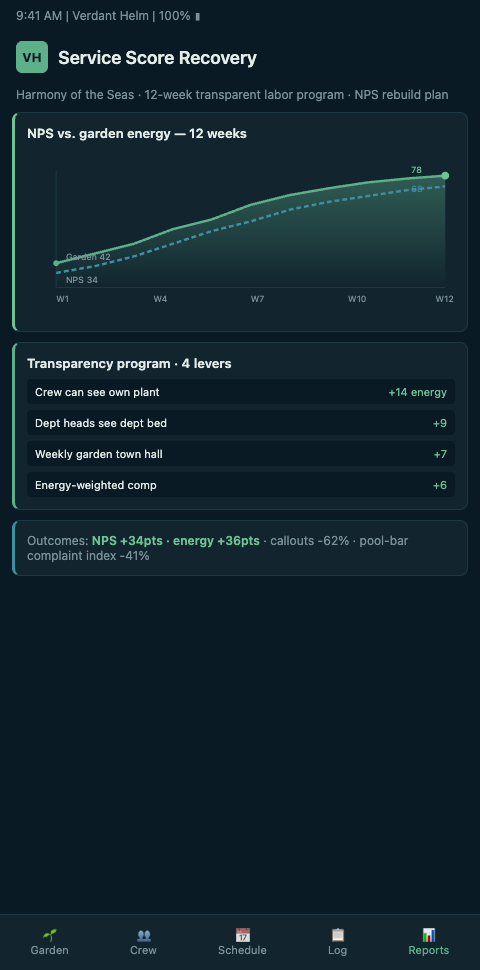
The flagship ship had lost 8 NPS points across Q1 and Q2 following a staffing restructure that reorganized reporting lines across the hotel division. The brand VP ran the standard recovery playbook — targeted guest-service training, refreshed section assignments, a bonus program keyed to post-cruise survey improvements. Six months in, the scores had stabilized but not recovered. The Hotel Director on her third sailing in the role changed one thing: she began sharing the ship's emotional-labor metric dashboard weekly with every crew member who worked guest-facing roles. The NPS moved four points in the following quarter.
The transparency wasn't the whole story. The recovery required concrete operational changes — better handover protocols, redistributed section load, honored recovery windows. But the visible metric became the coordinating artifact the crew used to notice depleting patterns in themselves and in each other. The Deloitte research on reporting workplace wellbeing metrics found 72% of workers at transparent-executive organizations rate wellbeing above average, compared to 57% at less transparent firms. The visibility itself is part of the intervention.
The transparency shift also changed the texture of the weekly ops meeting. Before, the meeting centered on the score and the presumed causes — which venue dipped, which shift had issues. After, the meeting centered on the visible garden state — which perennials were carrying what, what was available for redistribution, where the recovery windows should fall. The score stopped being the only language and became one reading alongside others. Department heads reported that difficult conversations about workload and burnout became easier once they had a shared visual vocabulary instead of competing anecdotes.
Transparency As Garden Shared View
Verdant Helm treats the emotional-labor dashboard as a shared-view garden — a single visualization that the Hotel Director, the HR lead, the maître d', the bar manager, and the frontline crew member can all see at the same time with appropriate filtering. The garden frame specifically resists the shame-triggering feel that raw numeric dashboards produce. A cabin steward looking at "emotional labor score: 62" feels exposed. The same steward looking at their perennial in a shared bed, with context showing bed conditions and voyage stress, reads the picture as situational rather than personal.
The Emerald journal paper on where service recovery meets its paradox establishes that recovery lifts satisfaction when conducted with procedural fairness and fails when overcompensation is perceived as inauthentic. Translating that to service-score recovery: the crew performing the recovery needs to be in a state where authenticity is possible, which requires the crew to see and understand their own state. Transparency enables the authenticity.
The shared-view garden carries three layers per perennial. First is individual state — what the specific crew member is carrying this voyage. Second is bed context — what the section/venue/deck has been asking of its perennials, including high-load events and unusual absorption patterns. Third is peer reference — how other perennials in similar beds are tracking, anonymized to the perennial but named at the bed-and-voyage level. The peer reference removes the "is it just me?" question that frontline staff often ask silently and never answer. This three-layer view mirrors the post-cruise NPS drop tracing playbook, where guest verbatim and crew state jointly tune the model.
This three-layer view shifts the interpretation a crew member gives to their own reading. A steward who sees her individual reading without context may conclude she's failing. The same steward who sees her reading next to bed context showing an unusually heavy voyage, and peer reference showing her colleagues trending similarly, reads the picture as situational. The situational reading invites problem-solving; the individual-only reading invites withdrawal. Research on frontline engagement consistently finds that situational framing outperforms individual framing for engagement outcomes.
The Bain Net Promoter 3.0 guidance on earned-growth rate and frontline accountability emphasizes that the frontline relationship with the scoring system determines whether the system improves outcomes or becomes theater. Verdant Helm builds transparency into the frontline relationship from the start. The crew sees what the manager sees. The manager sees what the crew sees. Discussions about depletion, assignment rebalancing, and recovery windows become conversations rather than top-down interventions.
The MDPI study on service gaps and recovery satisfaction found fairness and timeliness moderate the satisfaction-retention link — the same fairness-timeliness pattern applies to crew-facing transparency. A dashboard the Hotel Director shares weekly is timely. A dashboard every named perennial can see is fair. Together they change how the crew relates to the service-score recovery effort.
The PMC systematic review of validated wellbeing metrics for workers catalogs the measurement options for transparent dashboards. Verdant Helm uses a subset tuned for shipboard hospitality — emotional labor intensity, surface-acting ratio, recovery-window rebuild effectiveness, cross-voyage compounding — that balance scientific validity with operational readability. The metrics have to be comprehensible at a glance or the transparency doesn't work.
The Cruise Industry News coverage of Costa's strong NPS rebuild after crisis is an example of brand-level recovery using systematic feedback programs. The transparency lever at the shipboard level complements brand-level programs: shore-side guest feedback flows in, crew-side emotional-labor data flows in, and both are visible to the crew doing the recovery work.
The botanical frame matters specifically because it renders the shared view without reducing people to numbers. Crew looking at a garden see themselves as tending beds together — the Hotel Director tending beds alongside the cabin stewards, the maître d' tending beds alongside the waitstaff. The cooperative metaphor changes the politics of the dashboard, which in turn changes whether the dashboard gets used.
Advanced Tactics for Transparency-Driven Recovery
Three tactics convert transparency into measurable NPS movement.
The first is NPS-dip fast tracing with crew participation. When the trace from guest comment back to specific crew, night, and bed is visible to the crew, they see the connection between their state and the score in a way that shifts how they schedule their own recovery windows. The ScienceDirect study on CSR reputation and cruise customer loyalty documents the feedback loop between crew-wellbeing reputation and guest loyalty — the transparent trace operationalizes that loop on a per-voyage cadence.
The second is always-on monitoring between voyages. The cruise retention always-on monitoring playbook describes the continuous-monitoring architecture that sustains visibility through contract rotation and port-day releases. Transparency on a single voyage surfaces patterns; transparency across the contract surfaces the trajectory. Hotel Directors running service-score recovery need both.
The third is cross-niche cognitive-debt integration. The ISM audit continuous cognitive-debt playbook for cargo crews applies transparency to the bridge-team cognitive-debt reading, and the same architecture extends to hospitality emotional-labor debt. The shared metric vocabulary across bridge and hotel teams reduces the silo that often keeps service-score recovery efforts disconnected from safety and fatigue data elsewhere on the ship.
A fourth tactic is specific crew-access onboarding. The first time a cabin steward sees the emotional-labor view, they see it alongside a 10-minute walkthrough from their section leader explaining what each reading represents and what it doesn't. This matters because a new reader who misinterprets the surface-acting ratio as a performance judgment will disengage from the transparency effort immediately. The walkthrough is what converts the dashboard from a potential shame-trigger into a tool the crew member owns. Hotel Directors who skip the walkthrough report measurably lower transparency benefit because the dashboard reads as surveillance rather than shared artifact.
A fifth tactic tracks metric-mismatch tuning. When a cabin steward looks at her own emotional-labor reading and it doesn't match what she's feeling, the discrepancy itself is a diagnostic signal. Verdant Helm treats these mismatches as tuning inputs — the system asks the crew member to flag the mismatch, then weighs whether the metric needs refinement for her specific role, deck, or contract phase. The dashboard that crew can correct becomes more accurate over time. The dashboard that crew can only read stagnates.
Share One Dashboard For One Voyage
A Hotel Director or Cruise HR Leader planning a service-score recovery should pick the next voyage and commit to sharing the crew-facing emotional-labor dashboard weekly with every guest-facing staff member. Verdant Helm packages the shared view so the crew-facing version surfaces appropriate context without exposing individual comparisons that would harm the effort. Share the first view, hold a 20-minute ops meeting to discuss what the crew sees, and read the next post-cruise NPS. The transparency lever is one of the few recovery moves where the effect size shows inside a single voyage. Run it once, read the survey, decide whether it becomes the standing practice.
The first-voyage launch carries a specific risk the Hotel Director should anticipate. Two or three veteran stewards or servers will push back hard in the first ops meeting, reading the dashboard as management surveillance in a new wrapper. That pushback is not a failure of the rollout; it is the moment the rollout either earns the room or loses it. The Hotel Director who responds by showing her own reading first — her own emotional-labor draw across the voyage, her own recovery windows and misses — turns the conversation around within minutes.
The crew watching the Hotel Director sit inside the same frame they are being asked to sit in is what establishes the dashboard as shared artifact rather than top-down measurement. Cruise HR Leaders monitoring the rollout across a fleet should watch for the ships where the Hotel Director skipped this step. Those ships tend to produce the dashboard-as-surveillance reading inside the crew mess within two voyages, at which point the transparency benefit inverts into a trust cost. The move is cheap to execute and expensive to skip.