Catching Circadian Drift Before the Next Bridge Watch
The 03:50 handover that was already off course
On a Singapore-to-Long Beach TransPacific container run, a Filipino Second Mate took the 00:00-04:00 bridge watch on voyage day eight. By 03:50 he had logged two unexplained heading excursions of three degrees and had not acknowledged an ECDIS cross-track alarm for seventy-two seconds. The British Chief Mate who relieved him wrote "alert, handover clean" in the log. The Second Mate had slept four hours twenty minutes in the last twenty-four, and six hours forty minutes across the past forty-eight. His circadian low was at 04:00 local, precisely where the watch had put him.
The vessel was a 9,200 TEU Panamax container at the midpoint of a 14-day passage, with the next TSS transit falling forty-one hours away at the approach to the San Pedro Bay. The voyage plan had the Santa Barbara Channel routing at voyage day nine and the Long Beach pilot boarding at voyage day ten, three high-demand bridge events falling against a declining bloom curve with no scheduled recovery window between them.
The MAIB Bridge Watchkeeping Safety Study found fatigue contributory in 82% of groundings between 0000 and 0600, with watch-pattern disruption cited repeatedly. What that number hides is the drift before the incident. Circadian debt is slow-growing. It accumulates across three to four voyage days before it surfaces as a measurable lapse. The watch that fails is rarely the first one where the officer was tired. It is the fourth or fifth. By the time the heading excursion is logged, the signal has been present and unread for seventy-two hours. A Greek Master on the same run who had stood three previous transpacifics recognised the pattern retrospectively but had no instrument to surface it in advance — only the paper rest-hour form, which read as fully compliant.
Reading pre-watch energy as a perennial bed
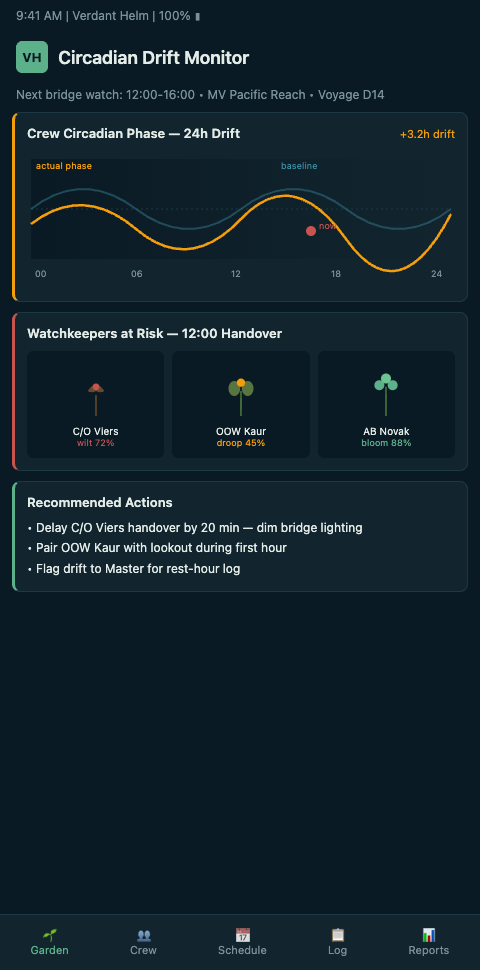
Verdant Helm treats each officer on a cargo bridge as a perennial in a circadian garden. The 4-on-8-off watch rotation is not a schedule — it is a watering cycle, and its effect on each officer's bloom state is measurable before the officer steps onto the bridge. A Second Mate who has been sleeping 5.4 hours per 24 across the past three voyage days shows up in the garden as a perennial whose leaves are wilting at the edges: still upright, still green, but visibly losing turgor. The Master who walks into the bridge at 03:45 for a handover check can read the wilt before he reads the ECDIS. On a VLCC running the Arabian Gulf to Singapore leg, the same reading surfaces on day five rather than day eight, because the tanker's cargo-watch intensity during STS operations compresses the debt curve by forty-eight hours.
The garden does three things the rest-hour log cannot. It renders trailing sleep debt across seven days as a single visual state, not a cell in a spreadsheet. It pairs that state with the watch the officer is about to take, so the circadian trough and the watch window are shown together. And it surfaces the prune decision — swap officers, shorten the watch, add a lookout, reschedule a TSS transit — as an obvious tend action rather than a judgment call the Master has to defend to the DPA on the next ISM internal audit call.
Project HORIZON's 90-officer simulator study showed sleep on watch observed most frequently in night and early-morning windows, with risk peaking in the last portion of each watch. That "last portion" is where the bloom collapses. A perennial does not wilt uniformly; it wilts from the tips inward. On a bridge, the tip is the last hour of the 00:00-04:00. If the garden reads a wilting perennial heading into that watch, the tending action is to put a second officer on the bridge for the final hour, not to hope the alarm catches the drift. The HORIZON data covered both 4-on-8-off three-watch and 6-on-6-off two-watch regimes, with the latter showing more severe decay but the former showing the characteristic mid-watch trough that container and tanker bridges actually run.
The Cambridge Journal of Navigation analysis of shipping accidents against circadian rhythms found clear peaks during night watches, with accidents fluctuating alongside biological rhythm rather than workload. This is why a garden works and a rest-hour form does not. The form records compliance with a 10h/24h minimum. The garden records the phase of the rhythm, which is what actually predicts the lapse.
Two officers with identical compliant rest hours can show very different bloom states — one peaking, one wilting — because their recent sleep windows fell on different sides of their circadian troughs. On a Shanghai-Long Beach container run crossing twelve time zones over ten days, the phase shift between ship time and biological time becomes the dominant signal; an OOW whose biological rhythm is still anchored to Shanghai while standing an LA-time watch is effectively standing a watch two hours deeper into his personal trough than the clock suggests.
Nautilus International's seafarer fatigue review found 18% of seafarers fell asleep at work in the past twelve months and 59% fight sleepiness monthly. Those numbers describe officers who passed rest-hour checks. The garden is what catches the 18% before they fall asleep, by reading the perennial bed as a living system rather than a compliance artifact. The same evidence base, cross-referenced against MAIB case files from the 2015-2023 window, shows the drift on a VLCC or ULCC is usually visible at the pre-watch briefing two to three watches before the lapse — a window long enough to swap officers, extend the handover, or defer a high-demand navigational event.
Advanced tactics for cargo bridges
Three tactics raise the signal-to-noise ratio of a pre-watch garden reading. First, anchor the circadian phase to local noon at the current position, not UTC or ship's clock. An officer on a TransPacific transit shifting time zone every second day has a biological rhythm lagging the ship's clock by up to three hours. The garden reads the lag and adjusts the bloom state accordingly. A watch that looks like 00:00-04:00 ship time may be 21:00-01:00 biological time — a very different trough. On an eastbound Singapore-Los Angeles run the phase drift is advancing; on the westbound return leg it is retreating, and the bloom-state curve inverts across the two halves of the round voyage.
Second, pair the reading with the handover, not the start of the watch. The officer taking the relief brings their own bloom state onto the bridge. The relieving officer carries their state off. The handover is the only moment when both states are measurable in the same room, and the Master who is watching the garden at that moment gets a clean delta. A handover where both officers are wilting is a different tending decision than a handover where one is peaking and one is wilting. On a Rotterdam-Jebel Ali container leg passing the Red Sea and Gulf of Aden with heightened watchkeeping demand, the handover delta is what flags the bed's approach to a collective trough, two or three watches before any individual alarm would fire.
Third, treat the wearable signal as a confirmation, not the primary reading. Shipowners' Club research on wearable fatigue technology notes wearables flag drift and microsleeps in real time, often before officers recognise their own fatigue. But the wearable alerts during the lapse. The garden reads the bloom before the lapse. Use the wearable to confirm the garden's pre-watch reading, and close the loop on any officer whose wearable fired on a watch the garden had called healthy. The Dover Strait near-miss cases compiled by the MAIB over the 2019-2023 window included several where wearable data existed but was reviewed only post-incident; the pre-watch garden reading would have surfaced the drift before the conn approach.
The IMO MSC.1/Circ.1598 Guidelines on Fatigue describe pre-watch identification as one of six modules for managing fatigue at sea. Those guidelines were written when pre-watch identification meant a checklist and a self-rating. A botanical garden view is the modern equivalent — the same concept, rendered as state rather than paperwork. Our analysis of why 4-on-8-off watchkeeping builds hidden cognitive debt walks through the debt-accumulation mechanism the garden is reading. For the alertness-as-alarm framing on the bridge itself, the companion piece on reading OOW alertness like an ECDIS drift alarm extends the pattern into the watch window. Offshore rig leaders spotting analogous hitch fatigue will find the hitch fatigue early-warning signs guide maps the same drift curve on rotations.
What deep-sea cargo fleet leaders should do next
Masters and Chief Mates running TransPacific or transatlantic cargo voyages can read a pre-watch circadian drift pattern today without changing the watch rotation, the ECDIS, or the MLC paperwork. Verdant Helm renders each OOW's bloom state against the upcoming watch window, so a bridge team handover surfaces drift before the ECDIS alarm does. DPAs and fleet superintendents get a fleet-wide view of which ships are carrying wilting perennials into night watches this week. Book a walk-through with our deep-sea team and we will read one voyage of your data against the garden — the drift is almost always already there.
Before the trial, ask the Master to sit one morning handover with the bloom-state view open alongside the rest-hour form. On an 11,000 TEU Panamax running the Santa Barbara Channel inbound, the first handover usually exposes one officer whose pre-watch reading would have changed the conn assignment; the second and third handovers usually expose the same officer's carry-over from the prior TSS transit. The DPA gets a weekly report that lists every wilted bed heading into the 00:00-04:00 window across the fleet, with the tending choice already costed — the swap, the supplementary lookout, the deferred Navtex log review — so the decision is auditable rather than defended after the near-miss. P&I clubs and charterers reviewing the voyage data see a bridge posture that reads drift in advance rather than reconstructing it from the ECDIS after the grounding.