Sowing a Circadian Energy Garden on Your Bridge Team
Four officers, four rhythms, zero shared view
A Greek Master takes command of a 6,500 TEU container vessel in Hamburg on a mid-voyage relief before the Rotterdam-Jebel Ali leg via Suez. The bridge team comprises a British Chief Mate who has been aboard eleven weeks, a Filipino Second Mate on week six, a Ukrainian Third Mate on week three, and a British deck cadet in his second month. Four officers, four different circadian profiles, four different debt trajectories, and not a single shared view of any of them. The joining Master has a crew list, a rest-hour spreadsheet for the past fourteen days, and a voyage plan. He has no rendering of energy state. By the end of voyage day three, he will be making TSS-transit and watch-assignment decisions on officers whose biological rhythms he cannot see, with a Suez convoy slot booked for voyage day five and a Bab el-Mandeb transit at day nine.
Project MARTHA, Solent University's long-term fatigue study, documented that night watchkeepers sleep less than their day counterparts, Masters face the worst fatigue and stress profiles of any rank, and motivation and cohesion drop after six months. The Safety4Sea overview of MARTHA emphasised voyage-length visualisation as critical. What "visualisation" means, practically, is a bridge garden — a live, shared, readable rendering of every officer's bloom state over the voyage timeline. Maritime Executive's coverage of MARTHA as "a new horizon for maritime safety" framed the TK Foundation's $3M study as building the empirical foundation for exactly this kind of energy mapping onboard. The MARTHA data spanned container, bulk, and tanker trades across routes including TransPacific, Atlantic round-trip, and Asia-Europe via Suez, which is why its conclusions generalise across the trades a joining Master is likely to face.
The first-week sowing pattern
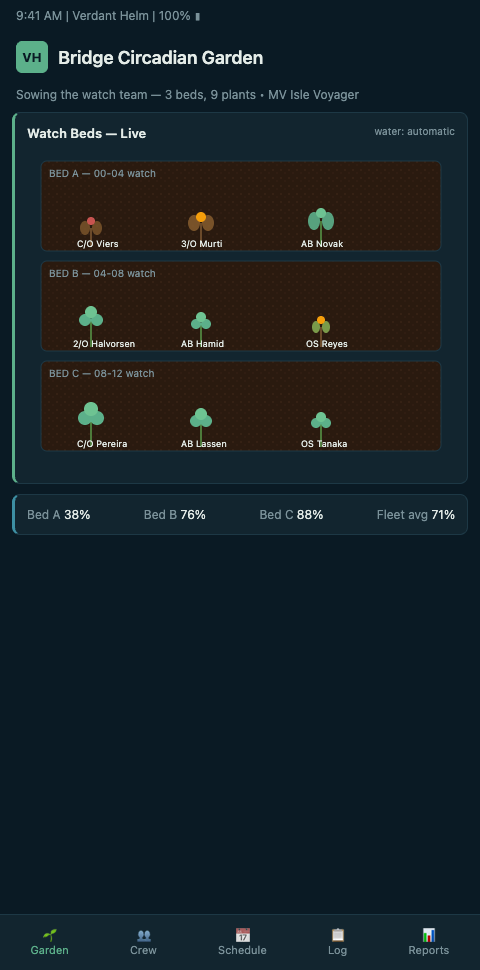
Verdant Helm is sown on a bridge team in three stages across the Master's first week aboard. Stage one is the bed preparation — capturing each officer's circadian baseline from the previous 30 days of wearable or self-reported data, rendering them as four perennials in a shared bed, and surfacing the phase differences. Stage two is the watering schedule — overlaying the 4-on-8-off rotation on the baselines and letting the garden show which officers are receiving sleep windows aligned with their biological rhythms and which are not. Stage three is the tending interface — pairing the garden with the voyage plan so that TSS transits, port calls, and COLREGS drills are scheduled against the collective bloom state rather than the compliance spreadsheet.
The garden metaphor gives the Master a vocabulary his bridge team already understands. Perennials are the officers — long-lived, seasonal, each with a personal rhythm. Blooms are peak alertness windows. Wilts are trough windows. Sinks are environmental drains on energy (heavy weather, dense traffic, cargo operations, bunkering at a congested terminal). Pruning is a reduction in duty or a swap. Tending is any positive action the Master or Chief Mate takes to support a perennial's bloom. The language scales from cadet to Master in a single shared schema, and crucially crosses the nationality lines common on modern cargo fleets — a Greek Master, a Filipino Second Mate, and a Ukrainian Third Mate all read the same garden.
Lloyd's Register Horizons' seafarer mental health spotlight made the collective-morale case. Crews without visible cohesion signals show deteriorating morale and retention. A bridge garden is a cohesion signal made visible. Officers see their own perennials alongside each other's. They read the Master's tending decisions in the same frame. The garden is simultaneously a fatigue instrument and a cohesion instrument, which is why it works where earlier fatigue-management attempts stalled. On vessels with extended contract lengths — Filipino officers on nine-month contracts, European officers on four-month contracts — the cohesion reading captures the rank-adjacent-to-rank dynamic that a generic welfare survey misses.
The Frontiers in Public Health 2025 scoping review of factors affecting seafarers' fatigue mapped the environmental and social causes onto a framework that reads as a blueprint for energy-garden categories. Watch rotation, sleep quality, social support, workload, environmental conditions, and voyage phase all become sinks or tending factors in a garden rendering. Cardiff University's Seafarers International Research Centre, with its 14-year longitudinal programme, models bridge team fatigue dynamics that translate directly into the garden's tending rules. The Cardiff data covered British-officered, Filipino-crewed vessels running the Europe-Far East trade, a combination that closely matches the manning profile of large container fleets. The Cardiff work also captured voyage-length effects — vessels running the 22-day Rotterdam-Singapore leg showed different debt kinetics from the 32-day Dalian-Rotterdam run, and the garden's sowing pattern must account for the difference at the Master's first-week baseline capture.
Nautilus International's refreshed guidelines for unrefreshed crews made the bridge-team-as-system case explicit. A bridge is not four officers running in parallel. It is one system whose alertness is a collective property. The garden renders the system. When one perennial wilts, the rest of the bed can compensate. When three perennials wilt together, the Master sees a bed in drought and responds as a whole, not as four individual conversations.
On a 6,500 TEU container bridge where the Chief Mate's watch covers the pilot-boarding approach at Jebel Ali, a bed-wide wilt reading three days before arrival triggers a different Master response than a single-officer wilt. The Master may move the Suez convoy slot by one cycle, request a berth deferral at Jebel Ali, or bring the Second Mate forward into the Chief Mate's watch for a cross-familiarisation segment that redistributes the pilot-boarding load across two officers rather than concentrating it on one.
Advanced tactics for the first-week sow
Three tactics make the sowing stick past the first week. First, make the Master's daily garden check part of the 10:00 bridge handover briefing, not a separate ritual. Officers present at the briefing see their perennials alongside the weather, the voyage plan, and the cargo operations schedule. The garden becomes part of the bridge's shared vocabulary within three days. Masters who treat the garden as a side tool see adoption drift; Masters who fold it into the existing daily rhythm see it take root. On a VLCC with a cargo-plan-heavy morning briefing covering the day's STS operation, the garden reading slots alongside the pumping schedule, ballast plan, and weather outlook without adding meeting time.
Second, let officers annotate their own perennials. A Ukrainian Third Mate who wakes up feeling thick after a 22:00-02:00 sleep can add a note — "cabin vibration on starboard aft, interrupted sleep" — that the garden attaches to their bloom state. Over a voyage, these annotations surface environmental sinks the Master would not otherwise see. Verdant Helm renders them as garden-bed conditions: soil moisture, light exposure, root-zone temperature. The annotation is the data the MLC rest-hour form could never collect. A Filipino Second Mate noting "generator room noise carried through the bulkhead during the 14:00-18:00 sleep window" feeds a maintenance priority that surfaces three voyages later when two officers report the same sink in the same cabin location.
Third, close every tending action with a visible outcome. A Master who swaps a wilting Second Mate off the 00:00-04:00 watch and replaces him with the Chief Mate should see, in the garden, the Second Mate's bloom state two watches later. If it has recovered, the tending action is logged as effective. If it has not, the garden prompts a follow-up — longer recovery, formal reduced-duties flag, medical review. The tending loop stays visible, which is how the garden earns ongoing trust from the bridge team.
The closed-loop property is what separates a garden from a dashboard — every reading has an observable downstream outcome, and the bed's credibility grows with every logged outcome. On a 14,000 TEU ULCV running Shanghai-Hamburg via Suez, the Master's tending loop across a 26-day passage produces roughly forty closed observations — each a prune, a staffing decision, or an environmental adjustment — that collectively replace the single-signature weekly rest-hour form as the primary bridge-resource instrument.
The rollout pattern pairs naturally with the able seaman's first voyage with Verdant Helm for the rating-side of the same bridge, and with turning Chief Mate rounds into garden-state entries for integrating the Chief Mate's daily inspection work into the shared bed. The parallel SOV energy garden rollout for offshore wind technicians shows the same first-week sowing pattern on a service-operation vessel, where the rotation is two-week on-off rather than a continuous deep-sea voyage.
What deep-sea cargo fleet leaders should do next
Joining Masters, Chief Mates, and DPAs stepping into a mid-voyage relief or a new-build can sow a bridge garden in the first week of command using Verdant Helm's guided setup flow. The garden runs on the wearable and self-report data the officers already generate, rendered as a shared bed the whole bridge can read. Fleet superintendents managing multi-ship fleets get a consolidated bed-of-beds view across every vessel in the fleet. Schedule a command-transition walk-through with our deep-sea team and we will sow the first voyage alongside the joining Master.
Before the walk-through, pull the outgoing Master's rest-hour binder for the preceding rotation and the bridge team's wearable exports for the past 30 days. The garden's bed preparation step reads both inputs into the four-perennial rendering within a single watch, so the joining Master can see the phase differences between his Chief Mate and Second Mate before the first Suez convoy brief lands.
On a Hamburg-relief joining into an 8,500 TEU container vessel bound for Jebel Ali, the bed typically surfaces one officer whose phase has drifted two hours against the ship's clock during the previous Black Sea call, which the outgoing Master had no instrument to flag. The DPA gets a command-transition report that tracks the joining Master's sowing across the first fourteen days, with the Chief Mate's rounds and the bosun's deck walks feeding the bed as secondary observers. P&I clubs reviewing command-transition evidence during a vetting cycle read the sowing record as a bridge-resource-management artefact the outgoing paperwork could never produce.