How Masters Replace STCW Rest-Hour Forms With Gardens
28 forms a week and three PSC findings
A Greek Master on an 82,000 DWT Panamax bulk carrier signs 28 rest-hour forms a week under the Manila-amendment STCW rules — four per officer per week across seven officers covering deck and engine. Over the past six months, Port State Control inspectors in Tanger Med have found discrepancies on three consecutive calls: officers signing for consolidated sleep windows that do not match the GPS-derived bridge watch records. The forms are STCW-compliant on paper. They are hollow in practice. Nobody reads them except the Master, the DPA during internal audits, and the PSC inspector looking for exactly this kind of discrepancy. The same vessel's previous PSC calls at Shanghai, Singapore, and Rotterdam produced clean inspections — Tanger Med's Paris MoU inspectors simply ran the cross-check that the other ports had not.
ScienceDirect's analysis of PSC weaknesses in enforcing work/rest hour regulations found PSC officers openly admit rest-hour deficiencies are under-reported, and that record-based compliance is structurally hollow. Nautilus International's damning fatigue findings showed one-third of seafarers report pressure to adjust rest-hour records. The Skuld P&I reference on hours of work and rest set out the STCW/MLC record requirements, exceptions, and the DMLC consequences of findings — the legal architecture around which the paperwork is built. The paperwork is real. Its compliance value is eroding. Across the Paris MoU and Tokyo MoU inspection regimes, rest-hour discrepancies have moved from a secondary finding to a primary trigger for deeper inspection in roughly the past three years.
The garden as live record
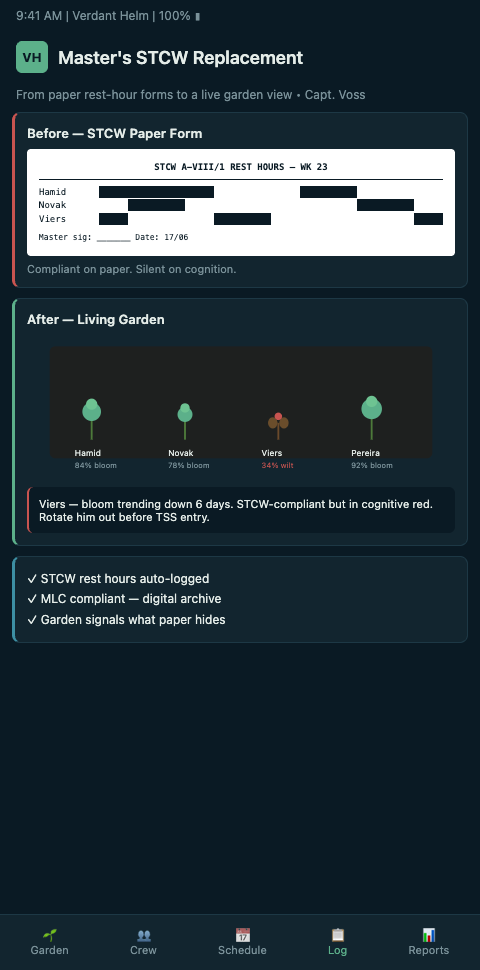
Verdant Helm replaces the rest-hour form as a daily instrument while preserving it as an audit artifact. The garden reads each officer's actual sleep windows from wearables, cabin sensors, and watch-log correlation. It renders the 10h/24h and 77h/7-day STCW minima as soil-moisture and weekly-rainfall readings on each perennial. A perennial whose soil moisture has dropped below minimum is surfaced immediately, not a week later on a form. The Master sees the compliance state as a garden property, not a spreadsheet cell. On a VLCC with a seven-officer deck-and-engine complement running Ras Tanura-Ulsan, the bed of seven perennials renders the full manning scale's compliance posture in a single peripheral glance.
The audit trail is generated on export. At the end of each voyage, or on demand from PSC, the garden generates an STCW-format rest-hour record that matches the compliant form layout. The record is built from the same telemetry the garden displays. There is no officer-signature step in the middle where the data can be adjusted. The form exists — PSC gets its artifact — but it is a rendering of truth rather than an input for truth. On consecutive PSC calls across a Paris MoU cycle, the exported records from the same vessel read as internally consistent, which is the property that moves an inspection from "verify discrepancies" to "verify consistency" in the inspector's workflow.
IMO's STCW Convention overview and the ICS Manila Amendments guide set the legal minima the record must satisfy. Verdant Helm's export respects the Manila format, the 24-hour period definition, the exception framework (limited to two exceptions per week of 77-hour minimum rest). What changes is the data flow. The officer does not fill the form from memory. The form fills itself from the bed. The Riviera Maritime review of crew-fatigue software mapped the market trajectory: automated rest-hour tools cut detention risk, because PSC discrepancies fall when the record is generated rather than composed. Riviera's fleet case studies showed detention-rate reductions of meaningful magnitude on container fleets that moved from form-first to telemetry-first compliance across two annual cycles. The pattern held across Paris MoU and Tokyo MoU jurisdictions equally, which matters for fleets that alternate between Rotterdam and Shanghai port states across a round voyage.
The tending value is larger than the compliance value. A Master who sees an officer's soil moisture dropping across days four through seven can tend the bed before day eight turns into a PSC-finding day. The prune is a scheduled recovery window, a reduced-duties flag, or a rota swap. The tending is logged. The log feeds the ISM audit trail, the DPA's fleet-wide review, and any incident-response investigation that may follow a casualty. ISF Watchkeeper and similar ICS-family rest-hour compliance products established the market baseline — what Verdant Helm replaces is the compliance-first mental model they encoded.
On a Rotterdam-Santos round voyage, the tending value manifests as three or four prune decisions per voyage, each of which closes the compliance loop and the fatigue loop simultaneously. The same pattern on a TransPacific Shanghai-Long Beach round produces slightly fewer prune decisions per voyage but deeper individual ones, because the Great Circle track offers fewer schedule flex points than the Atlantic routes do.
The Skuld P&I brief on rest hours enumerated the record-keeping obligations under STCW and MLC. The obligations remain. What Verdant Helm retires is the manual form as the primary compliance instrument. A garden-based record is harder to manipulate, easier to audit, and — critically — a better input to actual fatigue management than the form ever was. The ISM audit-readiness case is that continuous cognitive-debt metrics are a stronger evidence base than a weekly form, which is why the paperwork reform cascades into the ISM layer naturally. On a flag state audit — UK MCA, Greek HRS, Marshall Islands — the same continuous record answers both the fatigue-management and the SMS-effectiveness questions in one pull.
Advanced tactics for paperwork reform
Three tactics smooth the transition from form-first to garden-first compliance. First, run both in parallel for the first voyage. The officers fill the forms as before; the garden generates its version from telemetry. At the end of the voyage, compare. Where the two match, the form was accurate. Where they diverge, the garden is the corrective reading. Masters who have seen three voyages of parallel records rarely go back to form-first — the divergence is usually larger than expected and always in one direction. On a 28-day Qingdao-Long Beach round voyage the divergence typically shows up in the second-half sleep windows for the Second Mate and Third Mate, where cargo-watch and port-approach demands eat into the nominal off-watch hours the form still records as rest.
Second, hand the PSC export to inspectors on first request, not after a discrepancy. A Master who opens the inspection with "here is the STCW record generated from bridge and cabin telemetry" changes the inspector's expectation. The inspection becomes a verification of a continuous record rather than a hunt for discrepancies in a weekly artifact. PSC officers have limited time per vessel; they respond to clean records by closing the section and moving on. The garden export is clean by construction.
In Paris MoU ports — Rotterdam, Antwerp, Le Havre, Algeciras — the inspection-time savings have been documented in company fleet reports covering roughly eighteen months of post-deployment PSC calls. In Tokyo MoU ports — Singapore, Shanghai, Yokohama, Busan — the same pattern shows up, with the additional benefit that the exported record satisfies the MLC 2006 Title 2 Regulation 2.3 documentation obligations at a single stroke, which pays back for Masters who previously maintained STCW and MLC records in parallel formats.
Third, link the DPA's ashore view to the same garden the Master sees at sea. A DPA running six vessels gets a fleet-wide bed where each ship is a row and each officer is a perennial. Divergences from the fleet norm surface automatically — an officer whose bloom state has been dropping for five voyage days across two consecutive voyages is the one who needs a welfare conversation, not a new form to sign. The DPA's role shifts from record-keeper to gardener.
On a six-vessel Suezmax tanker fleet with mixed Greek and Filipino manning across vessels, the fleet-wide bed surfaces cabin-allocation and contract-length patterns the DPA could not previously see without pulling six separate rest-hour spreadsheets. The DPA also gets a cross-vessel comparison that informs crewing rotation decisions — a Second Mate whose bloom curve runs healthy on container vessels but drops on tankers reveals a trade-preference signal that the manning agency can use when the next contract is offered.
The paperwork reform connects directly to retiring MLC rest-hour paperwork, which extends the same principle to the MLC 2006 rest-hour regime alongside STCW. The ISM audit path is the subject of ISM audit readiness from continuous cognitive-debt metrics, where the garden becomes the evidence base for the SMS audit. Offshore rig leaders running analogous OIMS frameworks will recognise the same pattern in how OIMs replace stand-downs with energy maps.
What deep-sea cargo fleet leaders should do next
Masters, Chief Mates, and DPAs running cargo fleets under STCW and MLC can retire the rest-hour form as a daily instrument while preserving its audit artifact. Verdant Helm ingests wearable and cabin-sensor data to generate the STCW/MLC record on demand, with the Manila-amendment layout intact. Fleet superintendents get a consolidated compliance bed across every ship, with PSC-ready exports one click away. Book a paperwork-reform walk-through with our deep-sea team and we will run your next voyage in parallel — form-first on paper, garden-first on the dashboard, side-by-side at voyage end.
Before the walk-through, pull the last six weeks of rest-hour forms for the Chief Mate, Second Mate, and Third Mate alongside the bridge watch GPS log and the cabin badge access record. The parallel voyage reveals the exact windows where the signed form read compliant while the telemetry read a 6.8-hour sleep window or a fragmented 3+2-hour split. On a Tanger Med call with a Paris MoU inspector already flagged for a focused inspection on rest hours, the export carries the preceding voyage's continuous record rather than the binder the inspector expects.
The DPA gets a fleet-wide bed of perennials where compliance and bloom state read on the same screen, so the Master who needs to defend a Second Mate's reduced-duties flag to the charterer has the telemetry and the form in one pull. Flag state auditors running a DOC renewal under the UK MCA, Greek HRS, or Marshall Islands flag read the exported record as SMS evidence rather than paperwork, and the ISM findings close on the walk-through rather than a follow-up correspondence three months later.