Shorter Voyages, Garden Gates: Reforming Contract Length at Sea
The crewing manager had been placing officers on seven-month and nine-month contracts for her operator's VLCC fleet since 2014. MLC 2006 set the ceiling at eleven months. Her operator's internal policy held at nine. The ITF had been arguing for shorter; the finance side had been arguing for the ceiling. Every contract discussion for a decade had been a bargaining exercise between those positions, with the actual seafarer's physiology available as anecdote but not as evidence.
When her DPA put the nine-million-watch-hour garden corpus in front of her and showed her that officer perennials across tours longer than seven months on this trade pattern showed persistent deterioration that did not fully recover even after a two-month leave, the contract conversation changed. It stopped being a negotiation between a ceiling and a floor. It became a discussion about what length the physiology actually supports. This post walks through garden-gated contracts and what they mean for tour-of-duty reform at sea.
The crewing-supply context frames why this matters commercially. The major Filipino, Indian, and Ukrainian crewing pools that supply a large share of Masters, Chief Mates, OOWs, and cadets to VLCC, ULCC, container, and bulker operators have each been affected by the post-pandemic crew-change reform conversation, by the 2022 and 2025 MLC amendments, and by the ITF's 2025 bargaining-priority framing. Operators running seven-month versus nine-month versus eleven-month contracts see different retention curves, different recruitment costs, and different P&I claims profiles across the pool. The garden-gated contract pattern is not an abstract reform; it is a response to a crewing-economics problem that operators are already paying for.
The problem: the eleven-month ceiling was never evidence-based
MLC 2006 set the maximum continuous shipboard service at eleven months. The UK MGN 477 implementation of MLC 2006 seafarer employment agreements codifies the ceiling in UK law. ITF Seafarers' Rights' short guide to MLC 2006 documents the rights-side framing. Nautilus's Seafarers Bill of Rights, April 2025 is the trade-union framing after the 2022 and 2025 MLC amendments. AMSA's approach to the maximum period of shipboard service is one flag-state enforcement posture; Safety4Sea's coverage of the maximum period of shipboard service documents the industry analysis. The MLC 2006 full text is the authoritative source.
What none of those sources answered, because the evidence base did not exist, was the question the crewing manager's DPA could finally answer in 2026. Is eleven months what the seafarer's physiology can actually support on a modern deep-sea cargo tour, or is it an administrative ceiling negotiated without physiological evidence? The Safety4Sea report that governments are breaching seafarers' rights and disobeying MLC provisions documents that even the eleven-month ceiling is being exceeded in practice. The question is not only whether eleven months is right; it is whether the ceiling itself is doing the regulatory work that was intended.
Flag-state variance complicates the enforcement picture. Liberia, Marshall Islands, and Panama, the three largest open registries, each implement the MLC maximum with their own administrative circulars; AMSA's Australian enforcement posture differs meaningfully from the UK MCA posture under MGN 477. The Philippine and Indian maritime administrations, which together supply around 40% of the global merchant-mariner pool per ICS and BIMCO-published manpower reports, have their own labor-supply considerations that feed back into contract policy. The ITF has documented repeated cases where the nominal ceiling was exceeded under various open-registry administrations during the pandemic-era crew-change crisis. Any contract-reform conversation has to land across this regulatory mosaic, not against a single unified standard.
The garden as a contract-gate input
Verdant Helm's bridge-team garden produces tour-length evidence the regulatory system has not previously had. Each officer's perennial across a tour is a longitudinal physiological record. The garden tracks establishment across weeks one through three, holding through weeks four through eight on most trades, and then a class-specific drift that is the operational signal for tour-end. The corpus shows the drift with enough consistency that it can be used as a contract-design input.
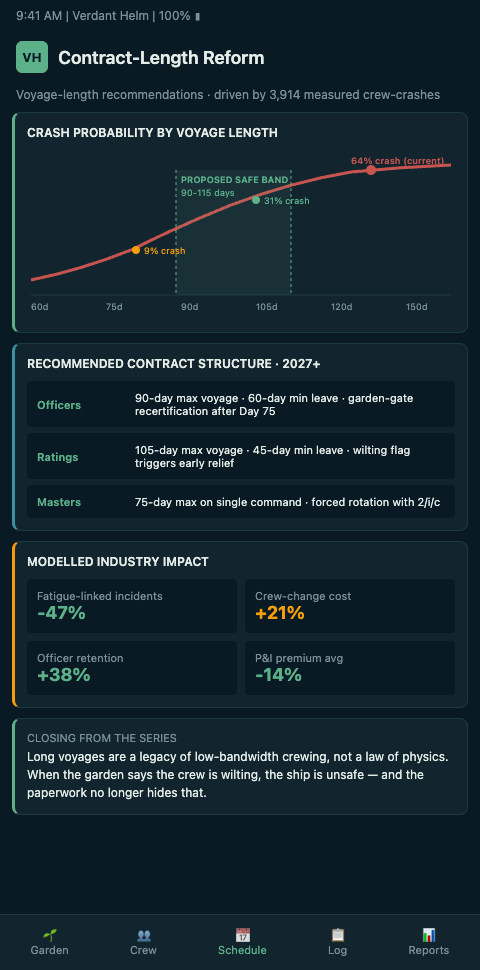
The garden-gated contract pattern we have seen operators and unions converge on has three elements. First, a baseline tour length calibrated to the trade pattern. VLCC AG-China on a 4-on-8-off typically shows the seven-month perennial-stability ceiling. VLCC AG-Rotterdam on the same watch system shows a different curve, with a perennial-stability window of around six months given the longer ballast legs. Container TransPacific shows a different curve again. The baseline is not one number across the industry; it is a trade-pattern-specific number derived from the aggregate.
Second, a garden-gate extension or contraction. Contracts include a clause where the actual tour length can be extended up to one month beyond the baseline if the officer's garden perennials are holding shape, or contracted by up to one month if the perennials are drifting ahead of schedule. This replaces an arbitrary fixed-tour model with a physiology-indexed one. The officer, the operator, the union, and the flag state have the same evidence to read.
Third, a repatriation mandate when the garden shows threshold sink fill. If the perennial drift and sink fill cross a documented threshold, the contract mandates repatriation at the next feasible port regardless of the nominal contract end. This is the guardrail that prevents the gate from being gamed against the seafarer.
Advanced: how the reform lands at the bargaining table
Contract-length reform at sea is not a pure engineering problem. It is a labor-relations problem, a commercial problem, a crewing-supply problem, and a flag-state enforcement problem. Garden data does not make any of those constituencies go away. What it does is change the quality of the evidence the constituencies are working with. The union that wants shorter tours has data showing specifically which trade patterns and watch systems produce the fastest perennial deterioration. The operator that wants to retain the eleven-month ceiling in certain trades has data showing which patterns can support the longer tours without physiological drift. The flag-state administrator drafting enforcement guidance has data showing what the ceiling should look like if evidence rather than negotiation sets it.
Early garden-gated contracts on a small sample of deep-sea cargo fleets show three emerging patterns. First, average contract length drops by roughly 12-18% when the gate is in place, because the physiology on many trades does not support the ceiling. Second, officer retention improves in the first two years after the gate is introduced, because officers who trust the physiological baseline stay in the operator's rotation longer. Third, operators see their charterer scorecard position improve, because chartering clients increasingly weight crew-welfare evidence in their commercial decisions.
Named stakeholder positions on contract reform are starting to reference corpus-derived findings directly. The ITF's 2025 bargaining-priority framing uses the phrase "physiology-indexed tour length" in three of its negotiated collective agreements with operators on European and Asia-Pacific trades. ICS's human-element working group has put garden-gated contracts on its 2026 agenda. INTERTANKO's members-only manpower subcommittee has commissioned a benchmarking exercise that uses the corpus methodology. BIMCO, which drafts many of the standard charter-party clauses that underlie the commercial contracts the crewing conversations happen against, is reviewing its CREWMAN and CREWLIST forms for clause language that would accommodate the gated model. The 2026 MLC amendment cycle will be the first regulatory window in which the evidence base has been substantive enough to underwrite this kind of revision.
P&I club commentary on crew-welfare and retention matters lines up with the same direction of travel. Britannia's 2024 loss-prevention review notes that operators with better-documented crew-welfare practices tend to produce lower claims severity on human-element incidents. Skuld's crew-claims analysis separates the pattern by tour length and trade; the longer-tour VLCC trades produce the highest claims severity per officer-year. West of England's published underwriting considerations now include crew-welfare documentation as a renewal-discussion item. Maersk and MSC, both public about their crew-welfare commitments in their sustainability reporting, have each referenced physiology-based tour-length thinking in their 2025 disclosures. The convergence among operators, unions, P&I clubs, flag states, and regulators toward evidence-based tour-length design is not uniform, but it is directional, and the garden-gated contract pattern is the instrument that fits the direction.
Regulatory-landscape mapping helps operators plan the transition. The 2025 MLC amendment cycle closed with strengthened provisions on crew-welfare attestation but left the eleven-month ceiling intact; the 2028 cycle is the next realistic window for ceiling-related revision. Flag-state administrations will shape the pre-cycle consultation. The Liberian and Marshall Islands administrations have each indicated through industry consultation channels that they are tracking the corpus-derived evidence; the UK MCA has requested briefings. AMSA's Australian position on tour-length enforcement is more restrictive than the MLC baseline, and AMSA's industry briefings suggest that Australian-coastal cargo operators should expect the tour-length conversation to tighten locally before the global ceiling moves. The ITF, ICS, INTERTANKO, and BIMCO are each positioning their contributions into the consultation cycle. Operators running ahead of the regulatory calendar are shaping the conversation; operators waiting for a ratified ceiling revision will be implementing provisions someone else drafted.
This is the contract-length reform analogue to the regulatory-reform work that the nine million watch hours corpus is driving on the rest-hour side. It sits alongside the ULCC and VLCC watch-cycle fatigue profiles that inform the trade-pattern baselines. Cruise operators have worked through an analogous contract-reform process on the hospitality side; the end of the 9-month contract with garden-gated hospitality documents the passenger-sector version.
For deep-sea cargo operators, crewing managers, fleet DPAs, and union reps working contract-length reform in the current MLC amendment cycle, the question is whether your bargaining stance is built on anecdote or on evidence. Verdant Helm's corpus is being used by operator and union negotiators on both sides of the table. Both sides prefer arguing from the same evidence base even when they read it differently.
If you are a deep-sea cargo crewing manager, fleet DPA, union representative, or flag-state labor attache engaged in contract-length reform on merchant vessels, we will share the redacted trade-pattern baseline data and walk you through how the garden-gated contract pattern would fit your current agreement structure. Bring your current contract templates and your top three trade patterns; we will show you where your current tour lengths sit against the physiological evidence and what a gated alternative would look like for your fleet.