Dropped-Object Precursors Hiding in Energy Dip Curves
The 2.3 kg Tool on Day 15
On a North Sea jackup, a 2.3 kg adjustable wrench dropped from the monkey board at 04:15 on day 15 of a 21-day rotation and struck the drill floor one metre from a floorhand's position. The post-incident DROPS report identified the immediate mechanism: a secondary retention lanyard had not been re-attached after a tool change. The investigation captured the mechanism cleanly and closed.
The garden record — which the rig had been running for the prior six hitches — showed the derrickhand had logged low-sleep self-reports on three of the previous five shifts, with an energy bed score that had fallen from 72 on day 10 to 41 on day 14. The lanyard failure was the mechanism. The cognitive state that skipped the secondary check was the cause. Treating the mechanism as the lesson closes the file; treating the cognitive state as the lesson opens the question of which other lanyard checks, tool inspections, and secondary retentions were also being skipped by the same crew across the same shifts.
IADC's dropped-object safety-meeting materials catalogue drops as the top near-miss category on rigs, with the derrick-area events being some of the most dangerous due to fall height (IADC Dropped Objects Safety Meeting Topics). IADC's own safety alert on a derrick-sourced drop describes a sheave pin migration that sent a 1.5 kg object nearly onto a worker, with the root cause traced back to maintenance practice rather than a single missed check (IADC Safety Alert 02-07 Dropped Object from Derrick Results in LTI).
BSEE's safety alert from risk-based inspections in the Gulf of Mexico documents a pattern of drops hazards recurring across rigs, some tied to tool management discipline, some to crew workload at the moment of exposure (BSEE Safety Alert 426 Dropped Object Hazards). The mechanisms vary. The precursor state often does not. Drops investigations that stop at the mechanism — the missed lanyard, the failed fixing, the incorrect reinstallation — describe the what without the why, and the why is where the next drop gets prevented.
Reading the Dip Curve
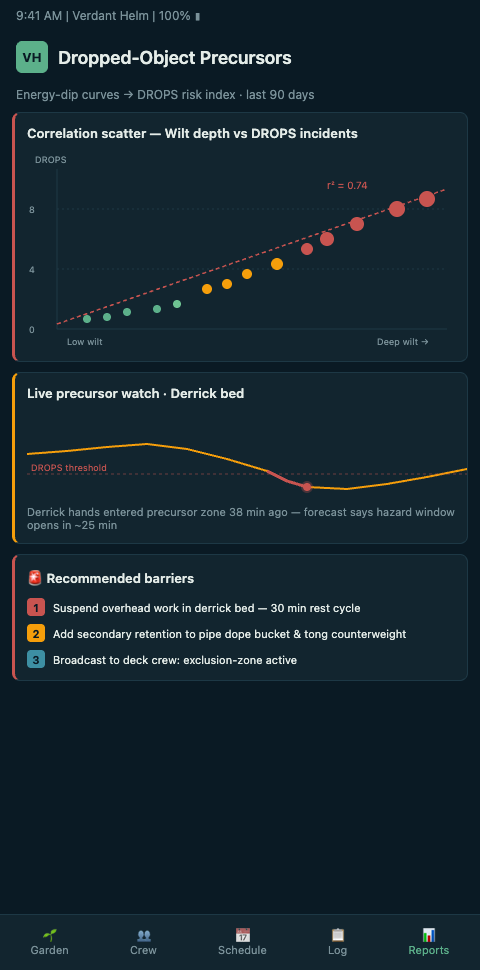
The garden view on Verdant Helm renders each crew member's energy as a curve across the hitch. Plants bloom, wilt, recover, and wilt again. A dropped-object precursor is not usually a single moment; it is a sustained wilt that depletes the micro-attention needed to close a secondary check. A derrickhand working the monkey board is holding a mental map of tool positions, lanyard states, and sequence dependencies. A fatigued perennial loses the last 10% of that map first, which is where the secondary retention lives. The wrench was dropped because the secondary lanyard was not re-attached. The secondary lanyard was not re-attached because the derrickhand's attention budget had been running in deficit for four shifts. The mechanism caught the post-incident investigation's attention; the budget should have caught the pre-incident scheduling review.
Three signal patterns in the dip curve correlate with drops precursors in practice. The first is the sustained wilt — an energy score that stays below 50 across three or more consecutive shifts, particularly on a derrick-exposed role. The second is the night-tour pair-trough — both members of a tool-handling pair scoring low on the same 12-hour tour, which removes the peer-check redundancy that prevents most secondary-lanyard omissions. The third is the post-recovery false-bloom — a score that jumps after a sleep cycle but has not fully re-integrated; the plant looks green but the roots are still shallow. A fourth pattern, less widely discussed, is the task-transition wilt — a derrickhand moving from a routine stabbing task to a tool-handover task during a deep fatigue state, where the cognitive switch between task modes is more expensive than either task alone.
ABS's offshore guide on dropped-object prevention codifies the energy-value calculations for what falling objects can do at different heights, which makes the cognitive-budget argument concrete: a 2.3 kg tool from the monkey board delivers the kinetic energy of a serious head injury, and the margin for attention error is measured in seconds, not hours (ABS Guide for Dropped Object Prevention on Offshore Units). Industry data from DROPS Online on PVD Drilling operations illustrates the drops-incidence base rate that the precursor framework has to beat to be worth deploying (DROPS PV Drilling Statistics and Prevention).
The garden layer sits on top of existing DROPS programs. Chevron's dropped-object prevention program provides the structural discipline — inspections, secondary retention, inspection registers — and the energy overlay adds a pre-task readiness signal for the humans who execute those disciplines (Chevron Dropped Object Prevention Program). IMCA's drops information note reinforces the contractor-wide practice landscape, which helps OIMs and toolpushers align rig programs with wider industry expectations (IMCA IN 1056 Dropped Object Prevention). The precursor framework does not change the DROPS register; it changes the supervision layer around the register. The inspections still happen. The secondary retention still gets inspected. The difference is that a wilted derrickhand executing a secondary-retention check gets a peer standing next to them, and the check gets a second signature, during the windows where the garden shows the attention budget is most at risk.
Advanced Tactics for the Drops Program
Three tactics move the precursor signal from dashboard to practice. The first is pre-task pairing. If the garden shows a sustained wilt for the derrickhand, the drops program pairs them with a floorhand whose bed score sits in the top quartile for the current rotation. The floorhand acts as the peer-check on secondary retention during the exposed task.
This does not add a new procedure; it re-assigns an existing one. The pairing is not permanent — it lasts the duration of the task envelope — and the floorhand's role is to watch, not to replace.
The rig medic rounds using garden signals feed the same data back to the sick-bay log, so the medic can see which crew members are carrying a sustained dip and raise them in the morning meeting.
The second tactic is the monkey-board hand-off. When a derrickhand's score crosses a wilt threshold mid-shift, the toolpusher rotates the position for the next trip or BOP prep segment. This is not punitive; it is botanical. A wilted plant gets shade and water, not more sun. The rotation is logged as a fatigue control and contributes to the safety-case narrative. The hand-off is facilitated by having a second derrick-qualified crew member cross-trained on the monkey board's specific configuration, which is a staffing investment that pays back the first time a trip runs through a trough window.
The third is the post-incident overlay. For every drops event or near-miss in the last 90 days, overlay the crew energy curve for the executing crew. Patterns usually appear in the first 10 events. Incidents clustered in the last third of the hitch, or on the second night tour of a pair, point to scheduling interventions rather than retraining.
The same overlay discipline feeds HSE continuous-telemetry audits.
The adjacent offshore-wind pattern on near-miss reports in fatigue troughs shows the same signal in blade-access work.
A fourth tactic is the pre-trip tool audit. Trips are the single most drops-intensive operation on a rig because tool handling scales with stand count. A pre-trip audit run by a rested supervisor — even if it duplicates the standard checks — catches secondary-retention issues that a wilted crew's routine audit misses. Timing the supervisor audit to the bloomed end of the 24-hour window preceding the trip is a targeted intervention that does not add procedure, only attention.
Common mistakes include treating the dip curve as a retrospective tool only, acting on a single low score rather than a sustained pattern, and relying on self-report alone (which degrades as fatigue deepens). A subtle trap: the derrickhand who self-reports "fine" on day 17 is often the one whose plant is most wilted; the garden cross-references peer observation, sleep data, and behavioural markers to avoid the false-positive-green signal. Another trap is treating drops as exclusively a derrick problem — floor-level drops from hand tools happen at similar rates and correlate with the same fatigue patterns; the precursor framework covers both.
Pull Your Last 20 Drops
If you run a drilling supervisor or HSE lead role, pull your last 20 drops events and near-misses from the DROPS register, and line them up against hitch day and executing-crew tenure. The dip pattern almost always shows up in the last third of the hitch, and it almost always clusters around specific task transitions or the second night-tour of a pair. Verdant Helm then gives toolpushers and OIMs a way to see the dip building before the tool drops, not after. Book a walkthrough: bring us one hitch of drops data and your crew roster and we will return an overlay that ties each incident to the energy curve behind it — plus three scheduling changes you can trial on the next hitch to test whether the precursor framework reduces your drops rate at source.