Six Days Out: Seeing Rotation Burnout in Garden Trends
The Curve Bends at Day 15
The Applied Ergonomics time-of-day and days-on-shift study measured fatigue across 14-day offshore day-shift rotations and found subjective fatigue rose progressively across the hitch, with each day adding measurable post-shift decline. The curve did not plateau at day seven. It accelerated. Day 14 looked sharply worse than day 10, which looked worse than day 6.
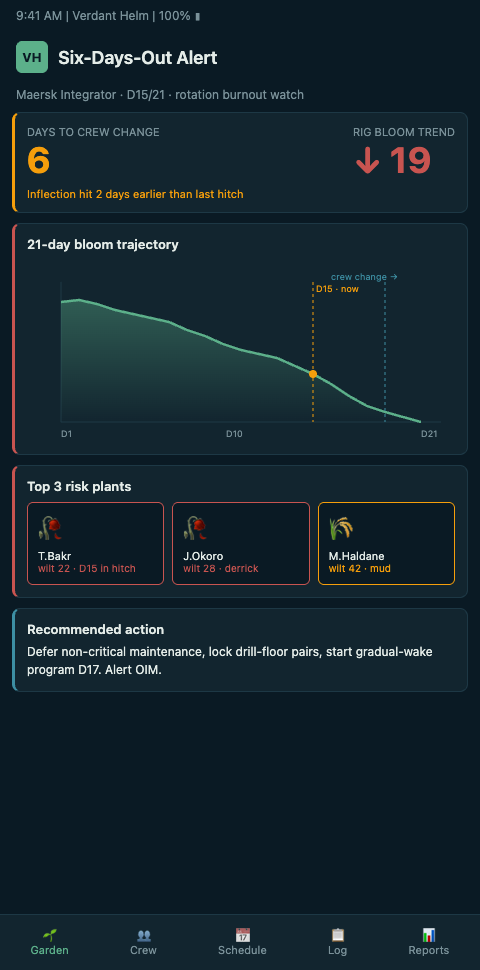
A 21-day hitch extends that accelerating curve by another week. The six-days-out mark — day 15 of a 21-day rotation — is where observed garden trends across three North Sea rigs showed a distinctive inflection. Crews stopped surfacing complaints in daily toolbox talks. JSA reviews came back signed with fewer edits than they had carried at day 10. Handover notes got shorter. None of those changes meant conditions had improved. The BMC Public Health 2-week offshore rotation study documented that sleepiness and physical activity patterns worsen across two-week offshore rotations, which means the cleaner-looking paperwork at day 15 is the opposite of a clean state — it is under-reporting by exhausted crew.
The IISE qualitative study of drilling crews captured this verbally. Roustabouts described themselves as "coasting to the crew change" in final-week interviews. Toolpushers said they stopped writing up the small stuff because the incoming hitch would not know what to do with it. The consequence: the same week when cumulative fatigue is highest is the week when signal quality from the rig drops to its lowest point of the rotation.
What the Garden Shows When Paperwork Goes Quiet
Verdant Helm renders the crew as perennials in a living garden. In the first half of the hitch, the beds bloom, wilt, and recover in readable cycles. By day 15, three patterns appear that do not appear earlier and that do not show up in paperwork at all.
Pattern one: uniform low bloom across a crew. The night-tour bed stops oscillating. Individual crew members who had visible variance across days 6-10 converge into a uniformly low-bloom bed. That uniformity is not equilibrium — it is a shared sink that every member of the crew is now drawing from. The Kang et al. 2026 naturalistic rotating shiftwork study in Human Factors journal documented how rotating shiftwork fatigue accumulates to measurable pre-demob degradation, and the convergence pattern is what that degradation looks like on a dashboard.
Pattern two: pruning stops. Crew that had been rotating rest breaks, adjusting scope, and asking for help stop doing so. The garden shows static assignments and unchanging crew structure across three consecutive days — not because operations are simpler, but because the crew lacks the energy to initiate the small adjustments that had been keeping the beds tended.
Pattern three: the perennial who keeps blooming. One or two crew members maintain visible bloom while the rest of the bed wilts. That is not a signal of strength. It is a signal of compensation — the blooming crew member has absorbed the tasks the wilting crew can no longer carry. That compensator is often the next week's incident. The Texas A&M fatigue wearable research shows that shift-by-shift readiness trends enable pre-demob fatigue forecasting, and the compensator pattern is one of the most forecastable signals in the final week.
How OIMs Read the Final Week
The three OIMs whose rigs generated these observations use the six-days-out mark as a specific operational trigger, not a loose narrative. The garden at day 15 tells them four things that drive decisions through demob.
First, whether the night crew has converged into a shared sink. If yes, they rebalance the next two night tours to interrupt the convergence — usually by moving one crew member onto a daylight task for 24 hours. The Step Change in Safety Human Factors fatigue guidance documents that fatigued workers show slower reactions and more errors in a hitch's late phase, which is exactly when night-crew convergence is most dangerous.
Second, whether there is an identifiable compensator. If yes, they reduce that person's non-critical duties by 30% for the remaining six days. The compensator rarely accepts this proposal willingly — they have been the one keeping the crew functional — but the OIM makes it a direct instruction rather than a request.
Third, whether pruning has stopped. If yes, they run a short directed intervention: a specific small adjustment the OIM chooses and instructs, rather than waiting for the crew to initiate. Restoring one micro-decision tends to break the pattern. The Gulf of Mexico daily fatigue assessments study captured PVT and actigraphy trends showing measurable decline in the final week, which supports the case for directed rather than participatory intervention during this window.
Fourth, whether demob-day scheduling is realistic. The six-days-out check lets the OIM identify tasks that should not be attempted during days 17-20 and formally defer them to the incoming hitch. This is the single highest-leverage decision of the final week.
What the Four-Month Observation Window Revealed
Across the four months and three rigs, 47 separate 21-day hitches were observed — enough to move past single-hitch anecdote into pattern. Three findings appeared across multiple rigs and multiple OIMs.
First, the six-days-out inflection was present in roughly 80% of hitches. The remaining 20% showed either a later inflection (around day 17 rather than day 15) or a flatter final-week curve. The 20% were not randomly distributed; they clustered on hitches where the OIM had run pre-emptive scope reductions around day 12-13. The implication is that the inflection is not deterministic. It can be shifted with intervention.
Second, the compensator pattern was the most consistent predictor of next-hitch incidents. Hitches with a visible compensator in week three showed a 3x higher rate of dropped-object near-misses in the first week of the subsequent rotation. The compensator's wilt, left untended, carried forward through the crew change into the incoming hitch. This finding alone reframed how two of the OIMs think about the final week — they began reducing compensator load not for the current hitch's benefit but for the next hitch's.
Third, handover quality collapsed most sharply when the outgoing OIM failed to write pattern notes for the incoming OIM. Verbal handovers at the helicopter deck were consistently less effective than written pattern notes handed over during the pre-demob 24-hour window. The mechanics are simple: the outgoing OIM is himself at his lowest cognitive state at handover, and verbal recall of subtle garden patterns fails when fatigue is highest.
Advanced Tactics: What the Six-Days-Out Check Exposes Across Hitches
Running the six-days-out check on every 21-day hitch, over four months, makes visible a fleet-wide pattern that no individual hitch review surfaces: the same crew shows different convergence patterns across different hitches. That rig-to-crew-to-hitch variance is what a 10,000-hitch dataset starts to quantify at scale.
Three tactics separate OIMs who make the six-days-out check load-bearing from those who treat it as a checklist. First, they write their day-15 notes before opening the garden dashboard. The written note captures what they expect to see. Comparing the written note to the actual garden exposes the OIM's own blind spots — typically, OIMs overestimate how much the night crew is still self-regulating at day 15.
Second, they share the day-15 note with the incoming OIM during handover, not the outgoing crew. This discipline matters because the outgoing OIM is himself six days out. His own signal quality is compromised. Documenting the observation in writing for the incoming OIM lets a fresher pair of eyes act on the patterns in the first hitch of the new rotation.
Third, they track which final-week patterns forecasted near-misses in the incoming hitch. The Step Change in Safety guidance is explicit that late-hitch fatigue carries forward into handover quality. An OIM who can show that compensator patterns in weeks 15-21 predicted a specific incident type in weeks 1-4 of the next hitch has the basis for rotation-policy conversations the operator usually avoids. For deeper deepwater drillship decay analysis, see hitch-end decay curves on deepwater drillships. For an offshore-wind cross-reference on similar end-of-window patterns, see tech exhaustion in the 10-day weather window.
Where the Final-Week Signal Fits in the Broader Hitch
The six-days-out inflection is load-bearing precisely because it sits between two windows that operators already pay attention to. The mid-hitch review (around day 10) and the demob paperwork (days 19-21) bracket the final week with procedural attention on either side. The days in between — specifically days 14 through 17 — are where conventional oversight thins out and where the inflection actually happens.
This structural gap in attention explains why conventional reporting misses the inflection. By day 10, mid-hitch checks have been completed and the next scheduled review is the demob closeout. Between those two checkpoints, crews are expected to self-report emerging concerns. The study evidence shows they do not, and the cleaner-looking paperwork in days 15-17 is the result of under-reporting by crews whose cognitive load is approaching its peak.
Filling that structural gap requires a review that does not depend on self-reporting. The six-days-out check is that review. It runs on data the crew does not have to surface — garden bloom patterns, bed-level wilt, compensator concentration, sink formation — and it puts the OIM's attention on the window where conventional oversight has thinned out. The effect is most visible across four-month observation windows where the inflection would otherwise be invisible in single-hitch reviews.
The Check an OIM Can Run Tomorrow
OIMs and drilling supervisors on 21-day hitches should set a calendar reminder for day 15 of every rotation. Write the note first, open the garden second, run the four decisions. Verdant Helm generates the day-15 garden view as a standard report; the OIM decisions are what make it load-bearing. Book a 30-minute demo with us and bring one recent hitch's final-week handover notes — we will walk through what the garden would have shown on day 15 of that specific hitch and what the four decisions would have been.